AI for Restaurants: Reservations, Reviews, and Menu Data
Published 2026-09-13 · Updated 2026-09-13 · 7 min read · ShooWork (FreeCo Co., Ltd.)
Skip the robot wok. The real AI wins in restaurants are answering the phone, reading reviews, and cutting dead menu items — ranked by payback speed.
Every time restaurants and AI end up in the same sentence, the conversation skids into robot woks and automated fryers. That is not your reality. Your reality is that nobody can pick up the phone between 6 and 8 p.m., you have four hundred reviews sitting on Google and delivery apps that no human has ever read end to end, and your menu has not meaningfully changed in six years because nobody can prove which dishes deserve to die.
Those boring administrative jobs — the ones that happen every single day and that nobody enjoys — are exactly where AI earns its keep today. The payback is measurable in hours saved per week and covers per shift, not in a press release. Kitchen automation is a capital project with a five-year horizon. Answering the phone is a Tuesday.
We run our own AI product line — a tools platform, a video-editing engine, ad tooling — so everything below is ordered by how fast we have actually seen a payoff land, not by how impressive it sounds in a pitch deck. Start at the top. Do not skip ahead because something further down sounds more fun.
First priority: reservations and repeat questions
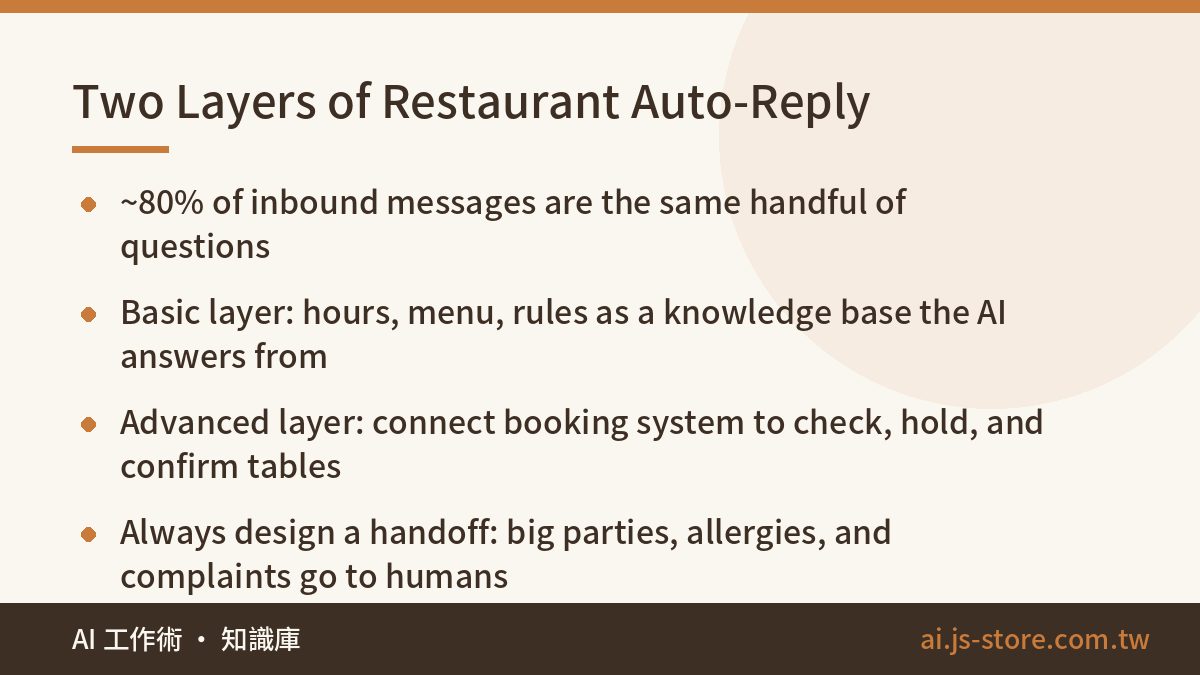
Roughly eight out of ten inbound messages to a restaurant are the same handful of questions. Do you have a table for four at seven? What time do you close on Sundays? Is there parking? Are dogs allowed on the patio? What is vegetarian on the menu? High frequency, highly repetitive, and with a single correct answer — that combination is the sweet spot for a language model, whether the channel is a website chat widget, WhatsApp, Instagram DMs, or your Google Business profile.
Build it in two layers. The basic layer is a knowledge base: hours, full menu with allergens, house rules, parking, private-dining minimums, holiday closures. The model answers from that and nothing else. This alone kills most of your message volume and costs almost nothing to maintain — one person updating one document.
The advanced layer connects to your booking system so the assistant actually completes the job: check availability, hold the table, send the confirmation, handle the cancellation. That is the difference between a bot that talks and one that gets things done — a distinction worth understanding before you buy anything, and we broke it down in AI agent vs chatbot.
One non-negotiable: if AI takes the booking, a human has to be able to take it back. Large parties, buyouts, allergy-critical requests, and anything that smells like a complaint need a clean handoff path to a named person. Do not let the bot grind away at a problem it cannot solve. Our support tiers framework walks through where to draw that line so the 80% the bot handles never contaminates the 20% that needs a human.
Second priority: reading and answering your reviews
Reviews on Google and the delivery platforms are free, continuous market research written by people who paid you money. The problem has never been the data. The problem is that reading four hundred reviews is a full day of work nobody has, so it never happens and the signal rots.
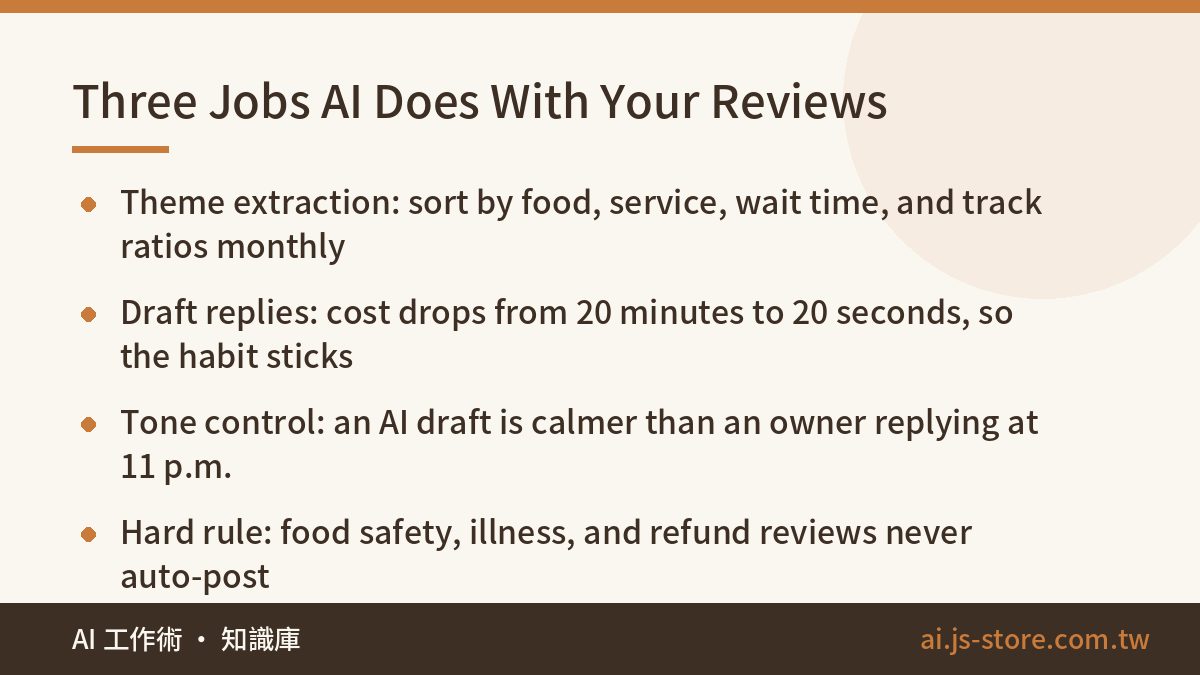
A language model does this genuinely well, in three distinct jobs:
- Theme extraction. Feed in every review from the last twelve months and get them sorted into food, service, atmosphere, wait time, value, and cleanliness, with positive-to-negative ratios per theme and per month. What you are hunting for is a line like "complaints about slow food doubled over the last quarter, concentrated on weekend dinner." That is a staffing decision, not a vibe.
- Draft replies. Responding to reviews measurably helps local search visibility, and almost no independent operator has the time. AI drafts, you skim, you hit send. The cost drops from twenty minutes to twenty seconds, which is the only reason the habit survives past week three.
- Tone control on bad reviews. The worst public reply is one written by an angry owner at 11 p.m. A model drafting the first pass is reliably calmer than you are. That is a real benefit, not a joke.
The hard rule: anything touching food safety, illness, refunds, or a legal threat gets handled by a human, full stop. Never let an automated reply post itself on those. Route them to a person the same way you would route a broken plate to a manager.
Third priority: menu engineering without the spreadsheet slog
Menu engineering is decades old and the math is not complicated: plot every dish by popularity against contribution margin, land it in one of four quadrants, then promote, reprice, rework, or remove. The reason most independents never do it is that assembling the data — exporting POS sales, matching it against recipe costs, building the grid — is a miserable two-week project that gets abandoned by day three.
That bottleneck is gone. Export your POS sales data, hand it to a model along with your plate costs, and ask for the quadrant classification, margin contribution by category, and a written summary of what changed since last quarter. What used to be a quarterly project is now an afternoon, which means you can actually do it quarterly.
Be clear about what you are getting. AI produces the analysis and the options. Pricing and menu decisions still belong to the chef and the owner. The model sees a low-margin dish and says cut it. It has no idea that dish is the reason a table of regulars comes back every Thursday, or that removing it would gut your identity. Treat the output as a well-organized argument, not a verdict. The same discipline applies to demand and assortment work generally — we covered the pattern in AI for retail and it transfers cleanly to a menu.
Easy win: social content and promo copy
Daily specials, new dishes, holiday events, weather-driven promos — the writing itself is not hard, it is just relentless. AI drafts, you edit and publish, and the time you spend staring at a blank caption box drops by something like ninety percent. If you are also producing short video for social, a tool that handles cutting and captioning gets you from phone footage to a postable clip without opening an editor; that is what our clip engine exists for.
Two guardrails. First, every factual claim — ingredients, prices, allergens, event times, opening hours — gets verified by a human before it posts. A model will state a wrong price with total confidence and no hesitation whatsoever. Second, stay inside advertising and food-labeling rules in your market. Naming your sourcing is fine. Implying a dish treats a medical condition is how you collect a fine.
AI in restaurants does not live in the kitchen. It lives in the jobs nobody wants but everybody has to do daily — answering the phone, reading reviews, organizing numbers.
The honest boundary: what not to automate
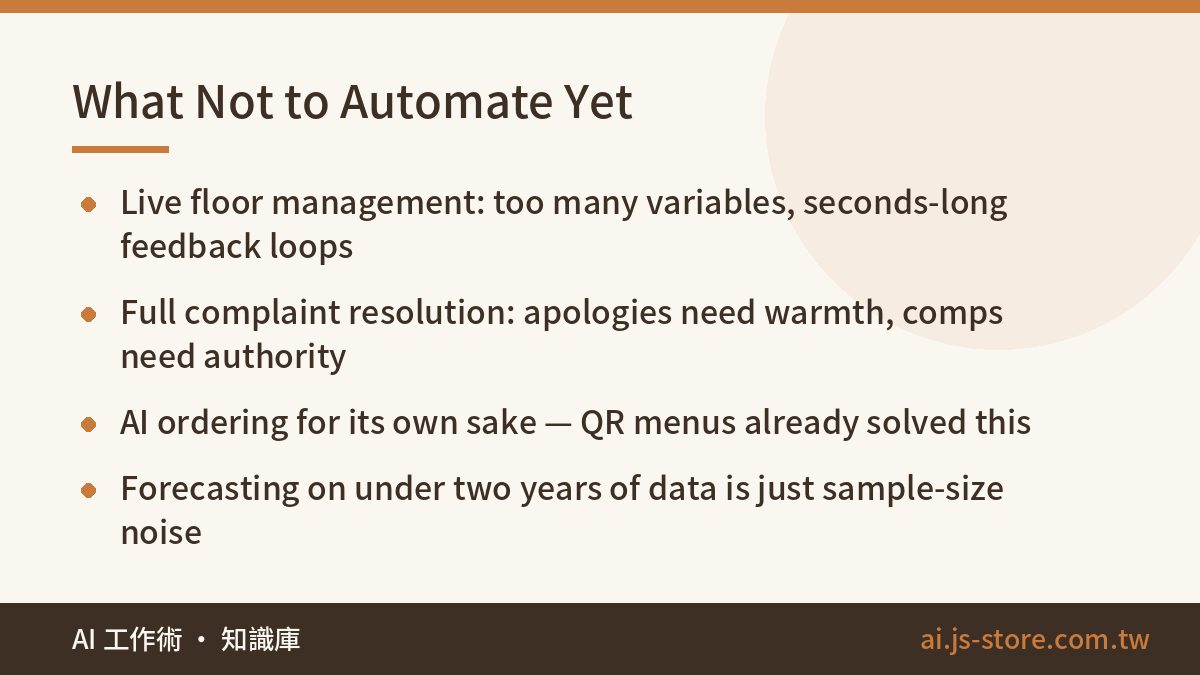
- Live floor management during a rush. Seating, firing tickets, table turns, the walk-in party of eight who lied about being six. Too many variables, too little tolerance for error, and the feedback loop is measured in seconds. An experienced host still crushes any model at this.
- Fully automated complaint resolution. A real apology needs warmth and a comp needs authority. AI has neither. It can draft, summarize, and route. It should not be the one deciding whether to eat the check.
- AI ordering for the sake of AI ordering. QR menus already solved this problem. Adding a conversational layer to a task that takes eleven seconds is not innovation, it is a slower menu with a longer failure mode.
- Demand forecasting on thin data. If you have eight months of sales from one location, you do not have a forecasting problem, you have a sample-size problem. Wait until you have two full years including the seasonal swings.
How to actually start
Pick one scenario — realistically, the inbound question flood. Run a two-week pilot at one location. Before you switch anything on, write down what you are measuring: calls missed per shift, average response time on messages, no-show rate, hours your manager spends on the phone. Without a baseline you will end the pilot with a feeling instead of a number, and feelings do not survive contact with a budget meeting.
Two weeks in, look at the numbers and make a real decision: expand, adjust, or kill it. Killing a pilot that did not work is a success — you spent two weeks instead of a year. Most AI projects that fail do not fail on the technology; they fail on scope, ownership, and never defining what winning looked like. We catalogued the recurring patterns in why AI projects fail, and restaurants hit all of them.
On buying: for the first pilot, use an off-the-shelf subscription. Do not build. Do not hire a developer. You are testing whether the workflow helps your business, not whether the technology exists — it does. If the pilot works and you outgrow the tool, that is the point to consider something custom, and how to choose between subscribing, buying, or building covers that fork properly. Pricing on these tools moves constantly, so check the official pricing page of whatever you are evaluating rather than trusting a number you read somewhere.
One last thing worth saying plainly: if you have no booking system, no POS export you can access, and no customer list, AI is not your next step. Digital groundwork is. A model cannot analyze data that was never captured. Get the basics recording, run them for a quarter, then come back to this list from the top.
FAQ
Q: Will an AI assistant annoy my customers?
Only if it traps them. Diners are fine with an instant, correct answer at 11 p.m. about whether you are open on Monday. What they hate is a bot that loops on a question it cannot handle with no way out. Give every conversation a visible escape hatch to a human, and satisfaction usually goes up rather than down, because the alternative was an unanswered phone.
Q: How much data do I need before menu engineering with AI is useful?
At minimum, twelve months of item-level sales from your POS plus reasonably accurate plate costs. Below that you are mostly reading noise and seasonality. The plate costs matter more than people expect — if your recipe costing is guesswork, the margin analysis inherits that guesswork and you will confidently cut the wrong dish.
Q: Should I let AI reply to Google reviews automatically?
Draft yes, auto-publish no. Have it write every reply and queue them for a thirty-second human skim before posting. The moment a food-safety, illness, or refund review lands, it should skip the queue entirely and go to a person. The time savings come almost entirely from the drafting anyway, not from removing the review step.
Q: We are a small independent with one location. Is this worth it?
Often more worth it than for a chain, because you have no back office absorbing this work — it all lands on the owner. The two highest-value scenarios, inbound questions and review handling, scale down to a single site perfectly well. Menu engineering is the one that needs enough transaction volume to be meaningful.
Q: What is a realistic timeline to see results?
Two weeks for the question-answering pilot to show a clear signal on response time and missed contacts. Four to six weeks before review response rates visibly change. A full quarter before menu changes show up in margin. Anyone promising transformation in a week is selling you something.