Does Google Penalize AI Content? What Actually Gets You Hit
Published 2026-09-14 · Updated 2026-09-14 · 8 min read · ShooWork (FreeCo Co., Ltd.)
Google doesn't penalize AI writing — it penalizes content with no reason to exist. Here's where the real line sits and the workflow we use on our own site.
Short version, so you can stop worrying and get back to work: Google does not penalize a page because a language model wrote the first draft. It penalizes pages that exist to manipulate rankings rather than to help a human being. Those are two completely different failure modes, and mixing them up has cost people either a year of unnecessary hesitation or a very deserved traffic collapse.
We get this question constantly, and almost everyone asking arrives with an answer already loaded. Half of them want to hear yes, it's dangerous, so they can keep paying a freelance writer and feel safe. The other half want to hear no, it's fine, so they can point a script at a keyword list and publish 400 pages this quarter. Both groups are wrong. The second group is the one that actually gets hurt.
We run our own AI tool platform — a video-editing engine, an ads tool, a writing tool — and every article on our own site goes through the process below. This isn't a summary of someone's conference talk. It's what we landed on after trying the lazy version first and watching it quietly fail: pages indexed, impressions flat, nobody reading, nothing ranking. Here's the line, where AI content genuinely breaks, and the five steps we use to stay on the right side of it.
What Google Actually Penalizes
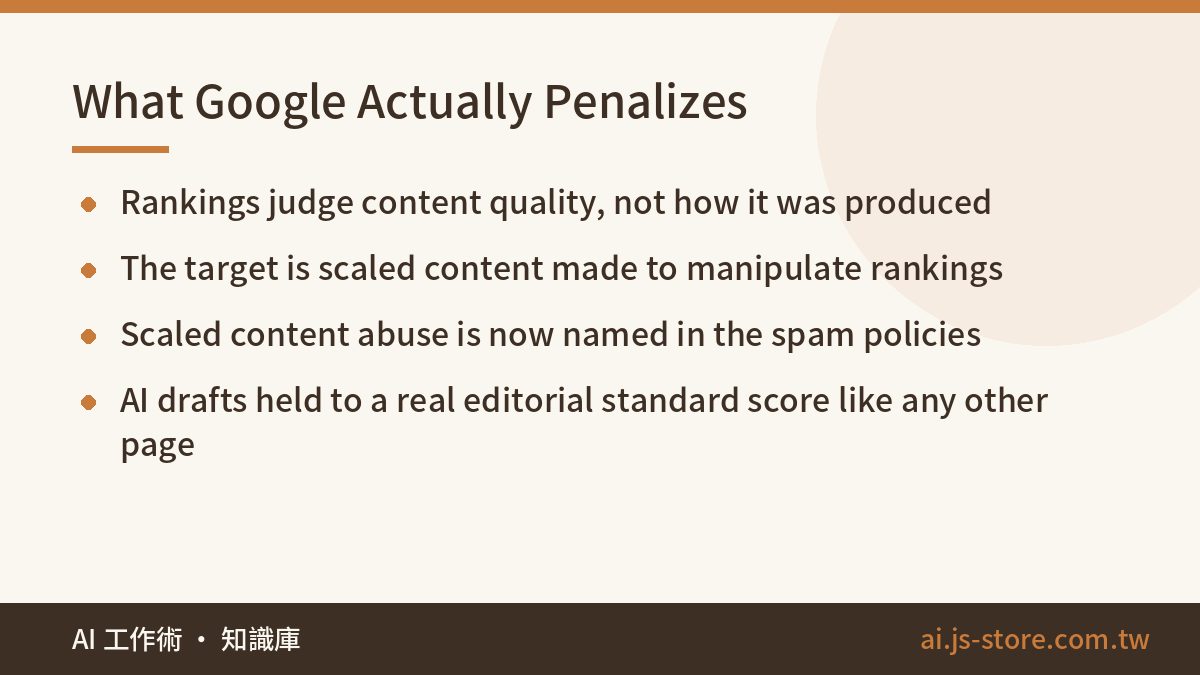
Google's position has been remarkably consistent, even as the tooling changed underneath it: ranking systems evaluate the quality of the content, not the method of production. Using automation or AI to produce helpful content is not, by itself, a violation. What is a violation is generating content at scale whose primary purpose is to manipulate search rankings. That rule predates AI entirely — it's the same rule that killed cheap content farms and spun-article networks a decade ago. AI just made the bad version cheaper to produce.
Don't pop the champagne yet, though. In the same window that Google clarified the AI question, it also tightened the spam policies to explicitly name scaled content abuse, and successive core updates kept hammering large volumes of low-value pages with no visible human involvement. Read those two moves together and the message is obvious.
AI isn't the crime. Laziness is.
Publish 500 articles a day that no human would voluntarily finish reading, and getting caught is a scheduling question, not a risk. Use AI to draft something you then genuinely edit, fact-check, and put your name on, and it gets graded on exactly the same curve as anything typed by hand. The system doesn't have a detector for "was this written by a model." It has a very good detector for "did anyone care."
One practical consequence: the volume-first strategy that AI seems to unlock is precisely the strategy the spam policies were rewritten to catch. If your plan starts with a number of posts per week rather than a set of questions your customers actually ask, you've already picked the losing side.
Where AI Content Actually Falls Down
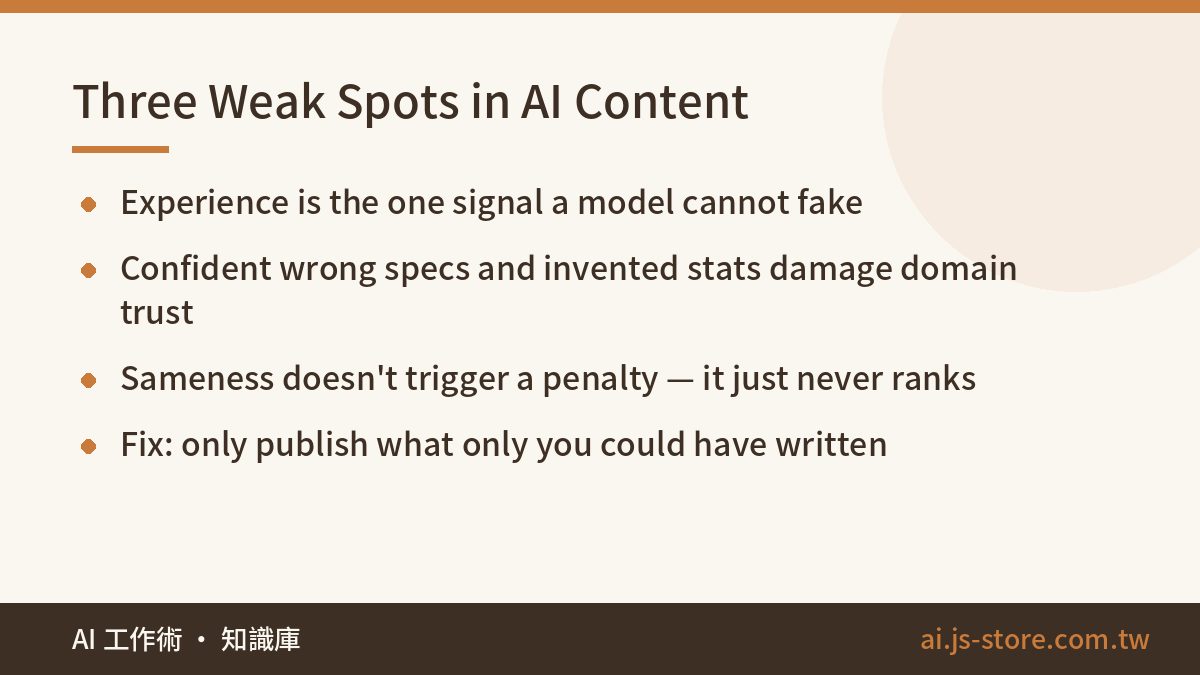
Rather than guessing at algorithms, look at the framework Google's own quality guidelines lean on: Experience, Expertise, Authoritativeness, Trust. Hold raw AI output up against that and the gaps are not subtle.
- Experience is the one AI simply cannot have. The model has never run a shop, never blown a budget, never had a client churn at 2am. Pure AI articles read as "everything is correct and nothing is real" — that hollowness is the missing first-hand layer. And experience is exactly the signal that's been gaining weight, not losing it.
- Factual accuracy is on you, permanently. Models state wrong specs, invented statistics, and hallucinated feature lists with perfect confidence. One error is embarrassing. Fifty errors accumulating across a site is a domain-level trust problem, and trust is the slowest thing to rebuild.
- Sameness is the silent killer. Ask five people to generate an article on the same topic and you get five near-identical structures, near-identical subheadings, near-identical advice. Your page and your competitor's page are functionally interchangeable. Why would any ranking system prefer yours?
That third one gets underestimated. It doesn't produce a penalty; it produces nothing. The page indexes, sits at position 40, and gathers dust. No warning in Search Console, no message, no diagnosis — just a quiet absence of results that most people misread as "SEO takes time."
Google has never penalized "content written by AI." It penalizes content nobody is accountable for. The real line is whether the person in the byline would defend every sentence on it.
Our Workflow: AI Drafts to 60, You Take It to 90
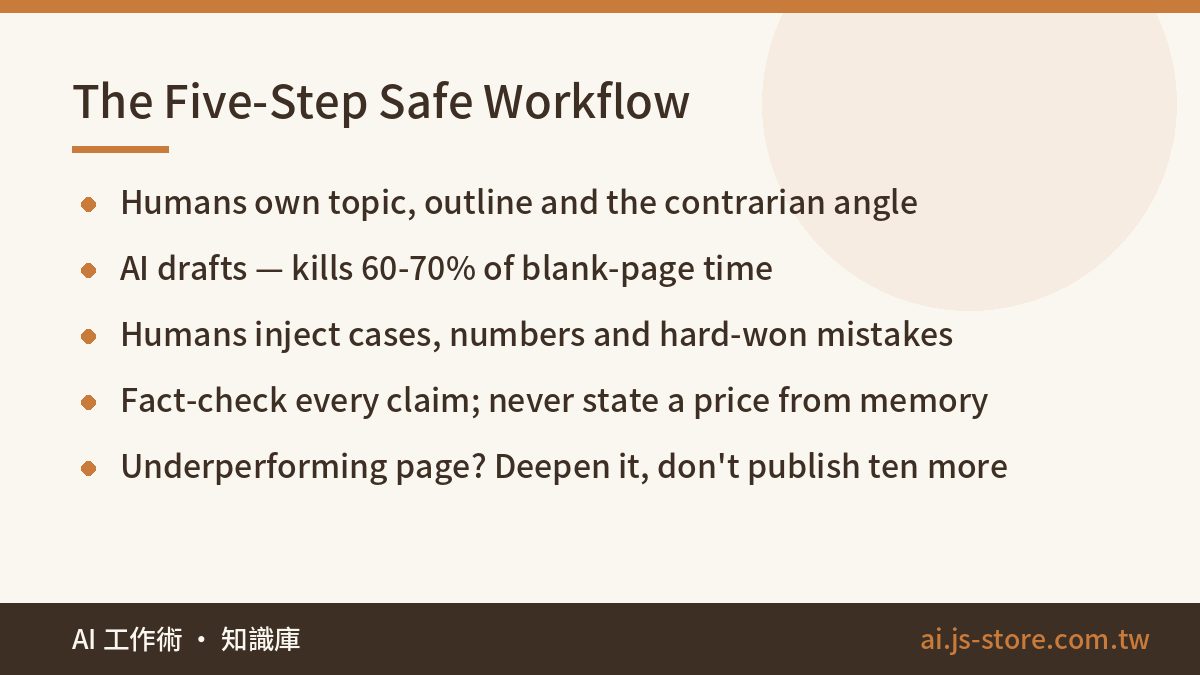
Here's the exact five-step process we use for our own site and our own commerce content.
- A human picks the topic and the outline. Search intent, angle, and the specific contrarian take we want to land — that's strategy, and we don't outsource it to a model. If you skip this step, everything downstream is average by construction.
- AI writes the first draft. Feed it real context: who's reading, the outline, our actual position, and any first-hand material we have — support tickets, internal numbers, notes from a failed experiment. What this step eliminates is the blank-page cost, which is genuinely 60–70% of writing time.
- A human injects the experience. This is the step that decides whether the article is worth publishing. Real cases, measured numbers, the mistake that cost you three weeks, the place where you disagree with the standard advice. When you're done, the piece should be one that only you could have written. If a competitor could publish it verbatim, you haven't finished.
- Fact-check and risk-check. Every number, every claim, one at a time. Double the scrutiny on anything touching regulation, pricing, medical or financial guidance, or competitor comparisons. Never let a model state a specific price — send readers to the official pricing page instead, because pricing changes and a wrong number is a trust leak that lives forever.
- Iterate on data after publishing. When a page underperforms on rankings or dwell time, go back and deepen that page. Do not respond by publishing ten more. Depth compounds; volume dilutes.
Notice where the weight sits. AI takes you from zero to sixty. You take it from sixty to ninety. Nobody gets to skip the second half.
The Honest Number: 2–3x, Not 10x
Running this process, our throughput is roughly two to three times what pure manual writing gave us. Not ten. If someone promises you 10x, ask them precisely which step they deleted — it's always the review step, because that's the only one big enough to produce that multiple.
Two to three times is a great outcome, by the way. For a small team it's the difference between publishing twice a month and publishing weekly with better research behind each piece. It just isn't the fantasy where you replace a content team with a cron job. The same math shows up everywhere else we've automated: real leverage looks like a solid multiple on the boring parts, not the elimination of judgment. We wrote about that pattern in more depth in Solopreneur Automation, and the boundaries are similar to what we cover in No-Code AI Limits.
There's also a quality floor you shouldn't cross. If reviewing an AI draft properly takes longer than writing the thing yourself — common for highly technical or highly regulated topics — then don't use AI for that piece. The tool is supposed to save you time, and sometimes it doesn't. Say so and move on.
Where AI Content Genuinely Wins
Given all the caveats, it's worth being specific about where this actually pays off, because the wins are real and they're not evenly distributed.
AI drafting is strongest on structured, repeatable formats: product descriptions across a large catalog, FAQ expansions, glossary and definition pages, localized variants of a piece you've already validated, and the first pass on comparison tables. These are places where the structure is known, the facts are yours, and the model is essentially doing formatting and phrasing at speed.
It's weakest exactly where your competitive advantage lives: original research, opinionated strategy, teardowns of your own failures, anything requiring a judgment call you'd defend in a room. Those pieces are slower, they're fewer, and they're the ones that actually earn links and rankings. A sane content plan uses AI to clear the routine tier so your human hours land on the tier that differentiates you.
If you're still deciding what to run this on — a subscription tool, a general-purpose model, or something built into your stack — the trade-offs are laid out in AI Tool Selection. And if you want to try the drafting step against your own outline before committing to anything, our free tools are the cheapest way to see whether the 60-point draft is good enough to be worth editing in your niche. ShooWork Write is built around this exact workflow — outline in, draft out, human edit mandatory — rather than around a publish button.
Ask a Better Question
"Will AI content get penalized?" is the wrong question, and it keeps producing bad decisions because it's framed around fear rather than value. The question that actually predicts outcomes is: does this page have a reason to exist?
Does it answer something a real person typed into a search box? Does it carry experience nobody else has? Would it survive a stranger fact-checking it line by line? If yes, the tool you drafted it with is irrelevant — Google doesn't care and neither does your reader. If no, hand-typing every word won't save it. Empty content sinks at exactly the same rate whether a human or a model produced the emptiness.
Build the process, keep a human accountable for every published sentence, and you get a content pipeline that's both fast and something you can sleep next to.
FAQ
Q: Can Google actually detect AI-written content?
Detection isn't really the mechanism, and betting your strategy on evading a detector is the wrong frame. Ranking systems evaluate usefulness, originality, and trust signals — thin, templated, unverified pages get filtered out whether a model or an underpaid freelancer produced them. Practically speaking, worry about whether your content is distinguishable from your competitor's, not about whether a classifier flags it.
Q: Do I need to disclose that AI helped write an article?
Google doesn't require an AI disclosure label for ranking purposes. What matters far more is a real, accountable byline and clear information about who stands behind the content. If disclosure fits your brand and your audience expects it, add it — it costs nothing and builds trust. Just don't treat a disclaimer as a substitute for editing.
Q: How many articles per week is safe to publish with AI?
There's no magic number, and asking for one is usually a sign the plan is volume-driven. The honest constraint is your review capacity: publish only as much as a knowledgeable human can genuinely fact-check and enrich. For most small teams that's one to three solid pieces a week, not thirty.
Q: We already published a lot of thin AI content. What now?
Triage rather than panic. Identify the pages with impressions but no clicks and either rewrite them with real experience and data or consolidate several into one substantial page. Delete or noindex the ones that serve no purpose at all. Rebuilding depth on twenty pages beats leaving two hundred hollow ones live.
Q: What does this cost to run properly?
The tooling is the cheap part — check the official pricing page for current plans. The real cost is editorial time, and that's the line item people underestimate. Budget for a human editor who knows the subject, because that's the input that determines whether any of this works.