Google Ads Agency Cost 2026: Fee Models, Hidden Fees, the 30% Rule
Published 2026-10-09 · Updated 2026-10-13 · 8 min read · ShooWork (FREECO CO., LTD.)
What a Google Ads agency really costs in 2026: retainer vs 15–25% of spend, setup fees, minimum budgets, and the 30% rule for when fees are too high.
Here's the short answer. A Google Ads agency charges a management fee, and you pay it on top of what you pay Google. Agencies price that fee in one of two ways. The first is a flat monthly retainer that stays the same no matter how much you spend. The second is a percentage of your ad spend, usually 15–25%. Some agencies quote 10–20%, and a few start as low as 5%. The percentage math is simple: if you spend 10,000 a month on ads and the agency takes 20%, you pay 2,000 a month for management. That's true in any currency.
The number on the quote is rarely your whole bill. Expect a one-off setup fee, a minimum ad budget (most agencies won't take you below it) and a first contract of 3–6 months. In September 2026 we went through published agency quotes in our home market. From the smallest tier to the largest, retainers varied more than tenfold. And the biggest real deals, with management fees bigger than most small businesses' entire ad budgets, never show up on anyone's public price list. Absolute numbers change by country and by agency, but the ratios in this article hold up almost everywhere. For exact numbers, get a current written quote.
If you remember one rule, make it this one: if the management fee is more than about 30% of your ad spend, you're paying for someone's attention, not for ad results. Below we cover how to read a quote, when each pricing model makes sense, and when you shouldn't hire an agency at all.
Flat Retainers: Easy to Budget, Easy to Misread
A retainer is the same fee every month, whatever you spend on ads. That makes budgeting easy, and the more you spend, the less management costs per dollar of ad spend. The catch: the real difference between two quotes is in what the work includes, not in the price.
| Account tier | What the fee usually covers | What to ask before signing |
|---|---|---|
| Small (low spend, still testing) | Basic campaign setup, upkeep, monthly report | Who adds negative keywords, and how often? |
| Standard retainer | Keyword and ad copy optimization, weekly or monthly report | How often do bids actually get changed? |
| Mid-size account | Several campaigns at once, conversion tracking setup | Is tracking tested, or just installed? |
| Large spend (consulting tier) | Strategy meetings, cross-channel recommendations | Who is accountable when results drop? |
| Enterprise | Dedicated team, help with creative and landing pages | Which named people work on your account? |
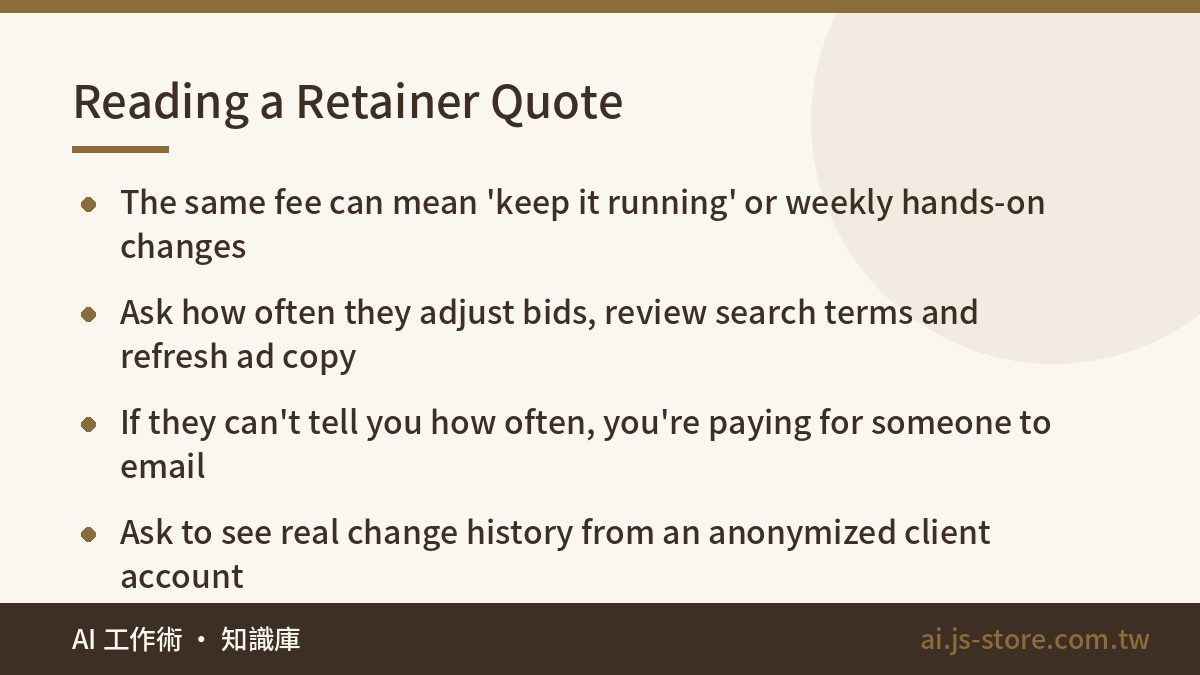
Two agencies can quote the same retainer for very different work. One will keep your account running as it is. The other will make changes every week. Before you sign, ask for specific tasks and how often they happen. How often do they adjust bids? How often does someone read the search terms report? Who adds negative keywords? How often do they refresh the ad copy? If an agency can't tell you how often, you're paying for someone you can email, not someone who's improving your account.
Don't accept “we optimize continuously” as an answer. Ask them to show you the change history from an anonymized client account. A good agency can show you real dates and real edits. If they won't show you, assume the changes don't happen often.
Percentage of Spend: When 15–25% Is the Better Deal
With percentage pricing, the fee follows your spend. Spend 2,000 a month and management costs roughly 300–500. Spend 10,000 and it's roughly 1,500–2,500.
This model suits businesses that are just starting out and still testing a budget, because you pay less when you spend less. But it has two built-in problems you should know about.
First, it pays the agency to tell you to spend more. Not every agency acts on that, but the incentive is always there. When a percentage-based agency recommends a bigger budget, ask what result they expect from the extra spend and how you'll measure it.
Second, a low percentage isn't automatically a good deal. Quotes under about 15% usually come from agencies that make money on volume. Each account manager handles more clients, so your account gets less of their time. You save on the rate, but the work gets thinner.
Here's the practical rule. While your spend is below the minimum an agency asks of retainer clients, percentage pricing is usually fairer. Once you're above it, a flat retainer usually costs less per dollar spent. At mid-size spend the two models cost about the same, so compare what the work includes and how often you get reports, not the pricing model. In our survey, the point where the two models cost the same was close to the minimum budget most agencies set. That isn't a coincidence. The minimum is the point where the work starts to pay for the agency.
The Two Costs Nobody Puts in the Headline
The setup fee. This is a one-off charge for building the account structure, installing conversion and remarketing tags, and writing the first keywords and ads. In our survey it was usually about the same as one month of a standard retainer, sometimes less. Paying a setup fee isn't unreasonable in itself. But get two answers in writing before you pay: whose name the ad account is in, and who keeps the account and its history when the contract ends.
Don't do this: let an agency run your ads from an account they own. If you leave, you lose your conversion history, your performance data and everything your campaigns have learned. Your next agency, or you, would have to start over from nothing. The account should be in your name, and the agency should get access as a manager.
The minimum budget. This isn't a fee, but it affects you just as much. Most agencies won't take an account below a certain monthly ad spend. The reason is simple: a small account takes almost as much work as a big one but brings in a fraction of the revenue. So if your budget is tiny, the problem isn't that agencies are too expensive. It's that nobody wants to take you on. Or the one who does is juggling a dozen or more other accounts.
The contract length. First contracts usually run 3–6 months. The usual reason is that ads need one to two months of testing, and results start to show in month three. That's fair, but find the early-exit clause before you sign, not after. If you're comparing several proposals, run each through the four questions in our guide to spotting BS in claims and vendor quotes. Vague promises stand out quickly.
The 30% Rule: How Much Management Fee Is Too Much
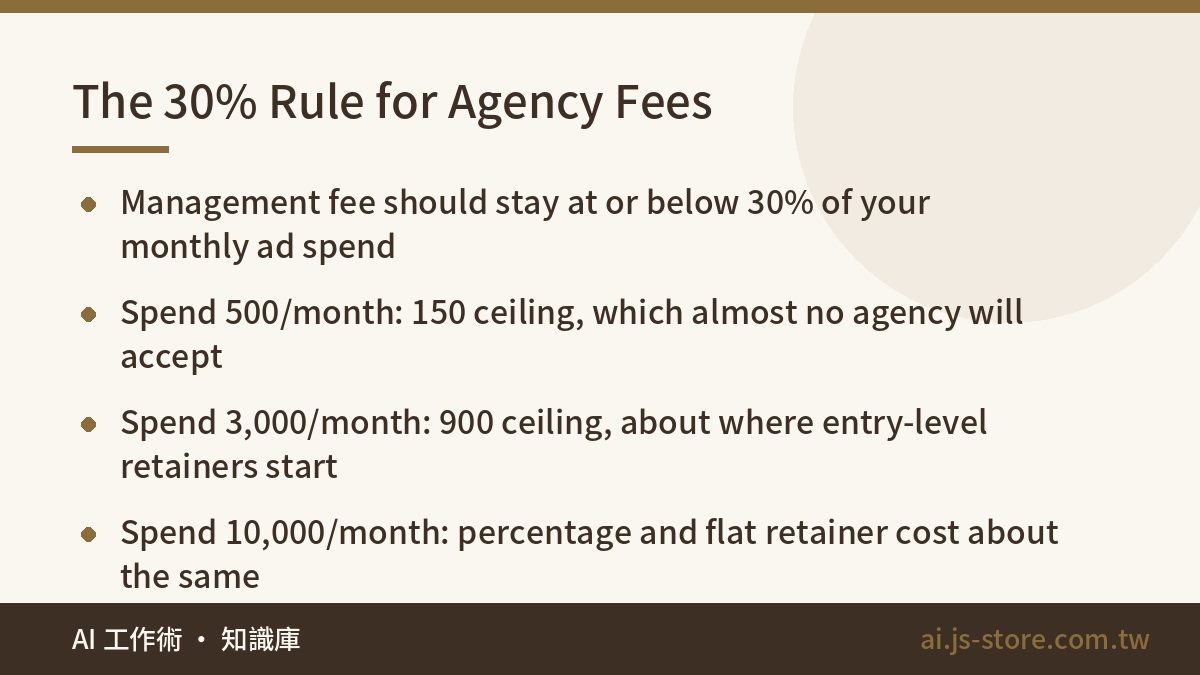
A common rule in the industry: the management fee should be no more than 30% of what you spend on ads. Check your own budget against it and a lot of decisions get easier. Use your own currency. The math works the same way.
- Spend 500 a month: fee ceiling of 150. Almost no agency works at this level. Run the ads yourself, or use tools to handle the basics.
- Spend 3,000 a month: fee ceiling of 900. This is about where entry-level retainers start, so most agencies treat it as their minimum.
- Spend 10,000 a month: fee ceiling of 3,000. A 15–25% fee and a flat retainer cost about the same here, so you can negotiate either.
- Spend 50,000+ a month: you can often negotiate a lower percentage, and the budget justifies a dedicated person who joins your meetings and answers for results.
If the fee you're quoted is above 30% of your ad spend, you're mainly paying for service, not results. That might still be worth it, for example if your product has high margins and you have no time at all. Just be clear about what you're buying.
DIY, Agency or Automation: Where to Draw the Line
We should disclose an interest first. We run Google Ads for our own platform, and we build ShooWork Ads, which automates day-to-day campaign management. So the advice below works in our favor, and you should weigh it with that in mind. We've kept the facts straight.
Hire an agency if you need strategy, coordination across channels, creative production, or a person who is accountable for results. That's work for people, and AI won't replace it.
But maybe your problem is different. You know you need ads but have no time to check them every day. Your budget is too small for any agency to take. Or you don't want to pay a fixed fee every month. Then you don't need a person. You need a set of checks that runs every day without fail:
- Keywords grouped by purchase intent, so a browser and a buyer don't get the same ad.
- Ad copy that fits the character limits, so nothing gets cut off.
- Searches that never convert get blocked before they use up your budget.
- Daily budgets that don't blow past your limit.
- Prices in your ads that match the prices on your landing page.
We learned that last one the hard way. Two ads on our own brand site kept prices from the previous promotion and ran for a day and a half before anyone noticed. Google Ads doesn't check this, and a monthly report would never show it. Everything looked fine, and the dashboard showed no errors. It's the same kind of problem we describe in our automation silent failure checklist. Afterward we built an automatic check that compares ad prices with page prices every day.
One more “don't”: don't hire an agency for a small account and then stop looking at it. Whoever runs your ads, insist on at least read access, and spend 10 minutes a week on the search terms report. It's the fastest way to see whether anyone is actually working on your account.
FAQ
Q: Does the agency fee include my ad spend?
No. The management fee goes to the agency or freelancer, and the ad spend goes straight to Google. They're separate payments. Check this on every quote, or you'll underestimate your total cost by a wide margin.
Q: Is a flat retainer or a percentage of spend cheaper?
It depends on your spend. Below an agency's usual minimum budget, percentage pricing is usually fairer. Above it, a flat retainer usually costs less per dollar spent. At mid-size spend the two cost about the same, so compare what the work includes and how often you get reports.
Q: Can I find an agency with a very small monthly budget?
It's hard. Most agencies set a minimum monthly ad spend because small accounts take nearly as much work as large ones. At that level, your realistic options are running ads yourself, hiring an independent freelancer, or automating the daily checks with tools.
Q: Why do two quotes for the same monthly fee differ so much?
Because the work and the time put in differ, not the price. Ask for specifics: how often they adjust bids, review search terms, refresh copy and send reports, and who adds negative keywords. Once you have those answers, you can compare the quotes fairly.
Q: How quickly do these numbers go out of date?
The pricing models and ratios rarely change much from year to year. Individual agencies change their prices all the time. Before you sign, get a current written quote and check three things: the setup fee, the minimum contract length and who owns the ad account.