GPT-6 Astra Guide: What It Does Well, How to Use It, vs Claude
Published 2026-10-02 · Updated 2026-10-13 · 7 min read · ShooWork (FREECO CO., LTD.)
GPT-6 Astra's real upgrade is agentic computer use, not chat. What the benchmarks mean, prompts to try, and when Claude or a free tier is the better pick.
GPT-6, codenamed Astra, launched on September 3, 2026, and OpenAI is calling it a generational leap. You probably want answers to two questions: how good is it really, and should you move your work over to it? Here's the short version. The big change isn't better chat. GPT-6 can operate a computer by itself and finish a multi-step job from start to end.
That's also why you shouldn't rush to move everything over. GPT-6 is expensive to run. For a lot of everyday work, Claude or even a free tier gets you the same result for much less. Use it where the agentic part actually matters, and nowhere else.
This guide covers what the model is, what the published benchmark numbers mean in practice, prompts you can copy today, where it still falls down, and a simple table for choosing between GPT-6 and Claude. At ShooWork we run our own AI tool platform, including a video-editing engine and Google Ads tooling. So this comes from someone who pays the bills for model usage, not someone reviewing it from the sidelines.
What GPT-6 Astra actually is
GPT-6 Astra is OpenAI's current flagship model. It opened as a limited preview, then went to paid users the next day, with some sensitive topics restricted. Compared with the previous generation, three upgrades matter:
- Agentic computer use. It can click through interfaces, look things up and move between apps to complete a task. Before, it mostly told you what to do.
- A very long context window of roughly 1.1 million tokens. It can take in a whole document archive, a codebase or months of email at once.
- Multimodal input. It reads images and text together, so screenshots, charts and scanned pages all work.
Put those together and you get a model that doesn't just answer you. It does the work. You need to make that mental shift before you'll get your money's worth out of it.
A quick note on that 1.1 million figure: you're billed by the token. Feeding it a huge context on every request is the fastest way to a surprising invoice. If you're not sure what a token is, read our explainer on what an AI token is and how to estimate your costs before you start. It takes about five minutes.
The benchmark numbers, and what they mean for you
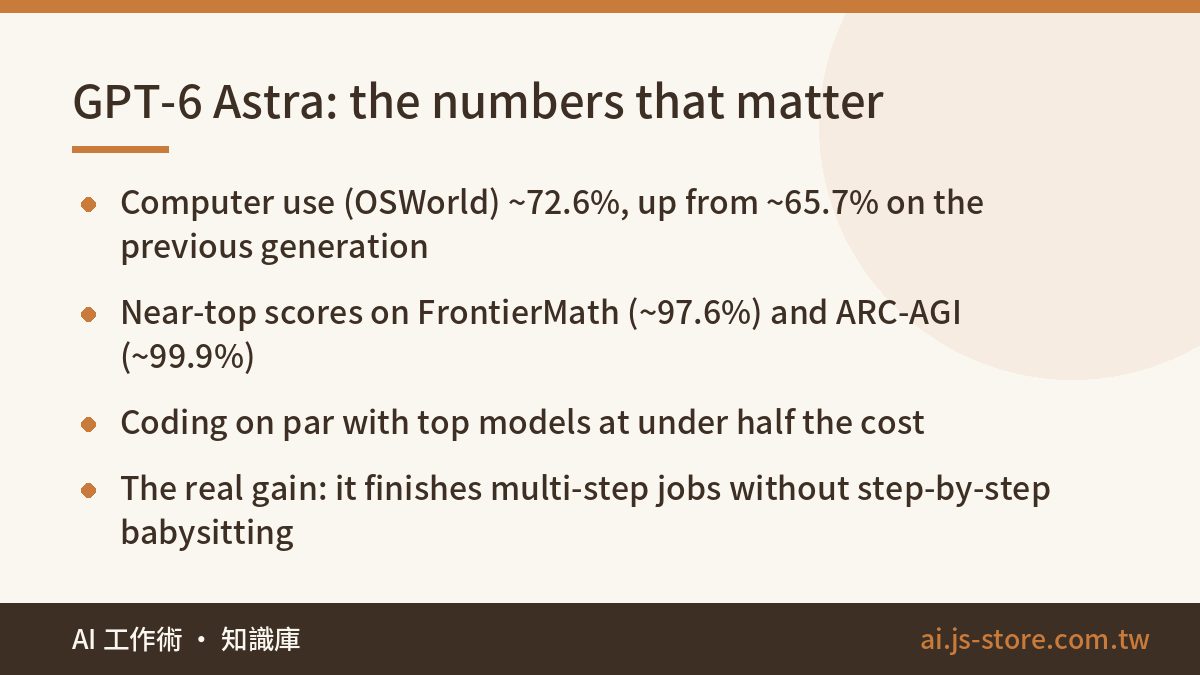
Adjectives are cheap, so here are the headline figures published around launch. Treat them as approximate, because benchmark results shift as labs and independent testers rerun them. The direction is still clear.
| Capability | GPT-6 Astra (reported) | What it means in practice |
|---|---|---|
| Computer use (OSWorld) | ~72.6%, up from ~65.7% | Can click, search and finish multi-step tasks across apps |
| Advanced math (FrontierMath) | ~97.6% | Close to the top of the scale on hard reasoning |
| Abstract reasoning (ARC-AGI) | ~99.9% | Near the human baseline on this test |
| Coding | On par with top models at under half the cost | Token-efficient, so long tasks cost less |
The number we care about most is the first one. A seven-point jump in computer use doesn't sound dramatic. In practice, it's the difference between an agent that stalls halfway and one that usually finishes. The math and reasoning scores are impressive, but very few businesses are held back by competition-level math.
Here's what changed for us. Running the ShooWork platform and our ShooWork Clip editing engine, a lot of our internal work used to be babysitting. We'd give the model one step, check the output, then give it the next step. Gather data, analyze it, write the report: three or four handoffs, each needing a person. With this generation, you describe the whole job once, let it run and review what comes back. That's where the value is, not in a few more facts it has memorized.
How to use GPT-6 today: hand it whole jobs
Getting access is simple. On a paid ChatGPT plan, pick GPT-6 Astra from the model menu. The harder part is changing how you prompt. Don't treat it like a chatbot you ask one question at a time. Give it a complete multi-step job with an answer you can check.
Three prompt patterns you can copy and adapt:
- Research to deck. “Read these 50 pages. Pull out the 3 key points. Turn them into a 10-slide outline. Only use numbers that appear in the material, and flag anything you're unsure about as a question for me.”
- Inbox triage. “Here's a week of my messages and email. Pull out every to-do, sort them by deadline and mark who is waiting on a reply from me.”
- Contract comparison. “Compare these two contracts. List every clause that's worse for me, and suggest how to rewrite each one.”
These have a few things in common. Each has a clear input, several steps and an output you can check against the source. Each also tells the model what to do when it doesn't know: ask instead of guessing. In our experience, that one instruction sharply cuts down on made-up numbers.
Don't give it a vague goal like “grow my business” and expect agentic magic. A vague goal gets you confident, generic output, just faster and at a higher price per token.
Where it stops: judgment is still your job
GPT-6 can do the steps. It can't decide whether you're going in the right direction, whether the result is good enough to show a client, or who takes responsibility when it's wrong. Those calls stay with you.
Watch for two ways it fails:
- It favors its own answers. Ask it to check its work and it will often defend what it already wrote. If something matters, check it against the source yourself or have a different model review it.
- It's wrong with a straight face. Better benchmark scores don't remove confident errors. They make them rarer and harder to spot. We see the most slips on local regulations, recent events and region-specific terms.
Our internal rule: a person checks anything the model produces before it leaves the company. A model that can work on its own still needs someone checking its work.
GPT-6 or Claude? Which one to use
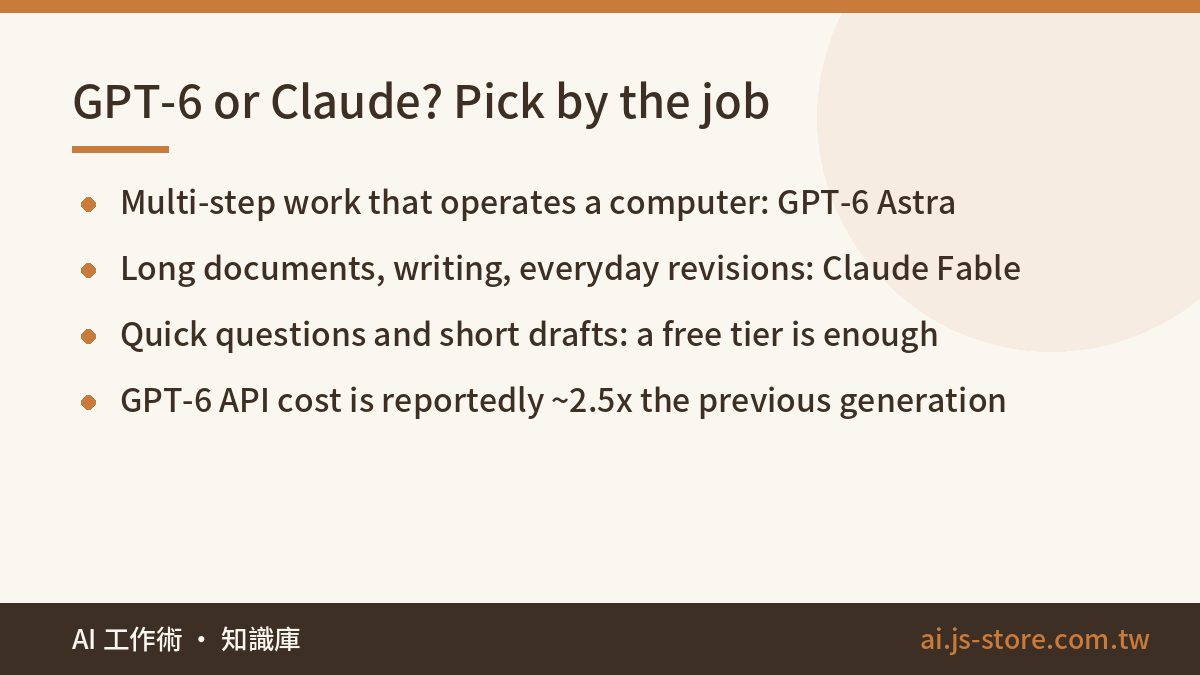
You don't need to switch everything. Match the model to the job, and save this table for the next time you're choosing:
| Your situation | Use | Why |
|---|---|---|
| It needs to operate a computer and run a multi-step job from start to finish | GPT-6 Astra | Strongest at agentic work, but the most expensive per task |
| Long documents, writing, back-and-forth revisions, your everyday main model | Claude Fable | Comparable coding results at a lower cost |
| Quick questions, short drafts, looking things up | A free tier | Don't pay for power you won't use |
On cost: GPT-6's API pricing is reportedly around 2.5 times the previous generation's. Check OpenAI's official pricing page for current numbers. Either way, using it for small everyday tasks is like hiring a contractor to change a light bulb.
For a fuller framework, including how to test models on your own tasks, read Claude or GPT? How to choose an LLM model. If you'd rather skip the setup and try ready-made tools, browse the ShooWork tools. There's nothing to install.
Before you move your workflow over
If a demo got you excited, slow down for one week. Pick one real task you do over and over, like inbox triage or building a report. Run it on GPT-6 and on your current model side by side, and track three things: how often the output was usable without edits, how long your review took and what it cost in tokens.
Most teams we talk to find that one or two of their workflows really benefit from the agentic upgrade, and the rest don't. That's a good result. It means you pay flagship prices only where they're worth it. We wrote up the method in why your AI project needs a PoC first.
And if your team can't say what they'd even use it for, the model isn't your problem yet. Map out your processes first, then pick the tool that fits them.
FAQ
Q: Is GPT-6 free?
No, not the full version. Its core capabilities need a paid ChatGPT plan. Free accounts usually get older or scaled-down models. If you mostly ask questions and write short pieces, the free tier is honestly enough.
Q: Is GPT-6 reliable for local or region-specific topics?
Its understanding and writing are strong across major languages. Local details are a different story: regulations, regional terms and current events can still be wrong, even when they sound authoritative. Check those yourself, and don't treat its answers as final.
Q: Will GPT-6 replace my job?
It replaces routine tasks with a clear right answer. The valuable parts of your work, like judgment, responsibility and taste, are still yours. It won't replace you, but it will replace the habit of doing everything yourself instead of handing work to AI.
Q: What's the biggest difference from the previous generation?
It isn't smoother chat. GPT-6 can operate a computer by itself and carry a multi-step task through to the end. That's the main reason to choose it. If all you need is Q&A, upgrading won't get you much.