Claude or GPT? How to Choose an LLM Model: 3 Practical Checks
Published 2026-09-24 · Updated 2026-10-14 · 8 min read · ShooWork (FREECO CO., LTD.)
Claude or GPT? We run both in production. Here are the three practical checks we use to choose an LLM model, and the one architecture rule that matters more.
“Should we go with Claude or GPT?” is the question we get asked more than any other, and the textbook answer is boring: it depends on the task. True, and useless. “Depends on the task” doesn’t tell you what to do on Monday morning. So this article breaks that answer into something you can actually run.
We run both model families in production. ShooWork Clip picks the best segments out of hour-long transcripts, ShooWork Write drafts long SEO articles, and ShooWork Ads rewrites ad copy and adjusts bids, with real traffic flowing through all of it every day. We pay both vendors’ invoices every month, and we have switched models mid-flight more than once. What follows are the three checks we actually use when we route a task to a model. None of them involve a leaderboard screenshot.
The short version: classify the task first, cost it using your own traffic shape, then test quality on your own data. After that, build so you can change your mind cheaply. That last piece matters more than the other three combined, and it’s the one most teams skip.
Check one: the task type matters more than the brand name
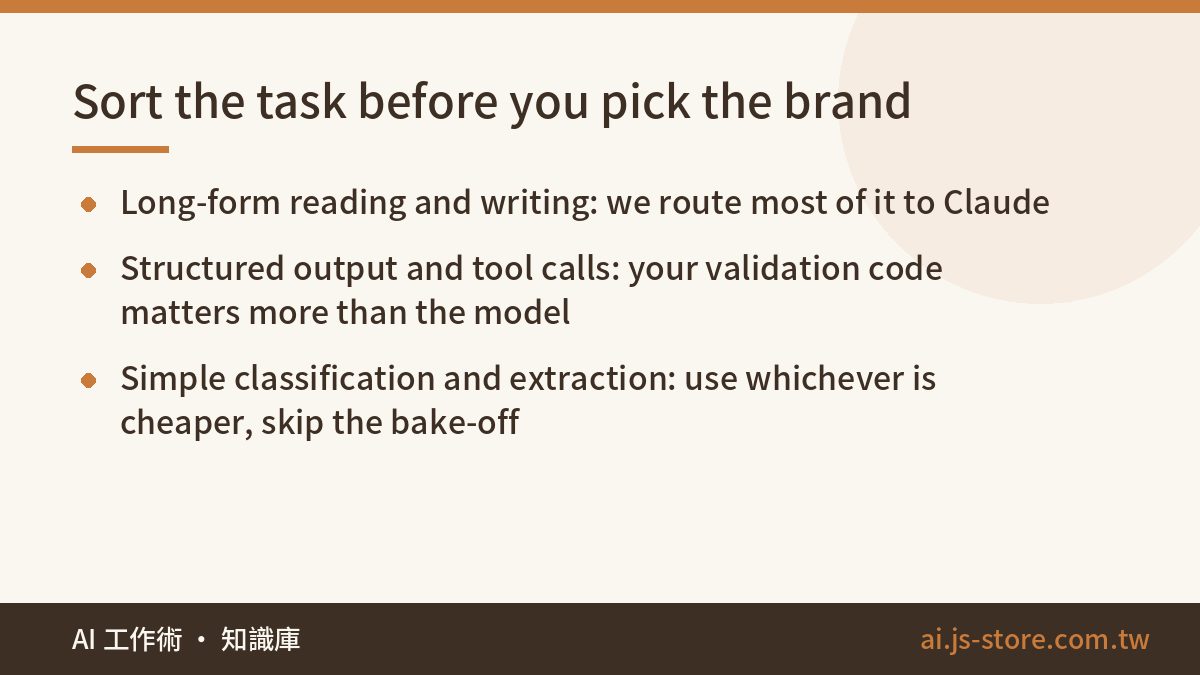
First, a myth to kill: “the strongest model” does not exist. What exists is “the model that is most consistent on this kind of task.” Once you accept that, you stop asking which vendor is best and start asking which bucket your workload falls into. Here is how we sort ours:
- Long-form reading and generation. Feed in a full transcript or a batch of documents and get back a long, well-structured output. We route most of this to Claude. Long-context stability and prose that doesn’t feel plastic are differences we notice daily, not in a benchmark. Segment selection in ShooWork Clip and first drafts in our content pipeline both live here.
- Structured output and tool calling. Return valid JSON, fill a schema, call functions inside a multi-step flow. Both vendors handle this. The variable that actually decides your reliability is whether your own code validates the format and retries on failure. The gap between the two models is smaller than the gap between good and bad plumbing around them.
- Simple classification and extraction. Tagging, sentiment, pulling a date out of an email. Both vendors’ lightweight models are more than enough. Use whichever is cheaper this quarter. Running a serious bake-off here is a wasted afternoon.
So step one is not picking a vendor. It’s sorting your workload into these buckets. Once you do, the options usually surface themselves. In our case, the third bucket carries the most call volume by a wide margin and almost none of our quality anxiety. The first bucket is the reverse: fewer calls, but they are the ones customers actually judge us on.
Check two: cost it with your own traffic shape, not the price list
Do not compare list prices side by side and call it analysis. Two things make list prices lie.
Your input-to-output ratio. Output tokens cost several times more than input tokens at every vendor. That means “read a long document, return a short summary” and “read a short brief, write a long article” land in very different places even at identical list prices. We see this inside our own product line: ShooWork Clip is the first shape (a 60-minute transcript in, a list of timestamps out), and ShooWork Write is the second (a two-paragraph brief in, 1,500 words out). Same model, completely different unit economics. Run the numbers with your ratio, not a generic one.
Caching and batch discounts. Prompt caching and batch APIs exist at both vendors, but the discount depth and the rules differ. If your application is a long system prompt plus high-frequency calls, the caching discount can outweigh the entire list-price difference between the two. Check the official pricing pages for current figures. They change often enough that any number printed here would be stale within a quarter.
Our method is simple: take a real traffic sample from your proof-of-concept stage, calculate the monthly bill for two or three candidate models, and only then decide. The spreadsheet takes half a day. What it decides is a fixed cost you’ll pay every month afterwards. If you want the wider picture of where AI money actually goes, we broke it down in AI Project Costs: The One-Time Build vs. the Monthly Model Bill.
Check three: test quality on your own data, in your own language
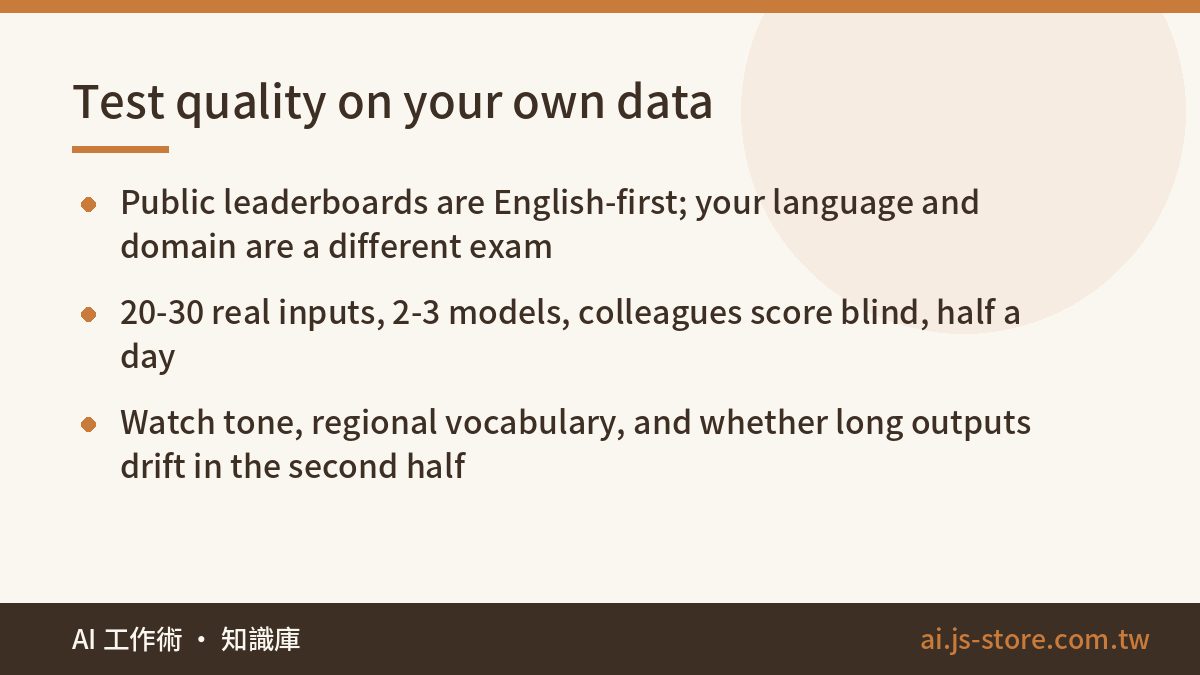
Public benchmarks are overwhelmingly English and overwhelmingly generic. If you ship in any other language, or in any specialized domain, the leaderboard is grading a different exam than the one your customers give you.
We operate primarily in a Chinese-speaking market, so we learned this the expensive way. We’ve seen a model that scores beautifully on English tasks produce stiff, translated-sounding output in our language. We’ve seen another default to the wrong regional vocabulary in brand copy. For an internal summary that’s a minor annoyance. For marketing copy with a client’s logo on it, it’s a rejected deliverable and an awkward phone call. The same trap applies if you only work in English: legal drafting, medical intake, your product’s own jargon. Generic scores don’t predict performance there.
The test doesn’t need to be sophisticated:
- Collect 20 to 30 real inputs from your actual use case. Not toy prompts. The messy ones.
- Run each through two or three candidate models with the same prompt.
- Have two or three colleagues score the outputs blind, without knowing which model produced which.
That’s half a day, and the result is closer to your reality than any ranking site. Pay attention to three things: how natural the tone is, whether the vocabulary is right for your region and domain, and whether long outputs “get tired” and start repeating or drifting in the second half. That last failure only shows up on long-form tasks, which is exactly why a two-line demo prompt will mislead you. If your output is SEO content, the quality floor has a second consequence, which we covered in Does Google Penalize AI Content? What Actually Gets You Hit.
Picking a model is like picking a contractor. Don’t judge the pitch deck. Judge who stays steady on your job.
More important than choosing right: stay able to switch
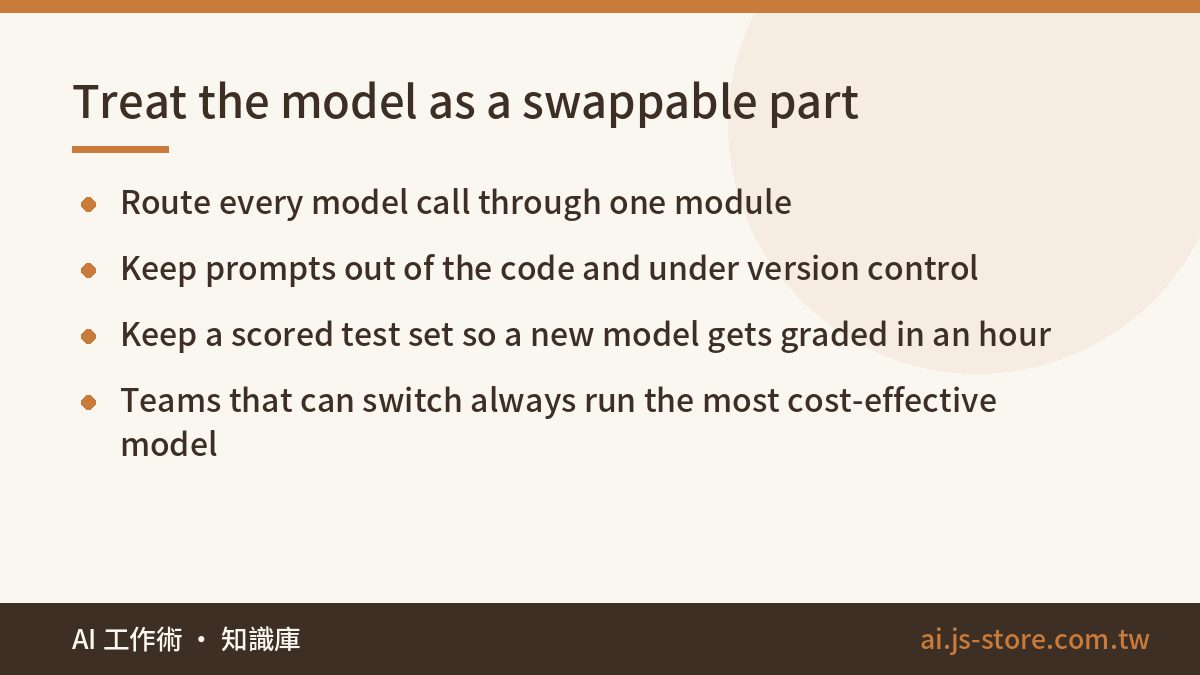
Here’s the advice that outweighs the three checks above put together: architect the model as a replaceable part. Concretely, that means three things.
- All model calls go through one module. Nothing else in your codebase should know which vendor sits behind it. If a model name is hard-coded in 40 places, you don’t have a model choice, you have a model marriage.
- Prompts live outside the code. Config files, a database table, anything version-controlled and reviewable. Prompt tweaks that live in five engineers’ heads are how you lose a week when one of them goes on vacation.
- Keep a scored test set. The 20 to 30 inputs from check three, plus the scores your colleagues gave. When a new model drops, you can grade it in an hour instead of arguing about it for a week.
This field changes shape every few months. Today’s best choice may be overtaken in six. Teams that can switch always run the most cost-effective model of the moment. Teams that are locked in watch everyone else save money and can’t do anything about it. Our own product line runs on this design. The last time one of our primary models shipped a major version, we swapped it in within days and no user noticed anything except slightly better output. That wasn’t heroics. It was the test set and the single module doing their job. More on how that fits our daily routine in How We Actually Use AI at Work.
So the order is: classify the task, cost it with your own traffic, test it on your own data, and keep the right to change your mind. If you’d rather start with tools where we’ve already done that routing work for you, ShooWork Clip is the one that stress-tests the long-form bucket the hardest. You can see it at /en/clip.
FAQ
Q: Is Claude better than GPT?
Neither wins across the board. In our production traffic, Claude is more consistent on long-form reading and writing, while structured output and simple classification come down to price and your own validation code. Sort the task first, and the answer usually picks itself.
Q: Should I use one model for everything to keep things simple?
No. Routing different task types to different models is normal and usually cheaper. The simplicity you want comes from a single call module in your code, not from a single vendor on your invoice.
Q: How do I compare LLM costs fairly?
Take a real traffic sample, apply your own input-to-output token ratio, and factor in each vendor’s caching and batch discounts. Then compute a monthly bill per candidate. List prices alone will mislead you, and you should check the official pricing pages for current rates.
Q: How often should I re-evaluate my model choice?
Whenever a major version ships from either vendor, and at least once a quarter regardless. If you keep a scored test set, each re-evaluation costs about an hour, so there is no good reason to skip it.
Q: Do I need a big engineering team to switch models safely?
No. One wrapper module, prompts in version control, and a 20-to-30-item test set are a few days of work for a single developer. That small investment is what lets a small team move faster than a large one that is locked in.