How We Actually Use AI at Work: An AI Team's Honest Routine
Published 2026-09-15 · Updated 2026-09-15 · 8 min read · ShooWork (FreeCo Co., Ltd.)
An AI tools team opens up its own workflow: where AI genuinely saves hours every week, the two red lines we never cross, and what we refuse to let it touch.
We get asked this constantly, usually with a slight edge to it: you sell AI tools, so what do you actually run on yourselves? Fair question. Plenty of companies sell AI and manage their own operations on spreadsheets and vibes. So here is the unglamorous version of our week — where AI genuinely saves us hours, and the parts that are less flattering but more useful to know.
Short answer up front: AI is deeply embedded in how we write software, draft content, and process meetings. It is completely absent from anything involving a price, a promise, or a legal judgment. We treat it as an output engine, not a decision-maker. Almost every practice below is downstream of that one distinction.
For context on why our answers are shaped this way: we build and operate ShooWork. We run the platform, the video-editing engine behind ShooWork Clip, and the campaign tooling in ShooWork Ads. We pay our own inference bills and get our own pages woken up at 2am. Everything here was learned by paying for it.
Code: AI Has the Fast Hands, a Human Holds the Gate
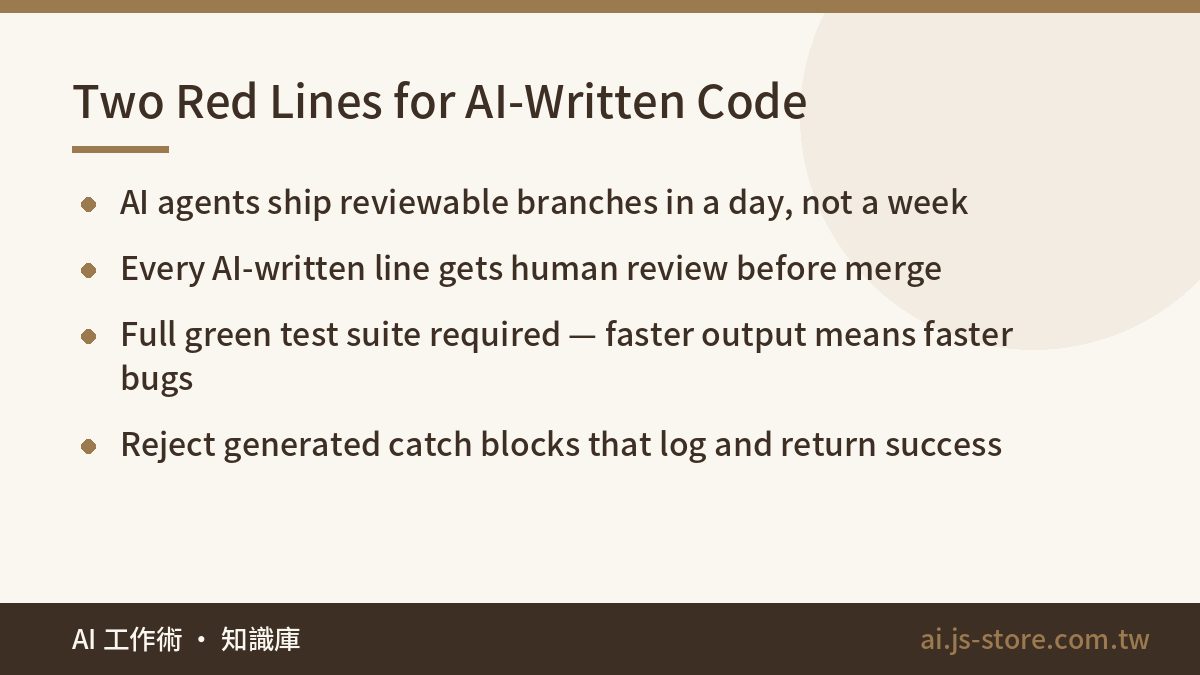
This is where we lean hardest. We let AI agents work directly in the codebase now — read the ticket, find the relevant files, write the implementation, run the tests, come back with a branch. Honest assessment: throughput is several times what it was. Features that used to get scheduled across a week now have a reviewable version the same day. That is not marketing copy, it is just what our pull request queue looks like.
Two lines we do not move. First, every line of AI-written code gets human review before it merges. AI is extremely good at producing code that looks right, and the distance between looks right and is right is exactly the distance to a 2am outage. Our reviewers are told to read AI output more suspiciously than human output, not less — because it arrives confident, well-formatted, and with a tidy explanation attached.
Second, the automated test suite has to be fully green before anything ships. That discipline matters more in the AI era, not less. When output speeds up five times and there is no test suite underneath it, you are not shipping five times faster — you are shipping bugs five times faster, and you will hear about them from a customer instead of from CI. If you are going to adopt agentic coding, build the tests first.
One specific pattern we reject on sight: generated error handling that logs a message and then returns success anyway. It is the most common defect in AI-written code we see, and it builds failures nobody ever finds out about.
Copy: AI Drafts, Humans Make It Sound Like Us
Marketing pages, social posts, blog drafts, ad variants — AI touches all of them. What we learned the hard way is that brand voice and factual accuracy cannot be delegated. AI will happily write a sentence that reads beautifully and is, in a regulatory sense, a fine.
We run our own ecommerce operation alongside the platform, and part of what we sell is food. In that category, copy rules are legal rules. One adjective the model thought flowed nicely is the difference between a product page and a penalty notice. So the split is fixed: AI is responsible for volume, humans are responsible for correctness. Reverse that division and you have built a machine for producing confident mistakes at scale.
On the SEO question everyone asks — no, we have not seen AI-assisted drafting hurt rankings by itself. What gets punished is unedited, unverified, nobody-added-anything content. We wrote up what actually triggers penalties in our breakdown of AI content and Google, and the pattern holds in our own analytics: the pages that perform are the ones where somebody with real experience rewrote the draft instead of approving it.
Meetings and Research: The Least Painful Place to Start
If you want one adoption win with near-zero resistance, start here. We record meetings, auto-transcribe them, and have AI produce a decisions-and-owners summary. Nobody complains, nobody has to change how they work, and the output is useful immediately. Action items get written down now, which is a low bar our team was previously failing to clear.
Research is more dangerous and we are stricter about it. AI narrows the search space fast — which library, which approach, which three vendors are worth a call. But we treat every stated fact as unverified. We have been confidently lied to about API parameters, about pricing tiers, and about whether a feature exists at all. The habit now: AI narrows the range, a human confirms the source. If a claim ends up in a client document, somebody clicked through to the primary source first.
AI has a clearly defined seat in our workflow: it is the engine for output, not the owner of judgment. The day you outsource judgment is the day the team starts depreciating.
The Things We Never Hand to AI
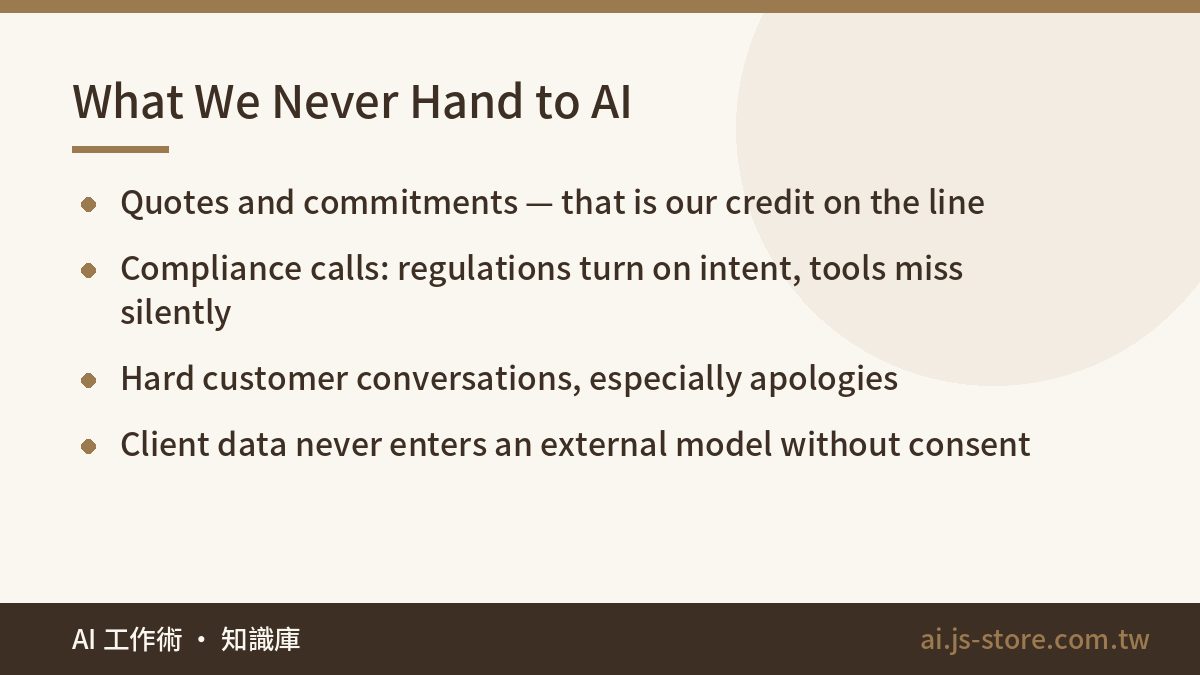
The list is short and we do not negotiate it.
Quotes and commitments. That is our credit. A number we send a client is a promise someone is personally accountable for, and no model has the context to make that promise.
Compliance calls. Regulations turn on substance and intent, not keywords. Tools miss things, and the miss is silent.
Hard customer conversations. Especially apologies. Let AI write the apology after an outage and the recipient can tell — and they are right to be angrier about that than about the outage.
Client data without consent. Nothing a customer gave us goes into an external model unless they have agreed to it. That is a floor, not a preference. If you have not worked through what leaves your network and where it is retained, start with the five questions we ask before rolling out any AI tool.
Prompts Are Assets, Not Something You Retype Every Time
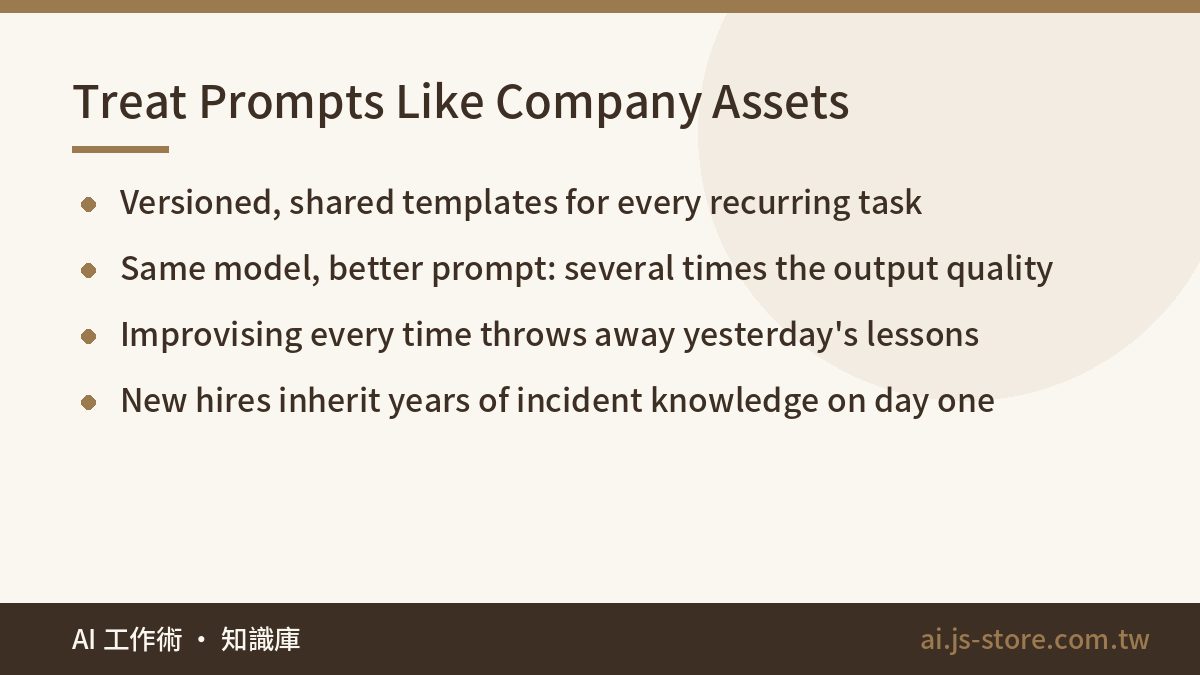
Here is the part almost nobody talks about. We manage our good prompts the way we manage code. Recurring situations — the code review checklist, the brand voice guide, the meeting summary format, the ad copy structure for a given campaign type — live as versioned templates in a shared place. People edit them, and the edits get reviewed.
The reasoning is plain economics. On the same model, the gap between a careless prompt and a refined one is several times the output quality. If everyone improvises fresh each time, you throw away what the team learned yesterday and pay for the lesson again. Half of how well AI works for you is the model. The other half is whether you bothered to accumulate your own knowledge of how to drive it.
A concrete example: our code review prompt now carries a list of specific failure modes we have actually been burned by. It grew one line at a time, out of real incidents. A new engineer inherits all of it on day one instead of collecting it over a year.
If You Are Rolling This Out, Get the Order Right
One sentence, compressed from a lot of expensive experiments: start with work that is repetitive, high-frequency, and cheap to get wrong, and keep the expensive-to-get-wrong work with humans. Most failed rollouts we have seen got this backwards. Somebody pointed AI at the highest-stakes process first because that is where the biggest number was, and one bad output burned the team's trust for a year.
In practice that means transcripts before contracts, first drafts before published pages, internal Q&A before customer-facing answers, test generation before production logic. Earn trust on reversible work, then expand.
It also means being honest about build versus buy. Not every workflow deserves a subscription, and not every subscription deserves a custom build on top of an API — we laid out how we make that call in our guide to subscribing, buying, or building. If you want to see the pattern in a shipped product, ShooWork Clip is the clearest example: the model does the grunt work of cutting and captioning, and a human still decides what the video is actually about. Because we use this stuff daily and pay for it ourselves, we will also tell you when a process is not worth automating — which comes up more often than the sales version of this conversation suggests.
FAQ
Q: Does letting AI write production code actually work?
Yes, with two conditions that are not optional: human review before every merge, and a test suite that must be fully green to ship. Under those conditions our throughput is several times what it was. Without them, you are just generating defects faster than you can find them.
Q: Will AI-assisted blog content hurt our search rankings?
Not on its own. What gets penalized is content nobody verified, edited, or added anything to. Our best-performing pages are AI drafts rewritten by someone with first-hand experience of the topic. The drafting tool is not the risk factor — skipping the human pass is.
Q: What is the easiest place to start?
Meeting transcription and summarization. Nobody has to change their behavior, the output is useful the first day, and a bad summary costs you nothing. It is the lowest-friction way to get a skeptical team comfortable before you touch anything that matters.
Q: How do you keep client data out of external models?
Consent first, and a written rule that customer data does not go into any external model without it. Beyond that, know which tools retain inputs, which are covered by your agreements, and who on the team is allowed to paste what. Pricing and retention terms change, so check each vendor's official pricing and data-handling pages rather than trusting a summary.
Q: Do you need engineers to get value out of this?
No. The highest-return uses for most teams — transcripts, first drafts, internal Q&A, repetitive formatting — need no code at all. Engineering matters when you want AI inside your own product or wired into internal systems, which is a much later step than most people assume.