What Is an AI Token? Pricing, Costs and How to Estimate Yours
Published 2026-10-01 · Updated 2026-10-13 · 7 min read · ShooWork (FREECO CO., LTD.)
Tokens are how AI models read text and how you get billed. Here is how token pricing works, why non-English costs more, and how to estimate your monthly bill.
A token is the smallest chunk of text an AI model works with, and it is the unit you actually pay for. It is not a word and it is not a character. It is a fragment the model's tokenizer carved out of your text: common English words are usually one token each, longer or rarer words get split into two or three pieces, and punctuation, spaces and line breaks get counted too. Whether you are using ChatGPT, Claude or Gemini, everything you send in and everything the model sends back is converted to tokens first and priced second.
If you are on a monthly subscription using the web app, tokens decide two things for you: how much content fits into a single conversation, and how fast you burn through your usage allowance. If you are a developer or founder calling an API from your own product, tokens are the bill. There is nothing else on it. And the gap between a rough guess and a real estimate is routinely 5x in either direction, which is how teams end up either over-provisioning a budget they never spend or getting a surprise invoice in month two.
We run our own AI tool platform, a video-editing engine that processes transcripts all day, and ads tooling that generates copy in bulk. So this is not a theory post. Below is how tokenization actually works, why non-English content costs noticeably more, how to estimate a monthly bill before you write a line of code, and the six things that actually moved our own numbers.
A token is not a word, and not a letter
Language models do not read text. They read numbers. Before training, every model builds a vocabulary — a tokenizer — that maps common character sequences to numeric IDs. When your message arrives, step one is chopping it into those sequences and looking up the IDs. Each ID is a token.
A few properties you will feel directly in your bill:
- Common English words are usually one token. "the", "apple", "marketing" each cost one. Rare or compound words get split — "unbelievable" might become three pieces.
- Spaces and punctuation count. The space before a word usually merges into that word's token, but newlines, brackets, bullet characters and emoji all consume their own.
- Numbers are expensive. A ten-digit figure can become three or four tokens. Pasting a spreadsheet export into a prompt costs far more than the character count suggests.
- Code costs more than prose. Indentation, symbols and camelCase variable names fragment badly.
The rule of thumb worth memorising: 1,000 tokens is roughly 750 English words, or three to four pages of plain text. That is accurate enough for planning. When you need the real number, every major provider publishes a free tokenizer page or a token-counting API endpoint — run your actual content through it instead of guessing.
The three prices on every API bill
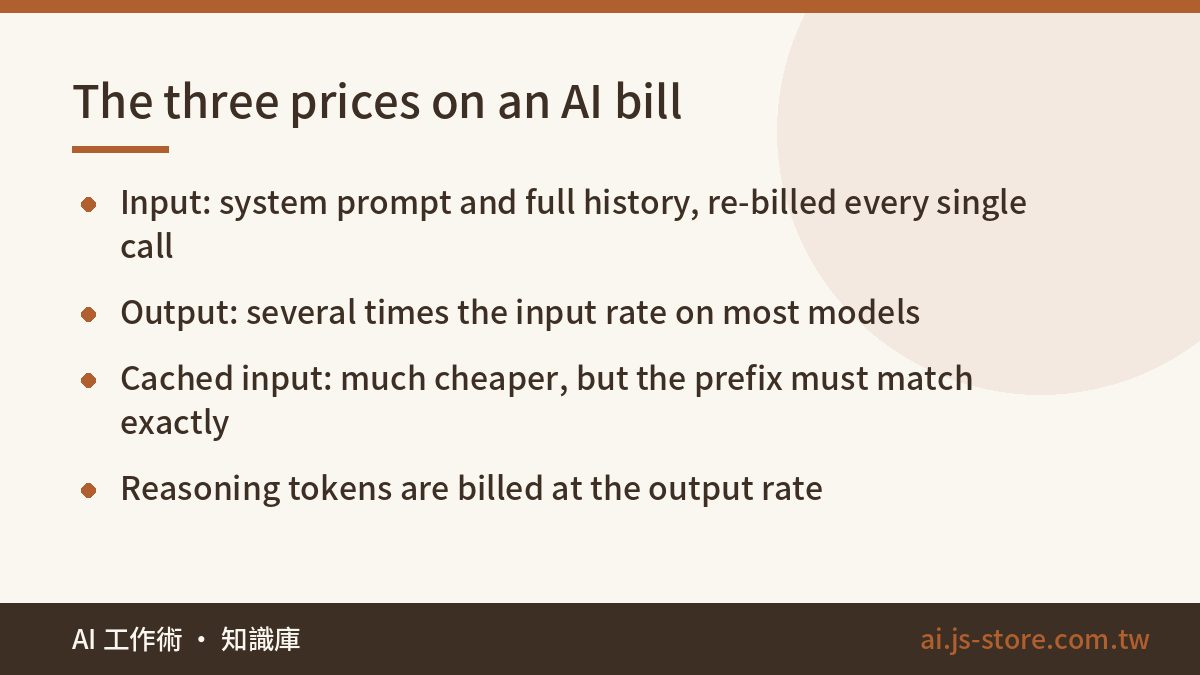
API pricing pages are almost always quoted as dollars per million tokens, split across two or three line items. Understand these three numbers and you understand about 90% of AI cost structure.
| Type | What it covers | How it is priced |
|---|---|---|
| Input tokens | Everything you send: system prompt, conversation history, attached documents, the user's question | The base rate. Usually the largest volume by far. |
| Output tokens | What the model writes back | Typically several times the input rate; the stronger the model, the wider the gap |
| Cached input | Repeated prefix content the provider keeps warm between calls | Substantially cheaper than standard input on most platforms — check the official pricing page for the current discount |
Three traps catch almost everyone:
- Conversation history is re-billed every single turn. The model has no memory. Each time you send a new message, your code is quietly resending the entire prior conversation as input. By turn 20, typing "ok, thanks" can cost you several thousand input tokens of accumulated history.
- The system prompt is billed every call. If you wrote a 1,500-word persona-and-rules block, you pay for 1,500 words on every request, forever. This is exactly why prompt caching matters so much in production.
- Reasoning tokens are billed as output. Turn on extended thinking or a reasoning mode and the model's internal deliberation — which you may never even display — is typically charged at the output rate. Bills of 2x to 10x your expectation are normal here.
On a subscription plan nobody hands you a token invoice, but tokens still govern your experience: they set the context window (how much fits in one conversation) and they drive your usage allowance, which is usually expressed as messages per rolling window. Longer messages and bigger attachments drain it faster. If you are still deciding which model to build on, our breakdown on how to choose an LLM model walks through the trade-offs beyond price.
Why non-English content costs more
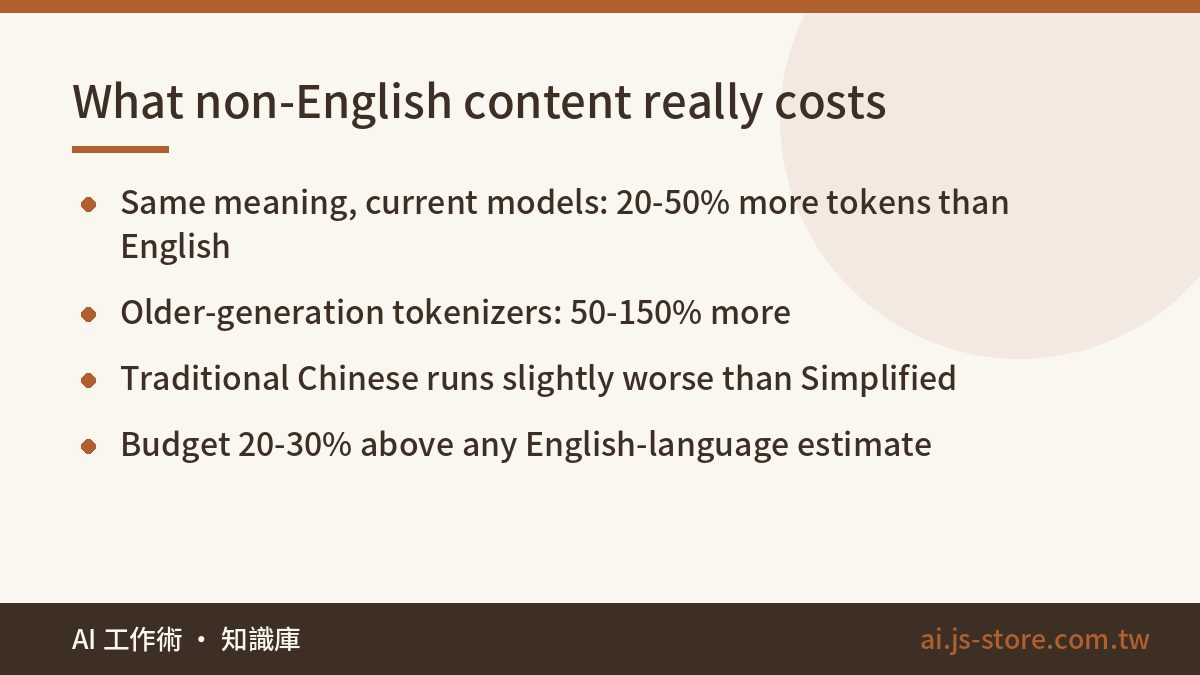
Tokenizer vocabularies are built statistically from training data, and training data skews heavily English. So English words earn their own dedicated tokens, while other scripts get encoded less efficiently. Chinese, Japanese and Korean characters each occupy their own Unicode code point and historically burned two or three tokens apiece. Thai, Arabic, Hindi and heavily accented European text all pay a similar penalty. Modern tokenizers have improved a lot — CJK characters now typically land around one to one-and-a-half tokens each — but the gap has not closed.
The comparison that matters is not tokens per character; it is tokens needed to express the same idea. Chinese is far more compact than English per character, which partly cancels out the penalty. Netting it out across the models we have measured, the pattern is consistent: the same meaning in a non-English language typically costs 20% to 50% more tokens on current-generation models, and 50% to 150% more on older ones. Traditional Chinese tends to run slightly worse than Simplified, because there is less of it in training data.
The practical rule: if you are building for a non-English market and you sized your budget from an English tutorial, add 20-30% and re-check with a real sample of your own content. We hit this directly with ShooWork Clip. A ten-minute talking-head video produces roughly 1,500 words of English transcript — about 2,000 input tokens before the system prompt. The same ten minutes in Chinese runs 4,000 to 6,000. Add the prompt and the timecode markers coming back out and you are well past 10,000 tokens per video. Multiply by a few hundred videos a day and the difference stops being academic. We wrote up what that pipeline cost us to get right in how we built an AI video clipping pipeline.
Estimate your monthly bill in three steps
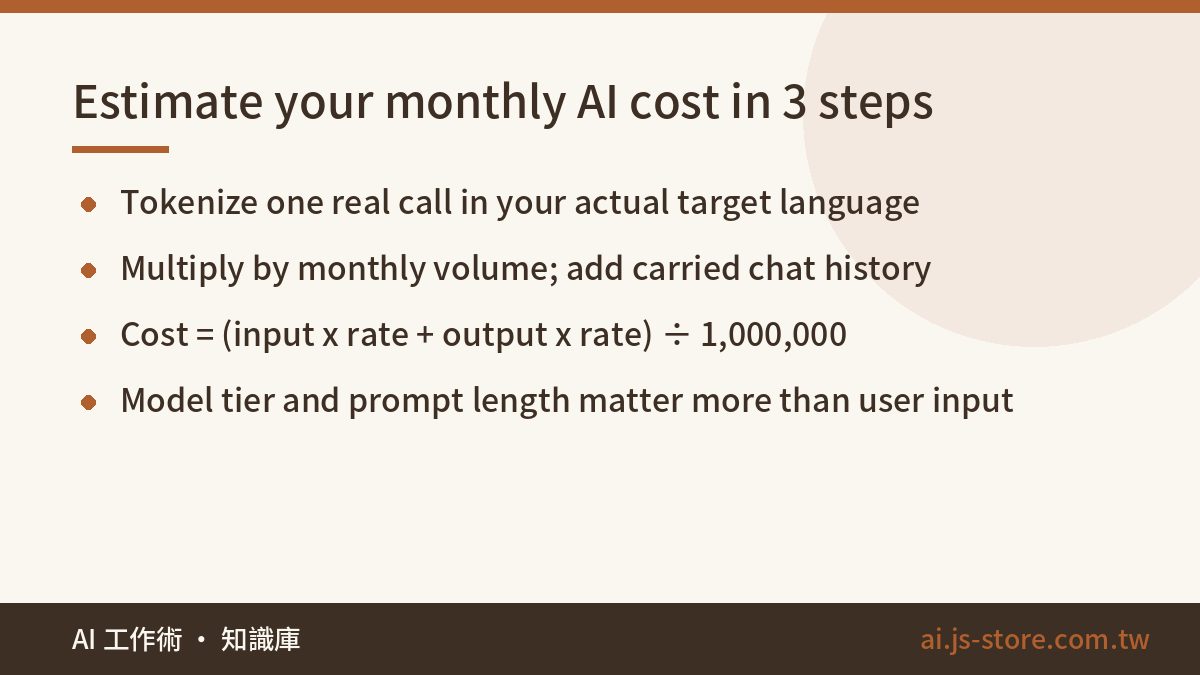
Do not wait for the invoice to find out. Before you write any code, this takes fifteen minutes.
- Measure one call. Paste your system prompt, one realistic user message, and a sample answer of the length you expect into the provider's tokenizer. Use real content in your actual target language — estimating a Japanese product with English samples will understate you by a third.
- Multiply by monthly call volume. Active users x calls per user per day x 30. For multi-turn chat, remember history accumulates; a workable approximation is to add half the average turn count x single-turn input as carried history.
- Apply the price list. Monthly cost = (total input tokens x input rate + total output tokens x output rate) ÷ 1,000,000, using the current numbers from the model's official pricing page.
Here is the shape of it for a support chatbot:
| Item | Assumption |
|---|---|
| System prompt + retrieved knowledge (input) | 1,200 tokens per call |
| User question + carried history (input) | 300 tokens per call |
| Model answer (output) | 300 tokens per call |
| Monthly calls | 10,000 |
| Monthly input total | 1,500 x 10,000 = 15M tokens |
| Monthly output total | 300 x 10,000 = 3M tokens |
Now plug in rates. Do not use numbers from a blog post, including this one — pull them from the official pricing page, because they change. What the arithmetic will show you is the shape of the problem: the model tier you pick and the length of your system prompt move the bill far more than anything your users type. A mid-tier model on this workload is a modest monthly line item; the flagship version of the same workload is several times that; a small fast model is a rounding error. Also budget for currency conversion and international card fees if you are billing from outside the US, and remember that most platforms bill in advance or on a monthly cycle in USD.
If the honest answer after this exercise is "I don't know my call volume yet", that is a signal to run a small proof of concept before committing to architecture.
Six things that actually cut our token bill
Ranked by how much they moved our numbers, not by how clever they sound.
- Turn on prompt caching. Put your system prompt, few-shot examples and static knowledge at the very front of the message and keep them byte-identical between calls so the cache hits. For any product with a long system prompt, this routinely cuts input spend by more than half. Change one character and the cache misses.
- Route by task difficulty. Classification, keyword extraction and sentiment checks go to a small model. Only genuine reasoning and long-form writing go to the flagship. In our clip engine, "is this segment an ad read?" is a small-model job; "pick the three most compelling moments in this video" is not.
- Write system prompts in English even when output is not. The same rules expressed in English cost 20-40% fewer tokens, and comprehension does not suffer. Instruct the model to respond in the target language; your users never see the difference.
- Cap output length. Set max_tokens, and say it in the prompt too: "three sentences maximum", "return JSON only, no prose". Output is your most expensive token class. Never let the model free-associate.
- Summarise or truncate history. Past a set number of turns, compress everything older into a short summary or keep only the recent window. This converts long-conversation cost from linear growth back to roughly flat.
- Stop sending whole documents. Retrieve the relevant passages with search or embeddings and send only those, not the entire PDF. This cuts cost and improves accuracy, because the model stops getting distracted by irrelevant context.
Even if you are purely a web-app user, the underlying habit transfers: stuffing a message with loosely-related context does not just drain your allowance, it degrades the answer. Tight, specific prompts are the cheapest optimisation there is. For how we structure this at volume, see our write-up on running an AI content pipeline.
FAQ
Q: How many tokens is one word?
For English, roughly 0.75 words per token — so 1,000 tokens is about 750 words. For Chinese, Japanese or Korean, most current models land around one to one-and-a-half tokens per character, versus two to three on older generations. There is no universal answer because every model has its own vocabulary. Run your real content through the provider's tokenizer tool to get the exact count.
Q: I only use the ChatGPT or Claude web app. Do tokens matter to me?
You are not billed per token, but tokens still set your context window — how much fits in one conversation — and how fast your usage allowance depletes. Longer messages, bigger attachments and marathon conversations all burn it faster, and answer quality tends to drop as the context fills with noise. Learning to write tight prompts pays off on a subscription too.
Q: Why is output so much more expensive than input?
Input can be processed in parallel in a single pass. Output has to be generated one token at a time, and every new token requires re-running attention over the entire context so far. It is simply far more compute per token. That is why capping response length is the single most direct lever on your bill.
Q: Does prompt caching really save that much?
For products with a long system prompt and frequent calls, yes — dramatically, since cached input is priced well below standard input on most platforms. The catch is strict: the cached content must sit at the front of the message and be identical every time. Insert a timestamp or a user name into that prefix and you invalidate the cache on every call. Check your provider's documentation for the exact matching rules and cache lifetime.
Q: What do people most often forget when estimating cost?
Three things, in order. Multi-turn conversations re-bill the entire history as input on every turn. Reasoning and extended-thinking tokens are charged at output rates even when hidden from the user. And estimating a non-English product using English samples understates the real figure by 20-30%. Run a real sample through a tokenizer, then multiply by realistic volume.