AI Content Pipeline: How One Person Ships a Team's Worth of Posts
Published 2026-09-24 · Updated 2026-10-14 · 8 min read · ShooWork (FREECO CO., LTD.)
How we run our social channels with no content team: a four-stage AI content pipeline, what we automated, and what we handed back to humans.
Running social media channels does not burn people out because they run out of ideas. It burns them out because of everything around the ideas: hunting for source material, cleaning up data, formatting, scheduling, reshaping the same post for four platforms. Track an in-house content person for a week and you will find that actual creation takes maybe 20% of their time. The rest is hauling.
An AI content pipeline is a workflow that takes the hauling away. Scheduled jobs gather material, a language model drafts from your brand voice guide, a human picks and approves, and the system publishes, reformats and pulls performance data back in. Done well, one person ships the volume of a three or four person team, and quality is still controlled by a human.
We run the social accounts for an e-commerce brand and for ShooWork, our own AI tools platform, with no dedicated social media team. This article walks through the four-stage pipeline that makes that possible. More importantly, it covers the parts we automated, watched fail, and handed back to humans. That second list is the one most articles about AI content leave out.
The Four Stages of a Content Pipeline
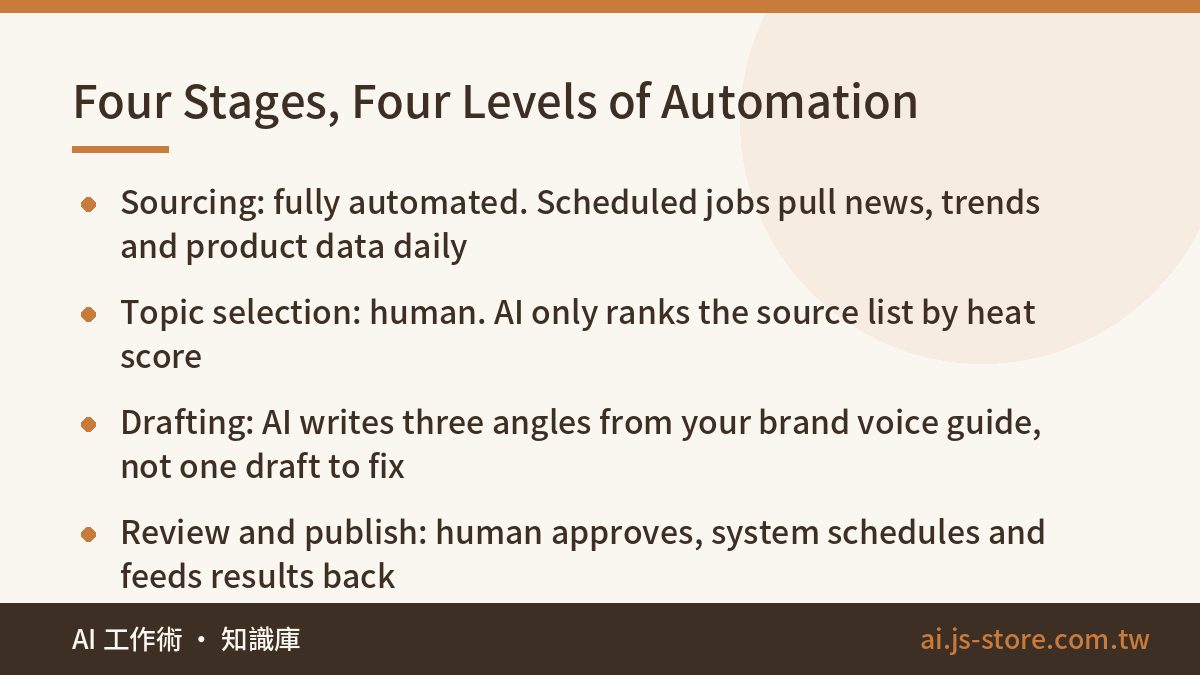
We split content production into four stages. Each has a different level of automation, and that is deliberate. Not every stage deserves the same treatment.
- 1. Sourcing (fully automated). Scheduled jobs run every morning and pull industry news, trending topics on the platforms we post to, and our own product data. Which tool had a usage spike overnight? Which old article suddenly got traffic? Everything lands in a single source list. This stage is pure transport with zero creative content, so it was the first thing we automated.
- 2. Topic selection (human). Someone looks at the source list and decides what we make today. We tried handing this to AI. We took it back. More on that below.
- 3. Drafting (AI does the heavy lifting). Once the topic is set, a language model drafts from our written brand voice guide and format templates: post copy, per-slide headlines and body text for carousels, hashtags. It produces three versions with different angles every time, not one version for a human to fix.
- 4. Review and publishing (human approval, automated everything else). A person reads, edits, and hits confirm. The system takes over from there: scheduling, per-platform format adjustments, and after publishing, pulling engagement data back into the database. That data feeds stage one the next morning.
Video runs through the same review queue. Long recordings go into ShooWork Clip, our own clipping engine, which returns short-form candidates. Those candidates land in the same approval step as the text posts, so nobody maintains a separate video workflow.
Generate Three Drafts, Not One
This took us months to figure out, and it is the single most valuable change we made.
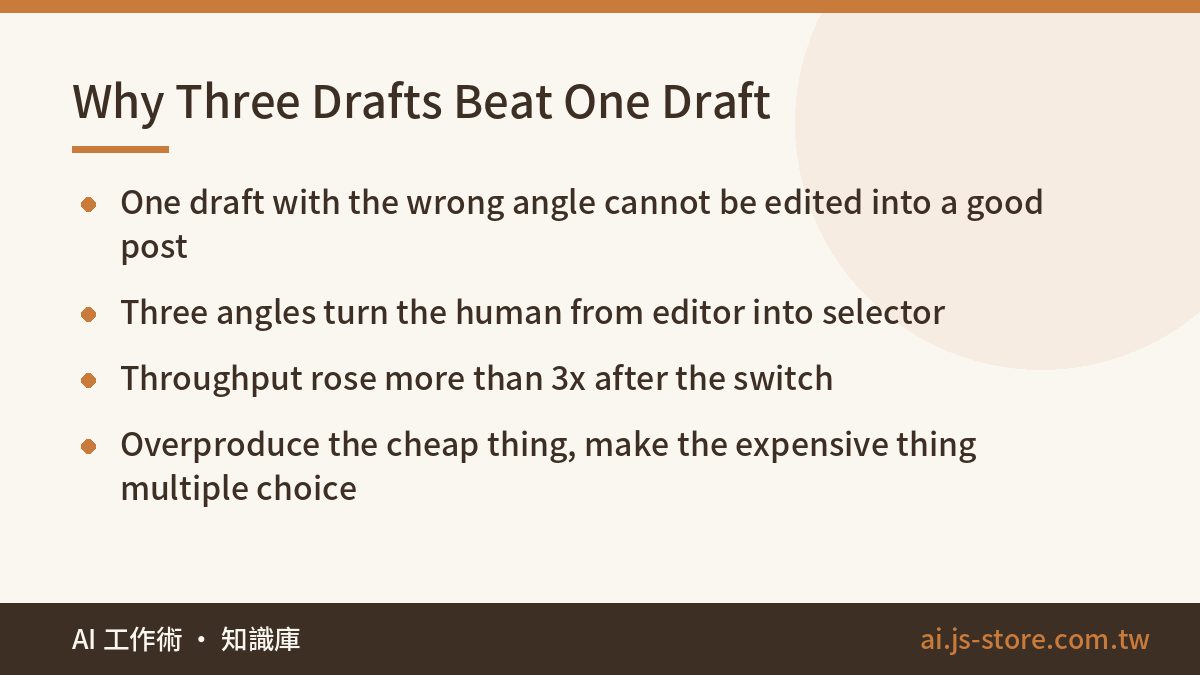
Our early setup was the obvious one: AI writes a draft, a human edits it. Editing time ended up longer than writing from scratch. The reason is simple once you see it. When a draft has the wrong angle, editing cannot rescue it. You are rewriting while pretending to edit, and rewriting inside someone else's structure is slower than starting clean.
So we changed the instruction. The model now produces three drafts with three distinct angles for every topic: say, a customer-pain angle, a data angle and a behind-the-scenes angle. The human's job shifted from editor to selector. Pick the closest one, tweak a sentence or two, approve. Throughput went up more than 3x.
The underlying principle applies to any AI workflow, not just content. Model output is nearly free. Human editing is expensive. Overproduce the cheap thing, and turn the expensive thing into a multiple-choice question. If you are designing a process around a language model and the human is still typing a lot, you have probably set it up backwards.
A good content pipeline is not about teaching AI to write. It is about concentrating all of your human time into the 20% only humans do well.
Two Things We Automated and Then Took Back
Here are two honest retreats. Both worked technically and both were mistakes.
Topic selection. For about a month we let the model choose topics directly from the source list. It chose reasonable topics. It never chose the ones that took off. Posts that take off depend on a feel for what your audience is emotionally reacting to this week, plus context memory like whether you already ran something similar last month. A model working from a ranked list has neither. Engagement softened noticeably over that month and recovered once a human took the decision back. Today the AI only sorts the source list by heat score. The final call is always a person.
Comment replies. Automated replies are completely doable. We built them. We do not run them. The whole point of a social channel is that people can feel someone is there, and templated replies get spotted immediately. Once spotted, they damage the account more than silence would. This one sits on our permanent do-not-automate list, and we recommend you put it on yours.
Both retreats taught us the same lesson. The question is not whether AI can do a step. The answer is almost always yes. The question is whether the step's value comes from judgment or from labor. Labor automates well. Judgment about people does not, at least not yet. If you want a framework for sorting your own processes this way, our piece on which processes to hand to an AI agent goes deeper.
The One Step We Added: Automated Compliance Checks
Not everything moved from machine to human. One step went the other way, and we added it because scale cuts both ways.
One of the brands we run sells supplements. Claims in that category are regulated, and a single careless sentence can trigger a fine or a takedown. So before any draft reaches a human reviewer, an automated check scans it for banned terms and, with a second model pass, for claims that are phrased legally but imply something prohibited. Drafts that fail get flagged with the offending sentence highlighted.
The logic is straightforward. AI produces fast, which means it produces mistakes fast too. If you scale generation, you must scale review. A human reading three drafts a day can catch a bad claim. A human reading thirty cannot, and will start skimming by day three. Put the machine check in front of the human so the human only sees clean candidates.
Even outside regulated categories, this step earns its keep. Swap banned health claims for competitor names you never mention, prices that changed last quarter, or phrasing that is off-brand. Our article on scaling marketing assets without diluting your brand covers how to write those rules down so a model can enforce them.
How to Build Your Own Pipeline, in the Right Order
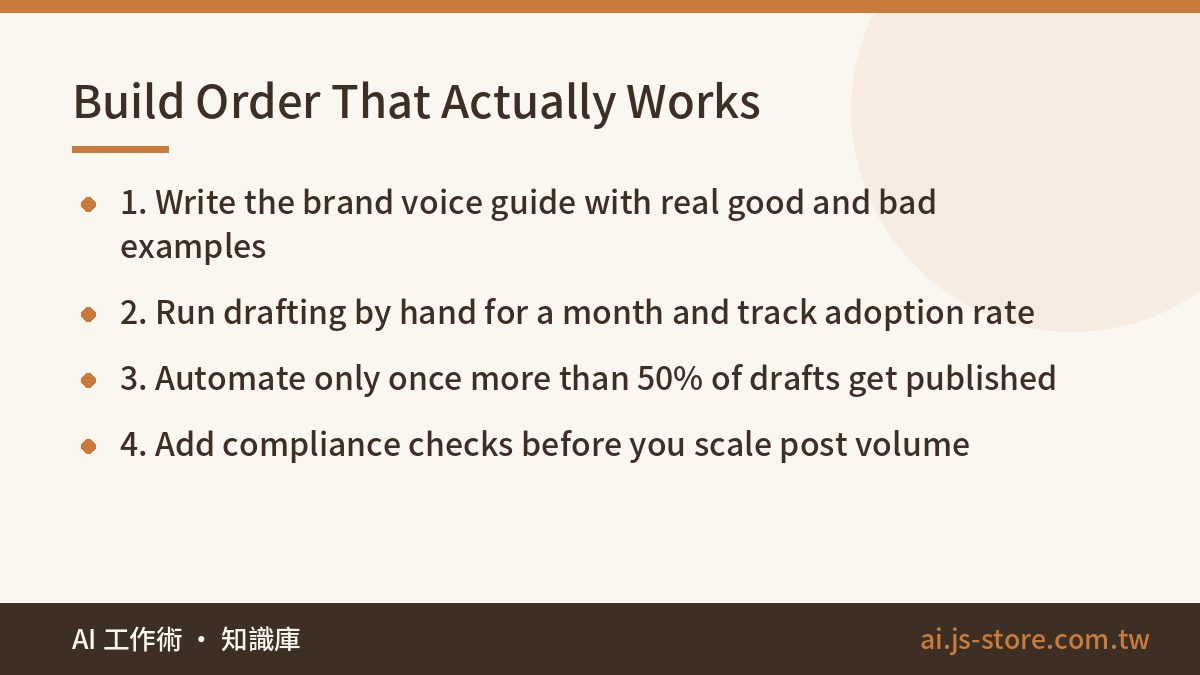
Do not try to wire up the fully automated version on day one. Here is the sequence we would follow if we were starting over. The order matters more than any tool choice.
- Write the brand voice guide and format templates first. This document is the ceiling on AI draft quality. No guide, no pipeline. Include real examples of posts you loved and posts you killed, with one line on why. A model learns far more from five contrasting examples than from three paragraphs of adjectives.
- Run it by hand for a month with off-the-shelf tools. Paste the guide into whatever model you use, generate three drafts per topic, and track one number: what percentage of drafts get published with light edits or none? That is your adoption rate.
- Automate only when adoption passes 50%. Below that, the problem is your guide or your prompts, and no amount of scheduling infrastructure will fix it. Above that, the drafting step is proven and wiring in sourcing, scheduling and reporting will pay off.
- Add the compliance layer before you scale volume. The week you go from five posts to twenty is the week a bad claim slips through.
Get this order backwards and you end up with a very efficient pipeline producing a large volume of content nobody wants to publish. We have watched it happen, and it is expensive to unwind.
The goal of content automation is not zero humans. It is one person producing a team's output, with a human still owning quality. If you want to see the pieces working before committing to a build, the drafting and clipping steps are available to test on our free tier. We run this exact pipeline every day, so both the benefits and the limits are visible.
FAQ
Q: How much of a content pipeline can actually be automated?
In our experience, everything except two steps: choosing the topic and replying to comments. Sourcing, drafting, formatting, scheduling and reporting all run without a human. The human reviews and approves, which takes minutes per post rather than hours.
Q: Why generate three drafts instead of one better draft?
Because a draft with the wrong angle cannot be edited into a good one, and model output is nearly free while human editing is expensive. Three angles turn the human's job from rewriting into picking, which was over 3x faster for us.
Q: Will AI-generated social posts hurt engagement?
Low-effort, unedited output can. Drafts written from a documented brand voice, then selected and edited by a human, have held up fine for us. What hurt our numbers was letting AI pick topics, not letting it draft.
Q: What is the first thing to build if I have no pipeline at all?
A written brand voice guide with real examples of good and bad posts. Every later step depends on it. Then run drafting manually for a month and measure how many drafts you actually publish before you spend anything on automation.
Q: Does video fit into the same pipeline as text posts?
Yes. We feed long recordings into a clipping engine that returns short-form candidates, and those candidates enter the same human review queue as text drafts. One approval step for everything keeps the workflow manageable for a single person.