AI Marketing Assets: Scale Output Without Diluting Your Brand
Published 2026-09-15 · Updated 2026-09-15 · 8 min read · ShooWork (FreeCo Co., Ltd.)
AI can produce marketing assets endlessly. The hard part is staying recognizable. Here is the spec-driven pipeline we run on our own brands.
If you landed here asking how to produce ten times more marketing assets with AI without your brand turning into mush, the short answer is this: stop treating brand voice as a feeling and start treating it as a written spec. Copy, images, and video have all been generatable for a while. Production was never the bottleneck. The bottleneck is that a model with no constraints produces the average of the internet, and averages do not have a personality.
We run this ourselves. ShooWork operates its own AI tool platform, the video engine behind ShooWork Clip, and the ads tooling behind ShooWork Ads — and we market all of it with a pipeline that is AI at the core. So this is not an article about whether AI can make marketing assets. It can, and has been able to for years. This is about the thing that actually breaks at volume: one post reads like an insurance brochure, the next reads like a motivational poster, and three months later your feed is a stylistic rummage sale.
The fix is boring and it works. A style constitution that goes into every single prompt. Fixed templates that own layout, so AI only owns variety. And humans kept at exactly two points in the line — deciding what to say, and deciding whether what came out is actually yours. Everything between those two points is what AI should eat.
Why brand voice evaporates the moment you scale
Ask a model for a product post with no constraints and you get the greatest common denominator of every marketing post ever indexed: enthusiastic exclamation points, safe adjectives, sentence shapes you forget while reading them. That is not a defect. It is the model doing precisely what it was trained to do — predict the most likely next thing.
Volume amplifies exactly that. A human writing ten posts a month leaks personality into all ten because they cannot help it. A model producing a hundred produces a hundred that are identical in their lack of personality. The output isn't bad; it's forgettable at scale, which costs you the one thing paid reach can't buy back.
The answer is not "use less AI." Teams that retreat to manual production end up with the same volume problem plus burnout. The real difference is that a human writer absorbs brand by immersion — sitting in meetings, reading complaints, watching the founder wince at a bad headline — and a model has none of that. A model can only absorb what you hand it in the prompt. So hand it to the model.
Turn brand feel into a spec: the style constitution
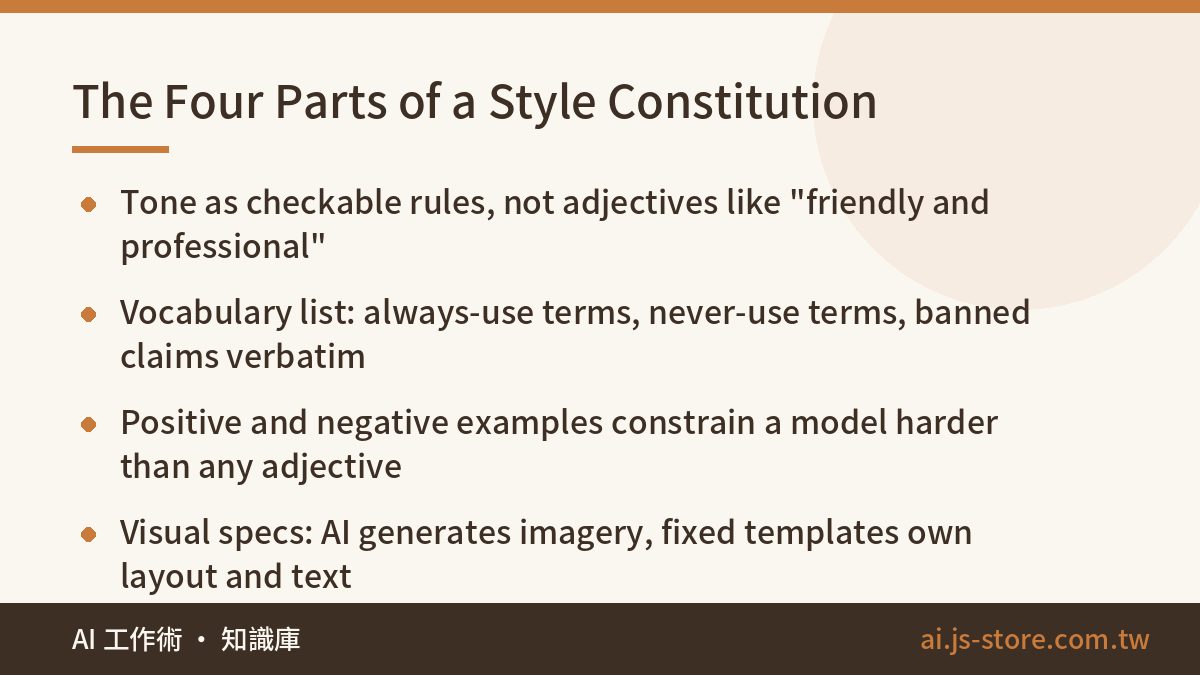
We keep one document per brand account, and we call it the style constitution. It is the most valuable asset in the entire pipeline — worth more than any prompt, any tool subscription, any individual piece of output. Four parts:
- Tone as rules, not adjectives. "Friendly and professional" is worthless; every company on earth would sign off on it. Useful rules look like: second person, always. No exclamation points unless someone is literally shouting. Self-deprecation is fine, condescension toward the reader never is. Contractions yes, corporate throat-clearing no. If a stranger who has never met your company couldn't check the rule, it isn't a rule.
- A vocabulary list. Words you always use, words you never use, product names spelled exactly one way. If you operate in a regulated category, the prohibited claims go in verbatim — that way compliance is enforced at generation time instead of caught at review time. Catching it at review means someone has to catch it every single time. Enforcing it in the prompt means it mostly never happens.
- Positive and negative examples. Three to five pieces that are unmistakably you, plus a few that are absolutely not you with one line on why. Examples constrain a model far harder than any adjective will. This is the highest-leverage section and the one teams skip most often.
- Visual specs. Hex values, composition conventions, type hierarchy. Image models are still less consistent than text models, so our approach here is deliberately conservative: AI generates the underlying imagery, and a fixed template owns the layout and every text layer. Consistency comes from the template. AI supplies variety. Don't ask a diffusion model to be your art director.
The whole document goes into every generation, and it's a living thing. Every time something comes out and makes you think "that's not us," go add a rule. After three months that file understands your brand better than any junior marketer you could hire — and unlike a junior marketer, it doesn't leave.
The right mental model isn't "I hired a cheap content person." It's "I built a spec-driven production line." The more precise the spec, the less volume dilutes the brand.
Where the humans stay in the line
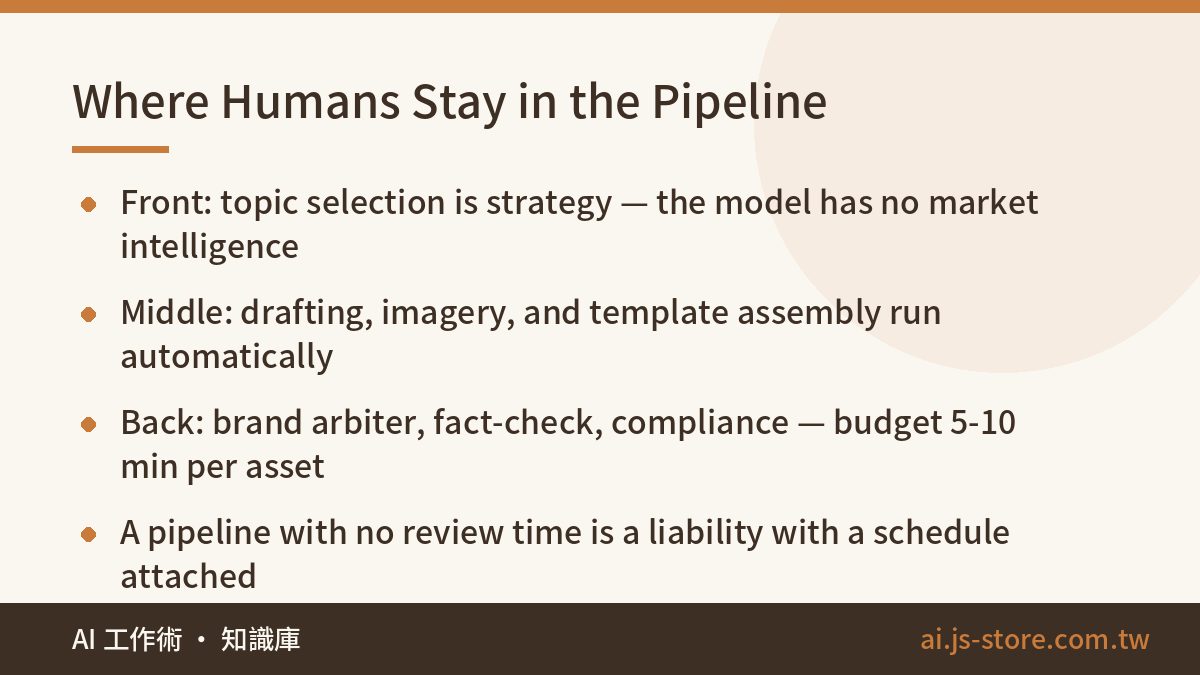
Our pipeline looks like this: a human sets topic direction, AI batch-generates copy drafts and base imagery, templates assemble everything automatically, a human reviews and adjusts, and scheduling runs automatically from there.
Humans sit at the front and the back. Both positions have a specific reason.
The front is topic selection, and it's strategy. What's worth saying this week, what timing makes it land, which customer objection is currently costing you deals — the model has none of your market intelligence. It has never read your support inbox or sat through a churn call. Handing topic selection to AI is how you end up with a technically competent feed that speaks to nobody in particular.
The back is review, and it's judgment. Three jobs: final arbiter of whether this sounds like you, fact-checking, and compliance. Budget real time for it. A pipeline that produces forty assets a week and gives one person twenty minutes to approve them isn't a pipeline, it's a liability with a publishing schedule attached. If you want to see where we do and don't let automation run unattended, our own team's honest daily routine lays it out.
Volume isn't the goal — cheap testing is
This is the reframe most teams miss. In a world where anyone can produce content endlessly, publishing ten more mediocre posts is worth approximately nothing. Attention is the scarce resource now, not production capacity.
What mass production actually buys you is cheap experimentation. Take one topic, generate three angles. Take one angle, generate five visual treatments. Ship them, read the numbers, then put real money and real human craft behind whichever one worked. Ten variants that teach you something beat a hundred that teach you nothing.
This bites hardest on paid media. Creative is the highest-leverage variable in most ad accounts, and the reason teams underspend on creative testing is that historically each variant cost days. When a variant costs minutes, your constraint moves to measurement discipline — a much better constraint to have. It's also why ShooWork Clip is built around producing several cuts from one source rather than one perfect export.
One caveat: test things that can plausibly differ in outcome. Three headlines that are synonyms of each other isn't an experiment, it's a spreadsheet with extra steps.
Three things we won't let AI touch
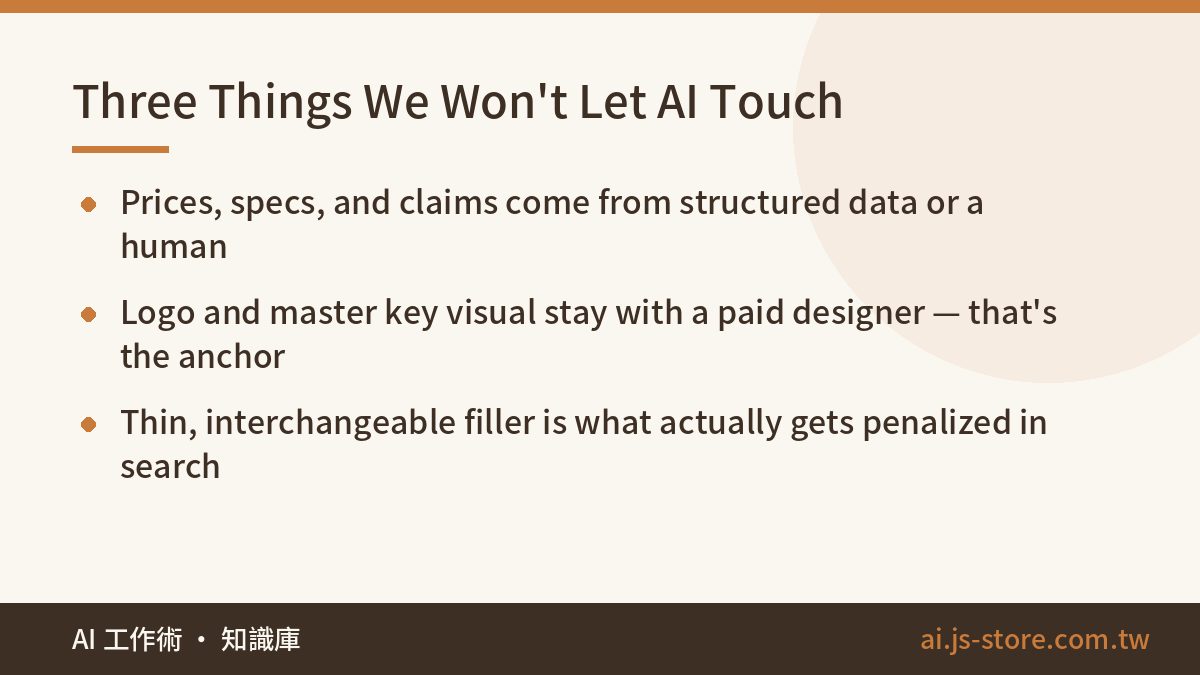
Facts that can't be wrong. Prices, ingredients, specs, promotion rules, certification claims. These get injected from structured data or typed by a human — never improvised by a model. An asset can be forgettable and survive. An asset that states a wrong price does not.
Your core identity assets. Logo, master key visual, the signature visual language everything else imitates. Those are the anchor your AI assets are trying to resemble. Outsource the anchor to AI and there's nothing left to anchor to. Pay a designer once, properly, then let the production line reference that work forever.
Undifferentiated filler. Not because search engines reliably detect AI text — mostly they don't — but because what actually gets penalized is thin, interchangeable content, which is exactly what unconstrained mass production produces. We broke down what really triggers it in does Google penalize AI content. Short version: the style constitution isn't only a brand tool, it's an SEO tool, because specificity is what both humans and rankings reward.
FAQ
Q: How much output can a small team realistically handle with this setup?
Far more than people expect, because the human hours shift from producing to deciding. A two-person marketing team running a mature style constitution can comfortably keep several channels fed. The honest limit isn't generation capacity, it's review capacity — assume roughly five to ten minutes of genuine human review per published asset and size your schedule around that number, not around how fast the model can spit things out.
Q: How long does it take before the style constitution actually works?
The first draft takes an afternoon and gets you maybe 60% of the way. The remaining 40% comes from doing the maintenance loop: every time an output feels off, write down why and add the rule. In our experience it takes six to eight weeks of real publishing before the document stops needing weekly edits. Skipping the maintenance is the single most common failure mode.
Q: Can AI keep image style consistent, or do I still need templates?
You still need templates. Image models have improved enormously at quality and barely at consistency — ask for the same visual treatment twenty times and you'll get twenty cousins, not twenty siblings. Let AI generate the underlying imagery and let a fixed template own the frame, the type, and the color. That split gives you variety where variety helps and rigidity where rigidity is the whole point.
Q: What does it cost to run a pipeline like this?
Cheaper than the headcount it replaces, but the number depends entirely on volume and which pieces you generate. Rather than quoting figures that go stale, check the official pricing page for current plans. The larger cost people forget to budget is the human review time at the end of the line — that one is real, recurring, and not optional.
Q: We tried AI content and it flopped. What did we probably do wrong?
Almost always one of two things. Either you gave the model no brand spec and shipped the average of the internet, or you optimized for quantity instead of using the quantity to test. Fix the spec first, then use the extra capacity to run real experiments. Publishing more of the same undifferentiated material faster just gets you to disappointment sooner.