RSA Ad Copy: Character Limits, 15 Headlines & Examples
Published 2026-09-28 · Updated 2026-10-13 · 7 min read · ShooWork (FREECO CO., LTD.)
Responsive search ads give you 15 headlines and 4 descriptions. The real character limits, how to write for message diversity, and when pinning is worth it.
A responsive search ad (RSA) is the default format for Google Search ads. You hand Google up to 15 headlines and 4 descriptions, and it assembles a different combination for every auction, showing up to 3 headlines and 2 descriptions at a time. You are not writing one ad anymore. You are writing a kit of interchangeable parts and letting the system test them against each other.
Two things trip up almost everyone on their first set. The first is the character limits: 30 characters per headline, 90 per description, counted including every space and comma, with no auto-shrink and no warning after the fact. The second is the number 15. It is not an invitation to write the same sentence fifteen ways. It is an invitation to cover several different reasons a person might click.
We run our own ads tooling and have written or audited hundreds of RSA sets, for our own campaigns and for e-commerce accounts. What follows is the practical version: how the limits actually behave, how to structure 15 headlines so the testing means something, when pinning is a fair trade, the rejection reasons we hit most often, and a good-versus-bad table you can copy into your next ad group.
What an RSA really is: a combination game
The old expanded text ad, where you wrote two headlines and one description and that was the ad, is gone. In an RSA the minimum is 3 headlines and 2 descriptions, but shipping the minimum throws away the entire point of the format. Google mixes and matches across everything you give it, learns which combinations earn clicks for which queries, and leans on the winners.
Think of it as supplying raw material rather than finished copy. Every headline has to make sense in position 1, position 2 or position 3, next to any other headline you wrote. That constraint is real and it changes how you write: no headline can depend on the one before it, no headline can be half a sentence, and every headline has to survive being the only one a person reads. On mobile, the third headline and second description frequently get cut. Put the thing that matters in the first two.
Character limits: 30 and 90, counted the hard way
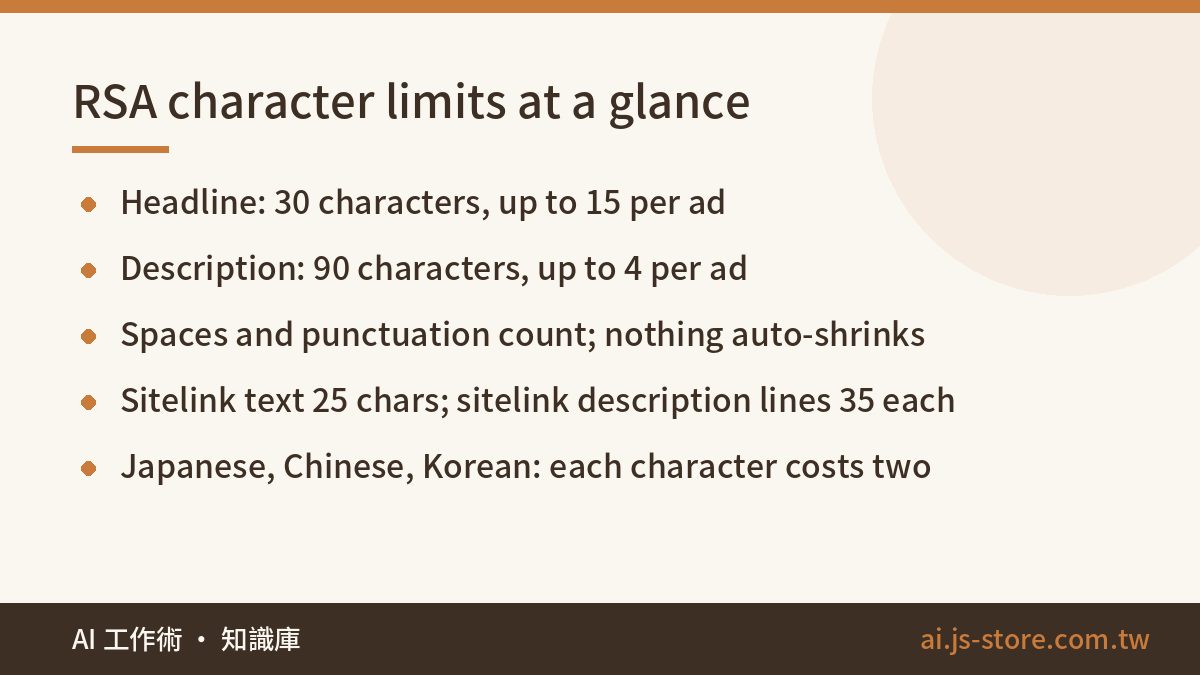
The limits are not suggestions and the interface will simply refuse the text. Every space, comma, ampersand and dash counts as one character. Nothing shrinks to fit. Here is the whole set you need for a complete search ad, not just the ad text:
| Field | Limit | Count | Notes |
|---|---|---|---|
| Headline | 30 characters | Up to 15 | Up to 3 shown at once |
| Description | 90 characters | Up to 4 | Up to 2 shown at once |
| Display path | 15 characters | 2 slots | Cosmetic; does not change the real URL |
| Sitelink text | 25 characters | Several per campaign | The clickable extra links below the ad |
| Sitelink description | 35 characters | 2 lines | Often used for prices, often forgotten later |
| Callout | 25 characters | Several | Short non-clickable selling points |
Three practical notes. First, 30 characters is roughly four to five English words, so the vague adjectives go first: premium, quality and solutions are eight to nine characters that say nothing. Second, numbers and short brand names are efficient information per character, which is why "Ships Free Over $49" outperforms "Free Shipping Available" in the same budget of space. Third, if you also run ads in Japanese, Chinese or Korean, every character in those languages costs two, so the same 30-character field holds about 15 characters of text. That single rule causes more confusion in multilingual accounts than anything else in the platform; if you are localising copy, our content pipeline guide covers how to keep those variants in sync.
Headline diversity: six message types, not 15 synonyms
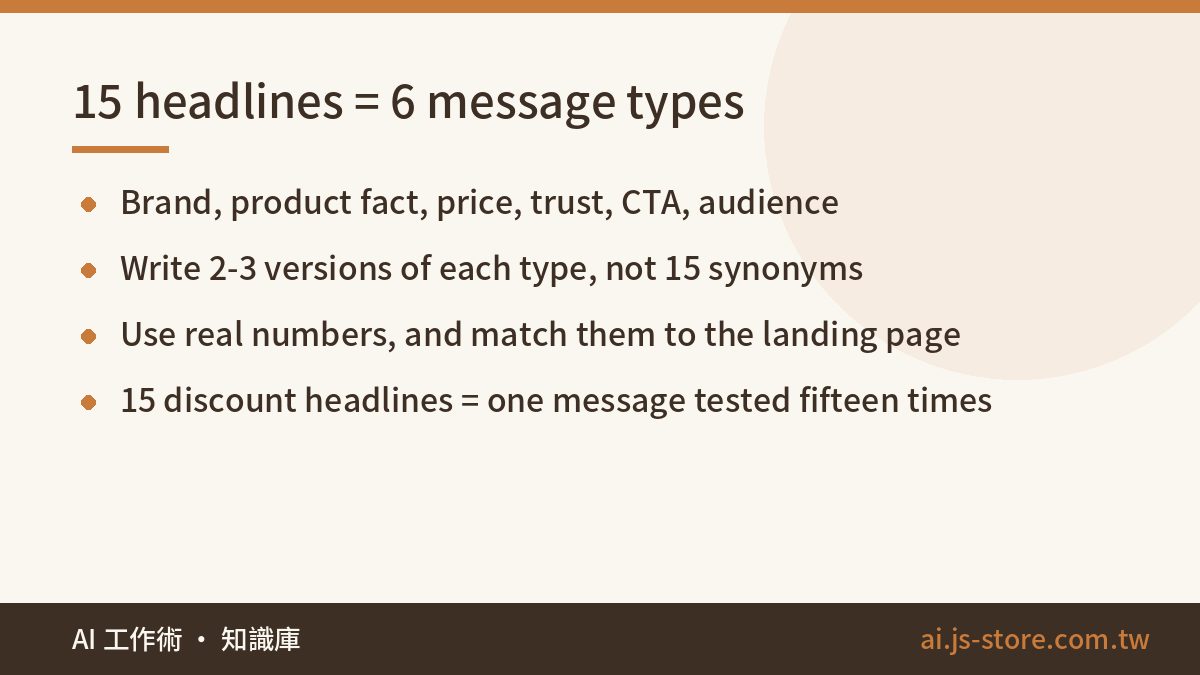
Google's Ad Strength meter has a line item literally called headline diversity, and it is the one people game badly. The right way to use 15 slots is to pick five or six message types and write two or three versions of each:
- Brand and product name — "Ridgeline Ceramic Drippers". This is what someone searching your brand needs to see.
- Core product fact — "Single-Hole Slow Extraction". State what the thing is, not how great it is.
- Price or offer — "Starter Kit From $39". If you have a number, use the number, and make sure it matches the landing page.
- Trust signal — "30-Day Returns, Free". Lowers the risk of a first order from a stranger.
- Call to action — "Order Today, Ships Tomorrow". A reason to click now rather than later.
- Audience targeting — "Built for Pour-Over Beginners". Lets the right person recognise themselves.
The failure mode is 15 headlines that are all offers: "Sale Now On", "Limited Time Deal", "Discount Ends Soon", "Storewide Savings". To the algorithm that is one message repeated fifteen times. Every combination it assembles looks identical, so the test produces no information and you learn nothing after spending the budget.
Pinning: control traded for combinations
Pinning forces a headline to appear only in position 1, 2 or 3. The cost is arithmetic: the harder you pin, the fewer combinations exist to test, and Ad Strength drops accordingly. Cases where it is worth it:
- Brand name pinned to position 1 when you are defending your own brand terms and every impression must lead with the brand.
- Required disclosures pinned to position 3 in regulated categories where a qualifier legally has to appear.
- Multiple headlines pinned to the same position — the compromise worth knowing. Pin three brand-flavoured headlines all to position 1 and the system still rotates among those three, keeping some test surface alive.
Our rule is simple: if you cannot name the reason, do not pin. "I think this line is better" is not a reason, it is a hypothesis, and the whole format exists to test hypotheses. When you do pin, pin a group rather than a single line.
Why ads get disapproved, and bad copy fixed
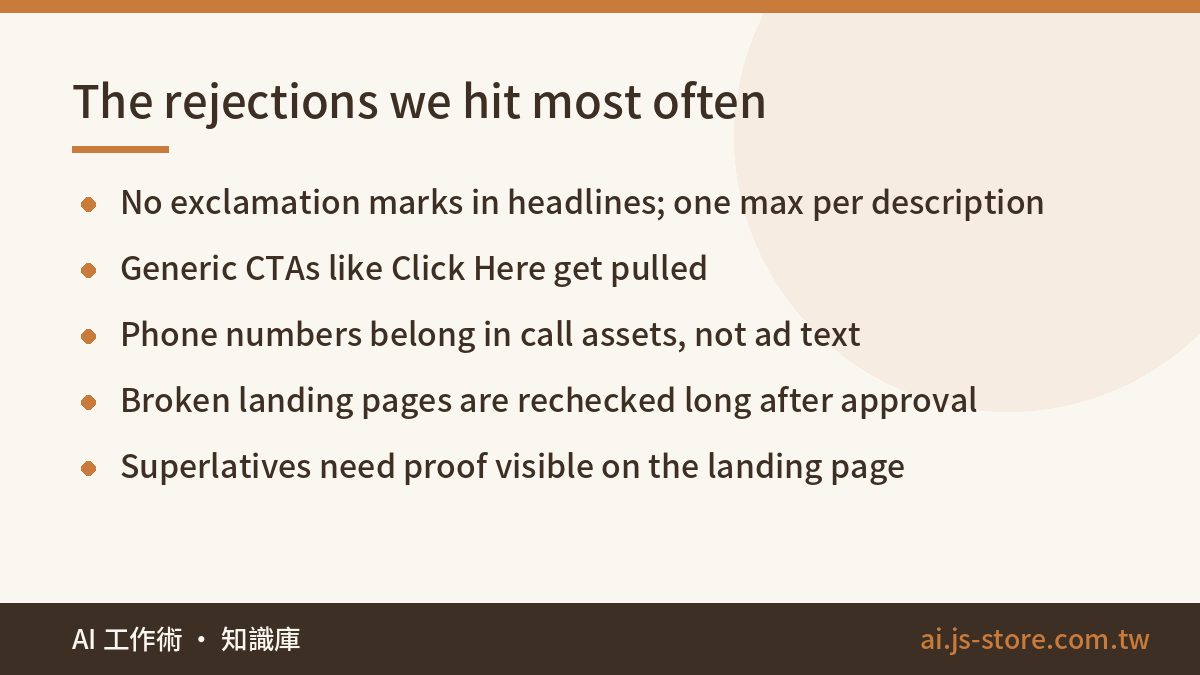
Most rejections come from the editorial and professional standards policy, and the same handful repeat. Exclamation marks are not allowed in headlines at all and you get one, maximum, in a description. Repeated punctuation, decorative symbols, emoji and gratuitous ALL CAPS get pulled. Generic calls to action like "Click Here" or "Press This" are rejected because they say nothing about the product. Phone numbers belong in call assets, never in headline or description text. Trademarks belonging to someone else can get your ad restricted after a complaint. And a broken final URL — a 404, a failed redirect, a mobile page that will not render — is an instant disapproval that keeps being rechecked long after the ad was approved.
| Bad | Problem | Better |
|---|---|---|
| Premium Coffee Gear!! | Exclamation marks plus a word carrying zero information | Ceramic Pour-Over Dripper |
| Lowest Prices Click Here | Unprovable superlative and a banned generic CTA | Starter Kit $39, Ships Free |
| Sale / Big Sale / Deal Ends / Save Now | One message repeated four times, no diversity | Keep one offer line, rewrite the rest as fact, trust, audience |
| Buy A Dripper Get Free Spoon Kit $58 | Crammed with no break, and wrong the moment the promo rotates | Split into two headlines; check the price against the live promo |
That last row deserves emphasis. Prices in ad copy have the shortest shelf life of anything you write. The promotion rotates, the ad does not get updated, and now you are advertising a price that does not exist — which is a consumer-protection problem, not just a conversion problem. Put a recurring calendar reminder against every campaign that mentions a number, and check sitelink description lines too, because that is where old prices hide longest.
Our workflow: AI drafts, a machine counts, a human signs off
We build RSA sets in three stages, and the middle one is non-negotiable. Stage one is an AI draft: feed in the product facts and generate 15 headlines and 4 descriptions that deliberately span all six message types. Language models are genuinely good at this — faster and more systematic than most people at covering angles they would not have thought of.
Stage two is a hard character count in code. Do not trust a model's estimate of "30 characters"; tokenisation means it is guessing, and it guesses wrong often enough to matter. Count every string programmatically, and send anything over the limit straight back for a rewrite. Stage three is human review: prices checked against the live promotion, claims checked against what the landing page can actually prove, tone checked against the brand.
That pipeline is what runs inside ShooWork Ads. You paste a landing page URL, it extracts the page facts and produces a full RSA set plus keyword structure, every headline and description is counted character by character on the backend with over-limit lines automatically rewritten, and the output is an importable CSV. There is an audit mode for campaigns already running that reconciles existing copy against current limits and current prices in one pass. Plans and what is included are on the pricing page, and new accounts get a free run to try the audit first.
The human review stage is not automated and should not be. Every export we produce carries the same line: AI-generated suggestion, verify prices and compliance before publishing. If you have not launched a search campaign yet, start with our beginner's guide to Google Ads and come back to RSA copy once the account structure exists.
FAQ
Q: Do I have to fill all 15 headlines?
No, but write at least 8 to 10 and make sure they span different message types. Too few headlines and the algorithm has nothing to test. Enough headlines that all say the same thing is functionally identical to too few. Ten solid headlines covering brand, product fact, price, trust and CTA beat fifteen padded ones every time.
Q: Do spaces count toward the 30-character limit?
Yes. Spaces, commas, apostrophes, hyphens and ampersands all count as one character each, and nothing is trimmed automatically. That is why numerals and short words earn their place: "Ships in 24 Hrs" fits comfortably, "Dispatched Within Twenty-Four Hours" does not.
Q: Does pinning hurt performance?
Pinning is not penalised directly, but it shrinks the pool of testable combinations, which indirectly limits how good a combination the system can find, and Ad Strength usually drops. Pin when you have a concrete reason — brand defence, a required disclosure — and prefer pinning several headlines to the same position rather than locking one.
Q: Does it matter if Ad Strength is not "Excellent"?
It is a completeness and diversity checklist, not a quality score, and it does not directly set your ad rank. Worth chasing, not worth sacrificing strategy for. A brand-defence ad that scores lower because of deliberate pinning is a perfectly good trade. Treat it as a checklist, not a KPI.
Q: Can I publish AI-written RSA copy as-is?
Not without two human checks. Character counts need to be verified in code, because models estimate length rather than count it. Facts — prices, offers, guarantees, any superlative — need line-by-line verification against the landing page. We hold our own product to exactly that standard: AI drafts, machine counts, a person decides.