Ads Agency vs In-House Hire vs AI: The Real One-Year Cost
Published 2026-10-09 · Updated 2026-10-13 · 8 min read · ShooWork (FREECO CO., LTD.)
Agency, in-house hire, or AI tool? Compare the real one-year cost of running Google Ads, what each actually buys you, and which fits your monthly budget.
Here's the short answer. An agency usually charges a monthly retainer or 15–25% of your ad spend, plus a setup fee, and many won't take small accounts. A full-time in-house media buyer costs well above their salary. Add payroll taxes, benefits and bonus, and you should budget about 1.2–1.4x the base salary. That's before recruiting and ramp-up time. An AI ads tool costs a small fraction of either, but it only covers the parts of the job where the rules can be written down.
That last point is the whole article in one line. These aren't three prices for the same service. They're three different products. An agency sells accountability. A hire sells judgment that's focused on your business. A tool sells steady, boring consistency. Work out which one you're actually missing, and the price question mostly answers itself.
A disclosure: we run our own AI tool platform, including an ads automation product, so we have skin in this game. I'll point out where that bias could creep in. But I'd rather you buy the right thing. People who buy the wrong thing cancel, and then they tell their friends.
Hiring an Agency: You're Paying for Someone to Own the Problem
Agencies price in two ways. Flat retainers go up with account size. Small accounts pay a modest monthly fee, mid-size accounts pay more, and large accounts with many campaigns can pay serious money every month. Percentage-of-spend deals usually land between 15% and 25% of what you put into the ad platform. Most agencies also charge a one-time setup or audit fee. Exact numbers vary a lot by market, so get at least three quotes. We cover fee models and hidden charges in our guide to Google Ads agency costs.
What you get is concrete: part of an experienced team's time, strategy across channels, help with creative and landing pages, someone to meet with, and most importantly, a person whose job is to handle exceptions when something goes wrong. No AI tool does that today.
Some costs don't show up on the invoice:
- Minimum budgets. Many agencies won't take accounts below a certain monthly spend. If you're small, they may not want you as a client.
- Lock-in. First contracts often run three to six months.
- Slow visibility. Reports usually come weekly or monthly, so what you know about your account is often a week or a month old.
That last one matters more than people expect. A monthly report is great for strategy and useless for catching a broken landing page on a Tuesday afternoon.
Hiring In-House: The Salary Is Only the Down Payment
Look up job listings for a PPC specialist or paid media buyer in your market. The salary you see there is not what the hire costs you. What it costs you is the fully loaded number:
- Base salary
- Employer payroll taxes, required insurance and retirement contributions
- Benefits and any yearly bonus, spread over twelve months
- Equipment, software seats and training
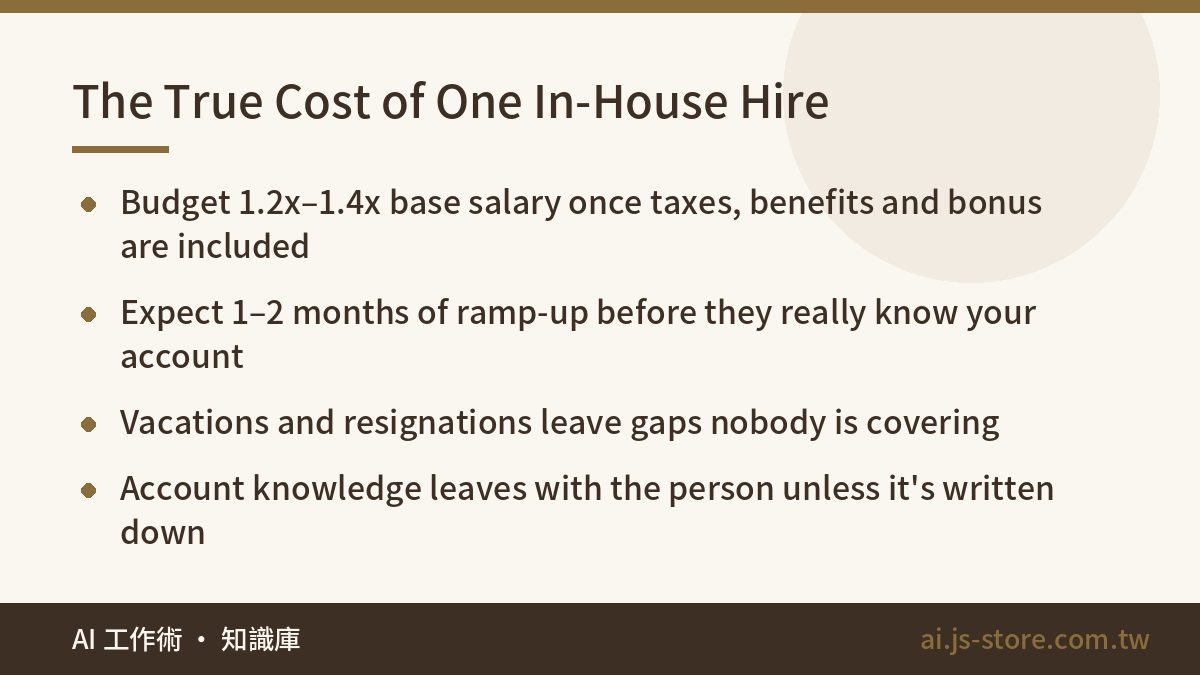
A reasonable rule of thumb is 1.2x to 1.4x base salary. In our home market, required contributions alone add close to a fifth on top of salary. Once you spread the usual year-end bonus across the year, the real monthly cost to the employer is about 25% above the advertised pay.
Then there are costs that never show up on a payroll sheet:
- Recruiting time. Writing the listing, screening and interviewing take weeks of a founder's or manager's attention.
- Ramp-up. Even a good media buyer needs one to two months to really learn an account they haven't worked on before.
- Gaps. Vacations, sick days, and the months between someone quitting and their replacement getting up to speed.
- Knowledge leaves with the person. Why a keyword was blocked, why the last promotion lost money, which match types burned budget: all of that lives in one person's head, not in a document.
The upside is just as real. A hire works only for you, learns your business deeply, makes calls on the spot, and can cover work beyond ads, like social media, email or your store backend. Once your monthly ad spend gets large, a person's cost is a small percentage of the money they manage. At that point, hiring often beats an agency on cost alone.
Handing It to AI: Cheap, Tireless, and Strictly Rule-Bound
This is where our bias lives, because we build ShooWork Ads. So here's an honest account of what AI can and can't do.
Today, AI is reliable for work that happens every day, follows written rules, and causes clear damage when it's done wrong:
- Adding search terms that spent money for 7 days with zero conversions as negative keywords. It needs a daily cap and a whitelist of brand terms, or it will block terms it shouldn't.
- Pausing campaigns once daily spend hits the limit you set, then turning them back on the next day.
- Checking every day that landing pages load, prices match, and finished promotions aren't still running, and alerting you when something's wrong.
- Grouping keywords by purchase intent, writing headlines and descriptions that fit the character limits, and producing files you can import directly.
What it can't do is just as clear: negotiate partnerships, shoot creative, set brand strategy, decide whether to end a promotion early, or handle a situation it has never seen. Leave those to people. If someone sells you an AI that will "replace your agency entirely," ask them who you call when it breaks.
One experience of our own changed how we think about this. The most valuable thing to automate isn't optimization. It's reconciliation, meaning checking that your ads match the facts on your site. On our own brand site, two ads kept the price from an earlier promotion. They ran for a day and a half before anyone noticed. The wasted spend was small. The problem wasn't: our ads showed one price while the page charged another. The ad platform doesn't check for this. An agency's monthly report wouldn't catch it either, because it isn't a performance problem. It's a problem of facts being wrong. A simple daily check would have caught it on day one.
One more warning: automation fails quietly. A rule that has stopped running looks exactly like a rule that's working. Whatever tool you use, make sure it logs every action and tells you when it didn't run. Our automation silent failure checklist covers what to look for.
How to Choose: Let Your Monthly Ad Budget Decide
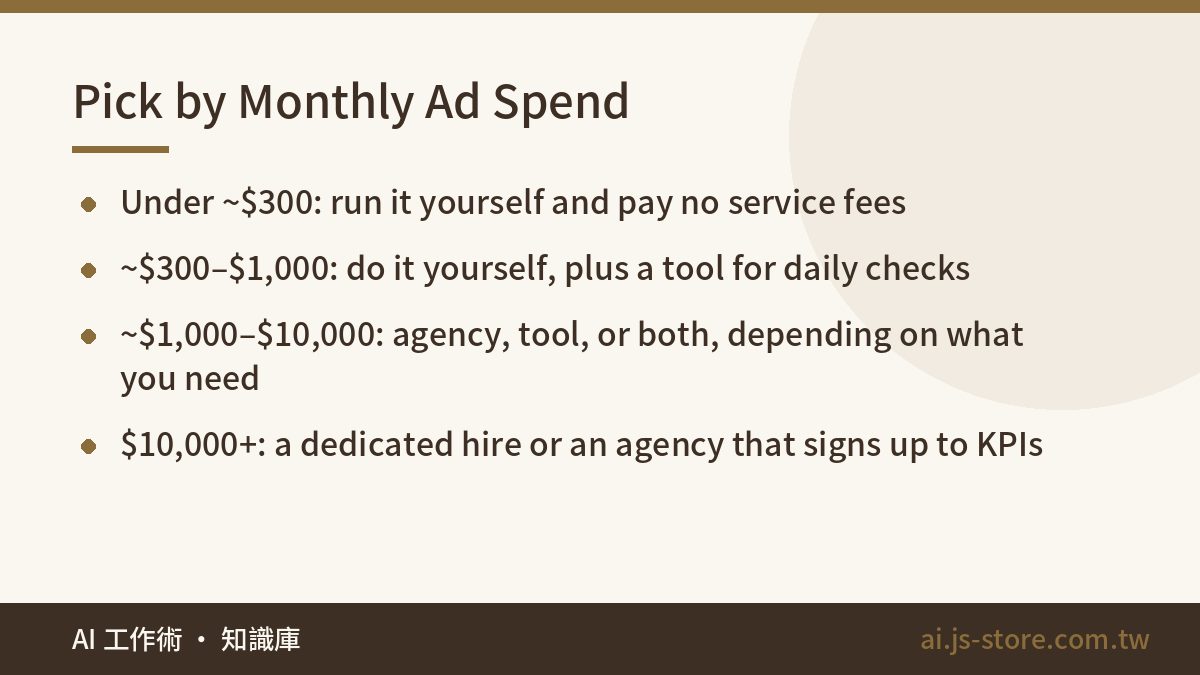
Monthly ad spend is the clearest way to decide. It sets how much a mistake costs you and how much of your results a service fee eats. Here are rough tiers in US dollars; adjust them for your market:
- Under about $300 a month: Run the ads yourself. Don't pay any service fee, because it would eat a large share of your spend. Focus on the basics.
- About $300–$1,000 a month: Most agencies won't take you, and the ones that do can't give you much attention. Run the ads yourself and use a tool to automate the daily checks. This gives you the most for your money.
- About $1,000–$3,000 a month: Either an agency or a tool makes sense. If you want meetings and strategy, hire an agency. If you know what to do but don't have time to watch the account every day, use a tool.
- About $3,000–$10,000 a month: Percentage-based and flat-fee pricing come out about the same at this level, so compare what's included and how open the agency is about its work, not just the price. A tool can work alongside an agency. You don't have to pick one.
- $10,000 or more a month: Seriously consider a dedicated hire, or an agency that will sign up to performance targets (KPIs). At this level, one bad call can cost more than a year of tool fees.
The Combination Most Businesses Actually Need
Most businesses don't need to choose between a person and AI. They need to stop paying people to do work a machine can do.
Here's the setup we see working: people own strategy and exceptions, and tools own the routine daily checks. Your agency or in-house buyer decides what to test, what to say and when to change direction. The tool handles negative keywords, budget limits, and landing page and price checks every day, without forgetting.
If you combine the two, write down who controls what before you start:
- Who can change bids?
- Who can add negative keywords?
- Who is responsible for the daily budget?
- Where is every automated action logged, and can both sides see the log?
Skip this step and you get the worst result: a person and a tool undoing each other's changes, with nobody sure who's responsible. Do it, and you get the agency's judgment for less money, because they no longer bill you for routine work. If you're comparing options, the pricing page shows what our plans include.
FAQ
Q: Does an in-house hire really cost that much more than their salary?
Yes. Payroll taxes, required contributions, benefits and bonuses usually add 20–40% on top of salary. In our home market, a media buyer's fully loaded cost is about a quarter above the advertised salary. That doesn't include recruiting time or the one to two months it takes them to learn your account.
Q: Can AI fully replace an ads agency?
No, and be careful with anyone who says it can. AI can take over the work that happens every day and follows written rules. It can't replace strategy, negotiation, creative production or handling the unexpected. If you need someone who is accountable for results and will sign up to KPIs, you need a person.
Q: My budget is tiny and none of these seem worth it. What should I do?
Run the ads yourself. Get three things right and you'll do better than most small advertisers: group keywords by purchase intent, add negative keywords to block searches from people who won't buy, and make sure the price in each ad matches the landing page. None of these cost anything.
Q: Will using an agency and an AI tool together cause conflicts?
Not if you agree on who does what and who controls what: who can change bids, who can add negative keywords, and who is responsible for the daily budget. The split that usually works is people on strategy and creative, and the tool on daily checks and reconciliation. Every automated action should be logged where both sides can see it.