AI Article Writing Tools: Writer vs Generator vs Pipeline
Published 2026-09-30 · Updated 2026-10-13 · 7 min read · ShooWork (FREECO CO., LTD.)
AI article writing tools split into three categories — writing tools, draft generators and content pipelines. Here's which one you actually need.
Search for "AI article writing tools" and you get forty names in a list, and nearly every comparison post measures the same three things: which one drafts fastest, which one costs least, which one supports your language. Fine. But it skips the only question that decides whether the money was worth spending — would you put that output live on your own site, under your own name, without touching it first?
Here's the short answer before the detail. The tools in those lists fall into three categories that solve three different problems, and buying the wrong category is where almost all the disappointment comes from. A writing tool (ChatGPT, Claude, Gemini) makes you a faster editor. A draft generator (Jasper, Copy.ai and the rest) makes you a faster typist. A content pipeline takes the whole job — topic selection, drafting, images, checks, publishing — and hands back pages you can leave alone. Only the third one removes work from your calendar rather than reshaping it.
We say that because we run our own pipeline daily. ShooWork operates an AI tool platform, a video-editing engine and ads tooling, and every expensive lesson we've learned about AI content happened after generation, not during it: image licences that weren't what the label said, originality you can't prove with a number, pictures that don't match the paragraph above them, and the slow rot of repeating yourself over thirty days of publishing. The comparison table is below, but read the categories first — otherwise the table tells you nothing.
Writing tool, draft generator, content pipeline — pick the category first
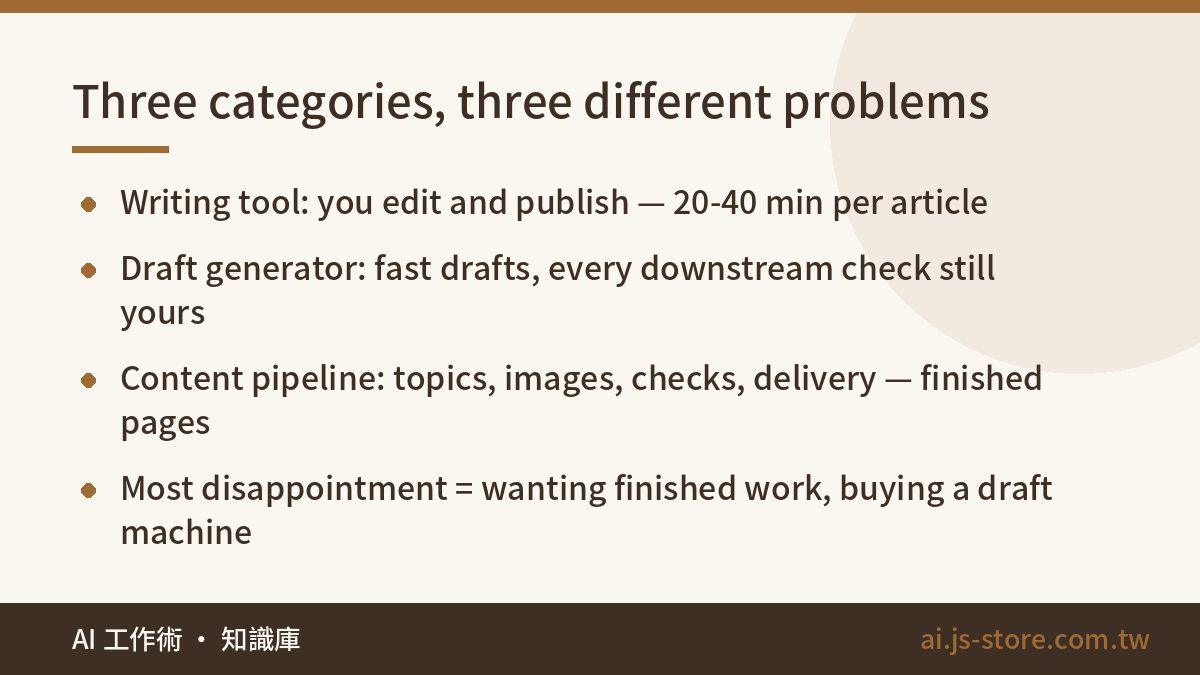
- Writing tools (you drive). ChatGPT, Claude, Gemini. You choose the topic, write the prompt, argue with the output, fact-check it, find an image, check the licence, paste it into your CMS. The quality ceiling here is the highest of the three, because you are the editor and a good editor beats any template. The cost is your time: budget 20 to 40 minutes per publishable article once you're practised, more when the topic is unfamiliar. If you're still deciding which model to sit behind, our notes on choosing an LLM model cover the three checks that actually matter.
- Draft generators (it produces, you inherit). Fill in a topic and a keyword, get a structured draft, batch ten of them if you like. Genuinely fast at the part that was never the bottleneck. Everything downstream is still yours: editing, duplicate checking, image sourcing, licence verification, internal linking, publishing. Nothing on that list got shorter.
- Content pipelines (the segment is outsourced). You define the subject area and the volume. The system picks topics, writes, sources and checks images, runs originality and duplication checks against what it already published for you, and delivers finished pages to your site. What arrives isn't a draft — it's something you could show a customer without opening the editor.
Most of the frustration we hear comes from one specific mismatch: someone wanted "I wake up and today's content is already live" and bought a draft generator. Six weeks later they're a full-time editor cleaning up AI prose every morning, which is strictly worse than where they started, because now they're paying for the privilege.
What's still on your plate when the tool finishes
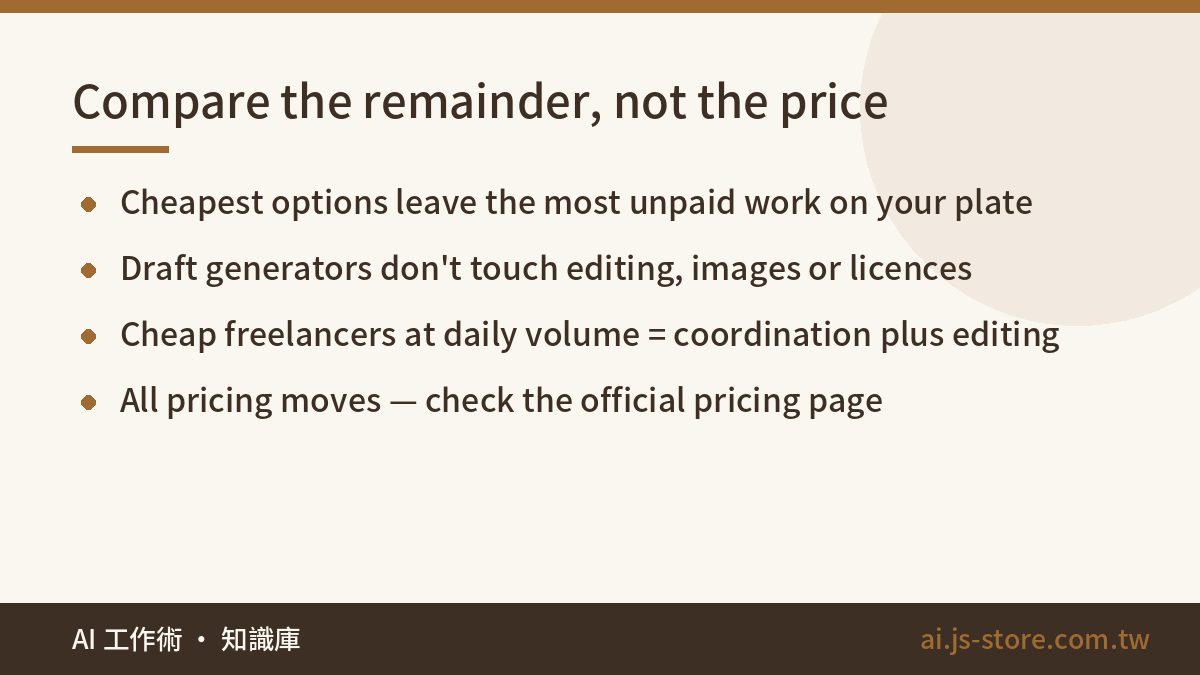
Price is the wrong axis to compare these on, because the cheap options are the ones that hand you the most unpaid work. Compare the remainder instead — what you still have to do after the tool declares itself done. All pricing moves, so check the official pricing page of whatever you're evaluating rather than trusting a number in a blog post.
| Category | Roughly what you pay | What you still have to do | |
|---|---|---|---|
| ChatGPT / Claude / Gemini | Writing tool | Free tier, or one low monthly seat | Everything: topic choice, prompting, fact-checking, editing, finding images, verifying licences, publishing |
| Jasper-style generators | Draft generator | Mid-range monthly subscription per seat | Editing, duplicate and originality checks, images, licences, publishing |
| Freelance writer | People | Per-article rate, varies wildly by niche | Briefing, chasing deadlines, editing — and images are almost always still yours |
| ShooWork Write | Content pipeline | Monthly plan by daily volume — see pricing | Tell us clearly what you sell and who buys it. After that, you read the report |
One honest note on the freelance row: a good writer who knows your industry will out-write any of this, and we'd tell you to hire them if you publish two considered pieces a month. Where people get hurt is hiring a cheap writer for daily volume, because then you've bought the coordination overhead and the editing workload.
The four checks that decide whether you dare publish — and no tool does them for you
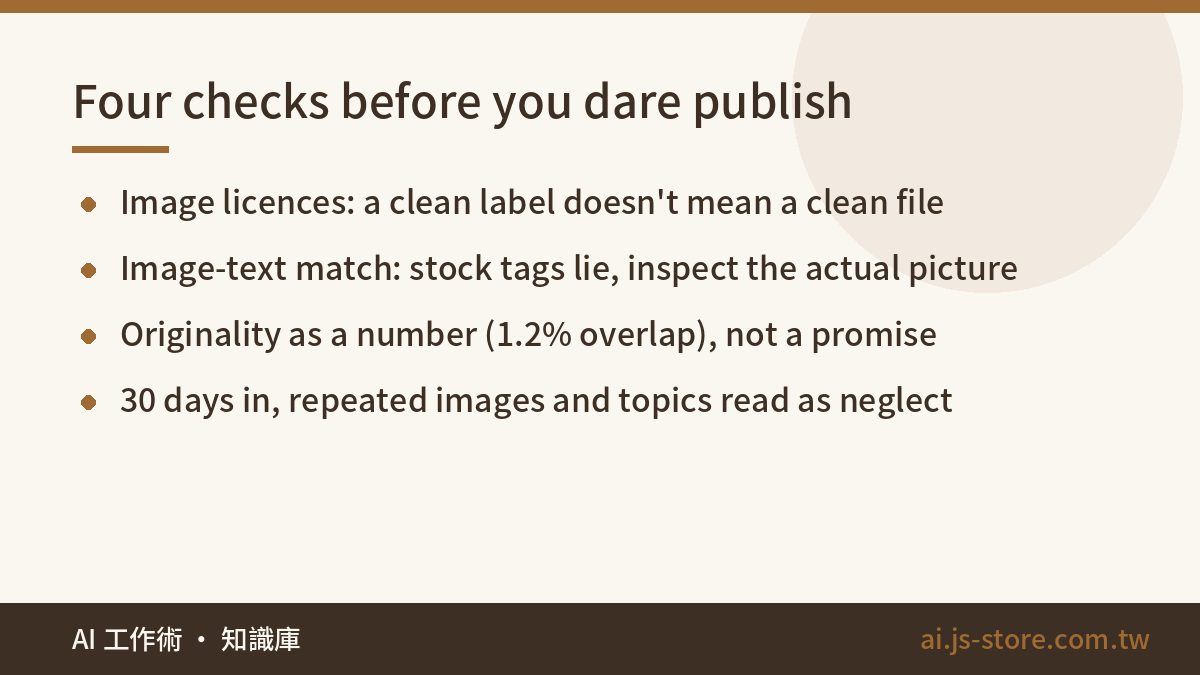
Every one of these cost us something real before we automated it.
- Image licensing. Free stock libraries are full of commercial photography that someone re-uploaded. The licence field says CC; the pixels have a watermark baked into the corner. A clean licence label does not mean a clean image — you have to inspect the file itself, not the metadata around it.
- Image-text agreement. Stock tags lie constantly. An image tagged with one city is a skyline from a different continent; a photo tagged "team meeting" is four people in a coffee shop. If you pick images by matching text to tags, you will publish something embarrassing. The check has to actually look at the picture and compare it to the paragraph.
- Originality expressed as a number. "Guaranteed original" is a marketing sentence. "This article overlaps its sources by 1.2%" is a figure you can challenge. For search engines and for readers, only the second one counts, and only the second one tells you when something has drifted.
- Repetition across time. This is the one nobody plans for. Run daily for thirty days and you'll find the same hero image twice, two articles arguing the same point from the same angle, three intros with an identical opening line. Readers read that as "nobody is looking after this site," and they're right.
Because of that fourth point, we designed ShooWork Write to deliver content plus a receipt: an originality percentage per article, and per image the licence and the creator, itemised. Not so you'll trust us — so you can verify us on a Tuesday afternoon without asking anyone. If you want the longer version of how that pipeline is wired together and what broke while we built it, we wrote it up in how one person ships a team's worth of posts.
When you don't need a content pipeline
Three situations where we'd tell you to keep your money:
- You publish once or twice a week and you like writing. Use Claude or ChatGPT as a writing tool, build two or three prompts you trust, and pocket the difference. A pipeline solves a volume problem you don't have.
- Your value is first-hand reporting or a strong personal position. Interviews, original research, opinion that only works because it's yours — a pipeline can't produce that, and any vendor claiming otherwise is selling you a disappointment with a delay on it.
- You want to flood a site with pages to move rankings. We turn that work down. Search engines have gotten steadily harsher on scaled thin content every year, and the downside isn't "it doesn't work" — it's that you gamble the whole domain on it.
The flip side: if your site genuinely needs fresh material every day — news, industry movement, local information, product-adjacent explainers — and you're currently losing two to four hours daily to finding topics, drafting and hunting for images, that's exactly the gap a pipeline fills. Before you commit, it's worth putting a number on those hours; our guide to calculating AI ROI shows how to turn saved hours into a figure you can defend to whoever signs the invoice.
How to decide this in one afternoon
Don't run a six-tool bake-off. Do this instead.
Pick one real article you actually need next week. Write it with a free writing tool and time yourself honestly, from blank page to published, images and licence checks included. That number is your baseline, and it's usually two to three times what people guess.
Now multiply by your target publishing frequency. If the answer is under four hours a month, stop shopping — you have a writing tool problem, and it's already solved. If the answer is over twenty hours a month, a draft generator won't save you, because the hours you counted were mostly editing, checking and image work, and that's the part it doesn't touch.
If you land in pipeline territory, the only evaluation that means anything is a sample built on your own subject matter, delivered with the checks attached. Ask any vendor for one day's worth of real output plus the originality number and the image licences. If they can't produce the receipt, they aren't running the checks — they're hoping. You can start a sample request from our free tools page; we'll run a day of output on your topics and let you decide afterwards.
FAQ
Q: Can AI-written articles rank in search?
Yes — search engines target thin, duplicative, low-value content, not the fact that software was involved. What gets punished is publishing twenty near-identical pages that answer nothing. The practical test is the same as it's always been: does this page answer the question better than what's already ranking? If you can't say yes, no tool will rescue it.
Q: Are free AI article writing tools good enough?
For a couple of articles a week, genuinely yes. The free tiers of the major models write perfectly publishable prose when you edit them. What free tools don't give you is the boring downstream work — licence-safe images, an originality number, and protection against repeating yourself across months of output. That's the whole difference you're paying for when you move up a category.
Q: Do I still have to edit output from a content pipeline?
You should always read it, and you'll want to add things only you know — customer names, current promotions, your own opinions. But you shouldn't be rewriting structure, fixing hallucinated claims or swapping out images every morning. If you are, you bought a draft generator with better marketing.
Q: How many articles per day actually makes sense?
Start at one. One solid page a day is 30 a month and about 350 a year, which is more than most sites in most niches ever manage, and it lets you see what's working before you scale the volume. Jumping straight to ten a day mostly buys you ten times the material you haven't read.
Q: What's the single biggest mistake people make here?
Judging tools by generation speed. Generation was never the bottleneck — verification and images were. Time your own full process once, end to end, and you'll pick a completely different tool than the one the comparison tables point you at.