How to Calculate AI ROI: Turn Saved Hours Into Real Money
Published 2026-09-21 · Updated 2026-09-21 · 7 min read · ShooWork (FreeCo Co., Ltd.)
A practical framework for measuring AI ROI: labor hours, error cost, turnaround speed — minus an honest cost list, measured from day one.
Three months after an AI project ships, someone asks the only question that ever really gets asked: so was it worth it? And the answer that comes back is almost always "the team says it helps a lot." That sentence is useless. It can't be compared to anything. Helps how much? More than hiring one more person? More than putting the same money into ads? "Feels helpful" isn't ROI. It's atmosphere.
We run our own AI tool platform — a video-editing engine, an ads tooling stack, a content engine — and every feature we ship has to survive a cost-benefit conversation, because we pay the model bill ourselves. When the math is fuzzy, the leak is real money leaving the account every month. So we built a framework that's blunt enough to use in a meeting: three measurable benefit metrics, minus one honest cost list, measured from day one.
Here's the whole thing in one line before we unpack it: AI ROI = labor hours + error cost + turnaround speed − (build + model bill + maintenance + learning curve). Everything below is about not lying to yourself in any of those terms.
Metric 1: Labor hours — the simplest math, and the one people get wrong
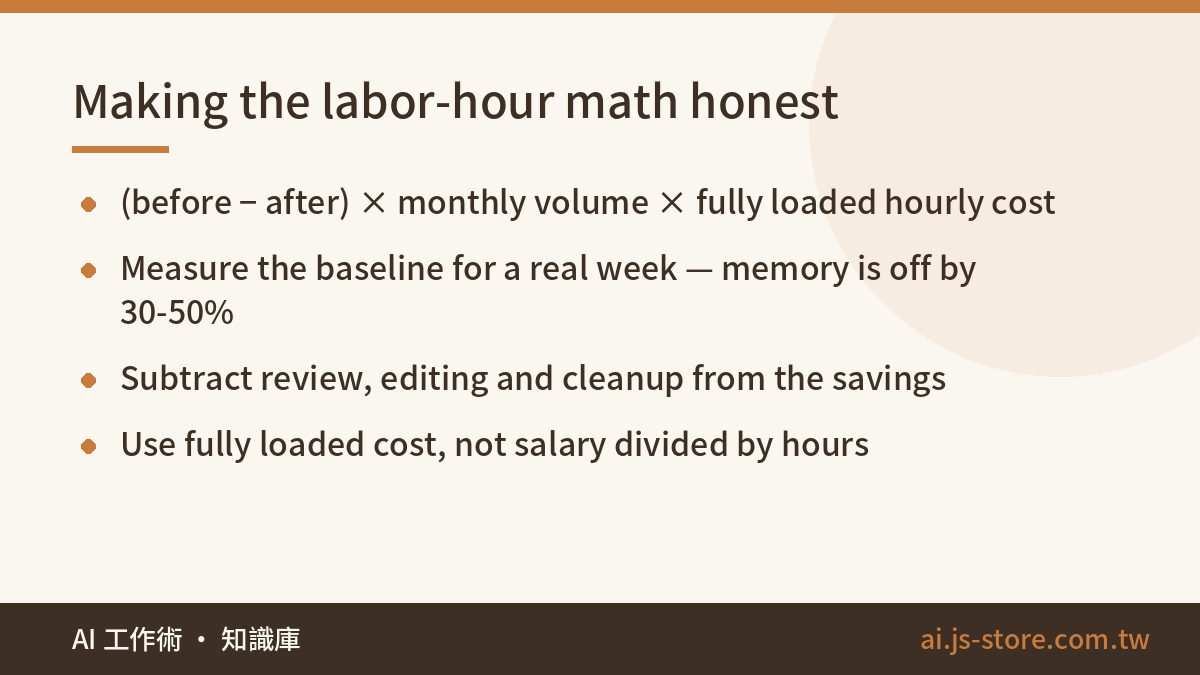
The formula is easy: (minutes per task before − minutes per task after) × tasks per month × fully loaded hourly cost. Three details decide whether that produces a real number or a comfort blanket.
- Measure the "before," don't remember it. Spend one week before the project starts having the people who actually do the work log real elapsed time per task. People are terrible at estimating their own time — off by 30-50% in both directions, in our experience. And once the baseline week is gone, every comparison you make afterward is fiction dressed up as a spreadsheet.
- Subtract the work you created. AI output needs review. It needs editing. Occasionally it's wrong and somebody cleans up after it. All of that comes out of the savings. If drafting dropped from 60 minutes to 12, but review added 10, your net saving is 38 minutes — not 48. Teams that skip this step routinely overstate ROI by a third.
- Use fully loaded cost, not salary ÷ hours. Payroll taxes, benefits, equipment, the management overhead of having one more person to coordinate. That's the number you're actually saving, and it's meaningfully bigger than the one on the offer letter.
Worked example: a task that took 60 minutes now takes 12 minutes of AI drafting plus 10 minutes of human review. Net saving: 38 minutes. At 120 tasks a month, that's 76 hours. At a fully loaded $40/hour, that's about $3,000 a month of labor value — before you've counted anything else. That's a number you can defend line by line, which is the whole point.
Metric 2: Error cost — usually bigger than the hours
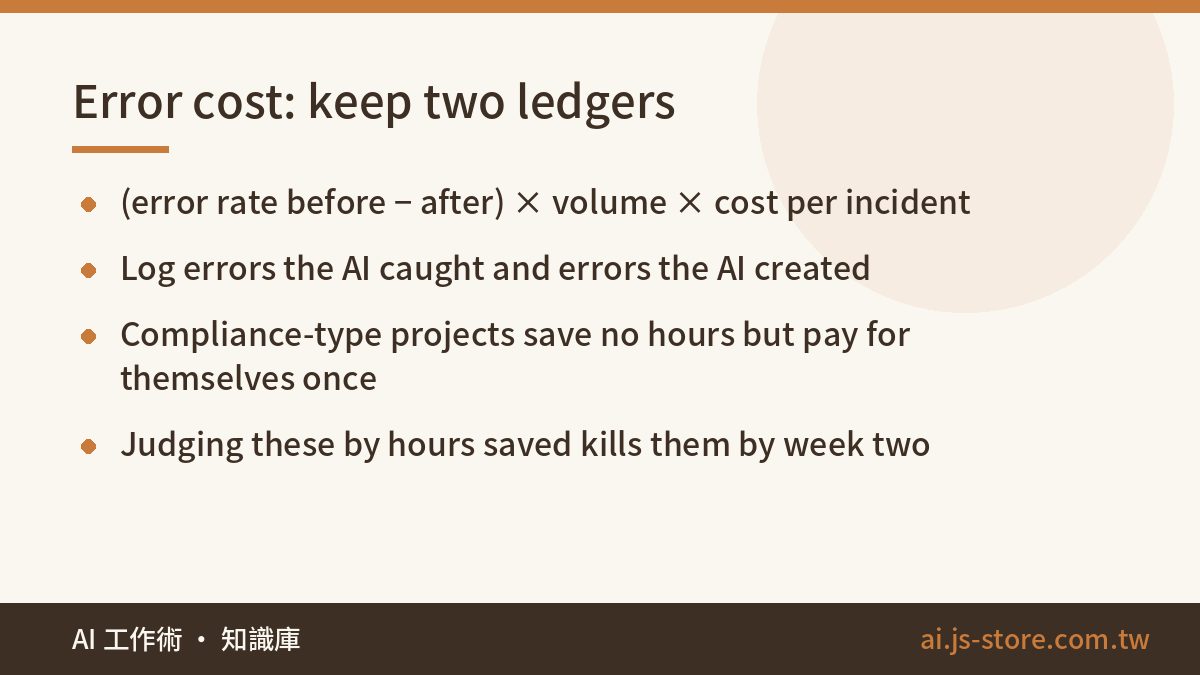
Every mistake has a price tag. Wrong data entered means somebody goes back and fixes it. A missed inquiry is a lost order. Ad copy that crosses a regulatory line is a fine, not an inconvenience. The formula mirrors the first one: (error rate before − error rate after) × volume × cost per incident.
The catch is that the sign isn't automatically positive. AI creates new categories of error — confident, fluent, wrong. So keep two ledgers, honestly: mistakes the AI caught that a human would have made, and mistakes the AI introduced that a human wouldn't have. If you only track the first ledger, you're doing marketing, not measurement.
Our own content compliance scan is the textbook case of an error-rate project. It saves almost no time, because nobody was word-by-word scanning ad copy for compliance risk before — that work simply wasn't happening. Its entire value is that catching one violation pays for a year of it. Judge that project on hours saved and you'd kill it in week two. Judge it on error cost and it's one of the highest-return things we run. The same logic applies across account management: see our daily Google Ads adjustment playbook for how small, boring, repeated checks compound into avoided spend.
Metric 3: Turnaround speed — fast is money by itself
Some value doesn't show up as time saved at all. It shows up as time elapsed. Replying to an inquiry in two minutes versus four hours produces two completely different close rates. Publishing daily instead of weekly puts you on a different traffic compounding curve entirely. A quote delivered same-day versus three days later is often the difference between your order and someone else's.
Written as a formula: reduction in cycle time → change in conversion rate or output volume × margin per unit. This is the hardest of the three to calculate precisely, and you shouldn't pretend otherwise. Take a before period and an after period, compare the ranges, and capture the order of magnitude. "Response time went from ~4 hours to ~5 minutes and close rate moved from roughly 18% to roughly 26%" is a defensible statement. "ROI of 231.7%" is a red flag — nobody has that precision, and anyone claiming it has quietly hidden three assumptions.
The point of calculating ROI isn't to justify yourself upward. It's so the next AI project knows where to invest and where to stop.
Don't fake the denominator: list every cost
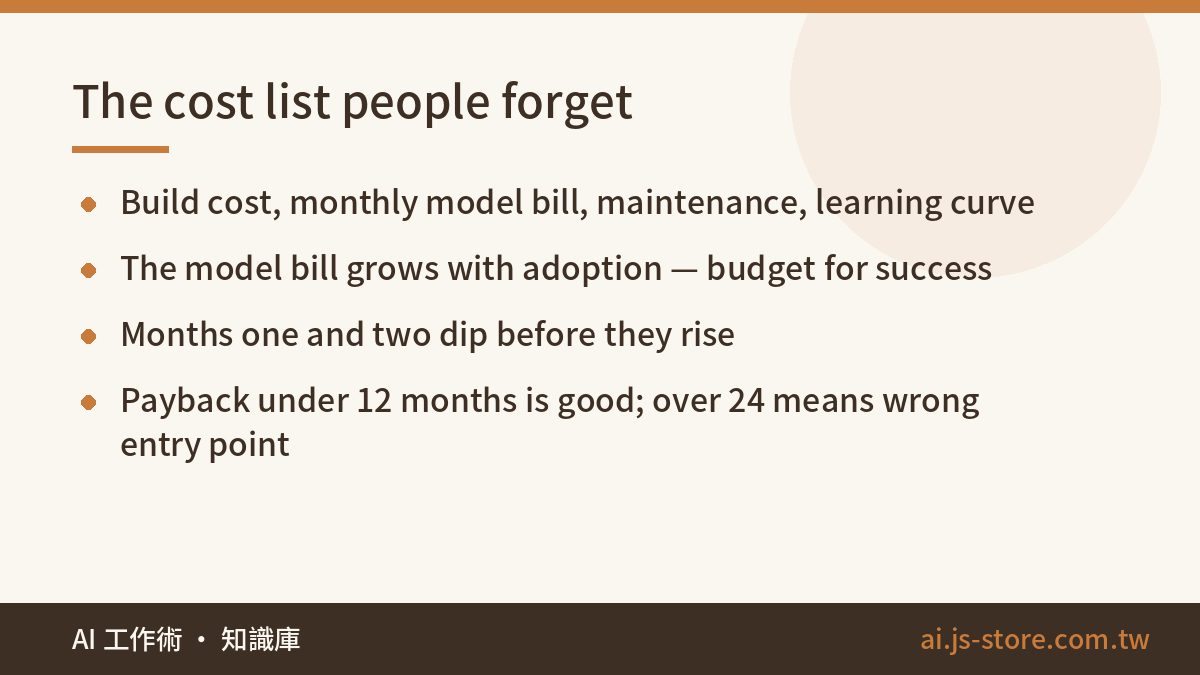
You can compute beautiful benefits and still produce a fake ROI if the cost side is missing line items. The complete list:
- Build cost — one-time, whether that's an agency invoice or your own engineers' time. Internal time is a cost even though no invoice arrives.
- Model and platform bills — monthly, and they grow with volume. This is the line that surprises people six months in, because a successful rollout means more usage means a bigger bill. We wrote about this trap in detail in the one-time build vs. the monthly model bill; if you're comparing tooling costs, our pricing page has current numbers rather than whatever a blog post guessed.
- Maintenance and prompt tuning — the most commonly omitted line, and it's real. Prompts drift, models get updated, edge cases surface. Budget a few hours a month per workflow, minimum.
- Learning and process-switching cost — for the first two months, productivity usually dips before it rises. Pretending month one looks like month six is the single most common way ROI projections miss.
Add it all up, annualize the benefits from the three metrics, and look at the payback period. Under twelve months is worth celebrating. Over twenty-four months usually means you picked the wrong entry point — not that AI doesn't work, but that you aimed it at a workflow that was too small, too rare, or too weird to automate.
Three ways the ROI number quietly lies
Even with the right formulas, three failure modes show up constantly.
Saved hours that never become money. This is the big one. If you save 76 hours a month and nobody's workload, headcount plan, or output changes, you have not saved $3,000 — you've created 76 hours of slack. That's fine, and sometimes it's the goal, but say it out loud. Hours become money only when they're redeployed into revenue work or when they let you not make a hire you'd otherwise have made. Write down which one before you claim the savings.
Double counting across teams. Marketing claims the hours, ops claims the same hours, and the company total exceeds what anyone actually spent on the task. One workflow, one owner, one number.
Attributing everything to the AI. If revenue rose 20% in the same quarter you launched a new channel, hired a salesperson, and shipped an AI workflow, the AI did not cause 20%. Use the narrowest attribution you can defend, and if you can't isolate it, report the operational metric (cycle time, error rate, output volume) instead of the revenue one. Honest small numbers survive scrutiny; inflated big ones get your whole program defunded when someone checks.
When do you start measuring? Day one.
The number one reason AI ROI measurement fails isn't bad math. It's that by the time anyone thinks to measure, the baseline is gone. You cannot reconstruct "how long this used to take" from memory six months later, and every attempt to do so produces a number suspiciously flattering to whoever built the thing.
So build measurement into the project itself. Define the metrics and the collection method during the pilot, before a single prompt is written. Measure the baseline for a real week before go-live. After launch, generate the report automatically every month rather than manually when someone asks — automated reporting costs almost nothing to set up when the data is already flowing through your systems, and a report nobody has to remember to run is a report that still exists in month nine.
The measurement itself is cheap. Timestamps, a task counter, an error log, a few fields in whatever system already handles the work. What's expensive is trying to reconstruct it later, because you simply can't. If you want to see what this looks like when the measuring and the working are the same habit, here's our actual routine, including the parts that didn't pay off.
One last thing worth saying plainly: some projects will come out negative, and finding that out in month three is a win. A framework that only ever produces good news isn't a framework — it's a press release. The teams that get genuinely good at AI are the ones who kill their own projects early and move the budget to the workflow next door.
FAQ
Q: What counts as a good ROI for an AI project?
Payback inside twelve months on fully loaded costs. Six months or less is excellent and usually means you picked a high-volume, high-repetition workflow. Past two years, the honest read is that the entry point was wrong — switch targets rather than defending the original one.
Q: The project already launched and I never captured a baseline. Am I stuck?
Partly. You can often reconstruct rough timing from system timestamps — ticket created to ticket closed, draft started to draft published — which gives you an order of magnitude. The other option is a small control group: have two people do it the old way for a week. Neither is as good as a real baseline, so capture one for your next project.
Q: Should saved hours count as cost savings on the P&L?
Only if they translate into a decision. A hire you didn't make, overtime you stopped paying, or output you increased without adding people — those are real. Slack in the schedule is a genuine benefit for morale and capacity, but it isn't a line item, and calling it one is how finance stops trusting your numbers.
Q: How much does the measuring itself cost?
Very little if you design it in from the start — mostly timestamps and counters in systems you already run, plus an hour or two to set up the monthly report. The expensive version is the retroactive scramble, which costs several days and still produces a worse number.
Q: Which of the three metrics should a small team focus on?
Turnaround speed, usually. Small teams rarely have enough volume for labor-hour savings to be dramatic, and their error costs are often absorbed invisibly. But being the one who replies in minutes instead of days is a competitive edge that shows up directly in close rate — and it's the metric your customers can actually feel.