Is AI Customer Service Worth It? An Honest 3-Check Framework
Published 2026-09-25 · Updated 2026-10-13 · 7 min read · ShooWork (FREECO CO., LTD.)
Most companies asking for an AI support bot shouldn't build one yet. Here are the three checks we run first: volume, repetition, and documentation.
"We want an AI support bot" is in the top three things people ask us to build. Our honest answer, most of the time, is: not yet. Not because AI support doesn't work — it does, we run it — but because most companies asking are nowhere near the point where it pays for itself. Build it anyway and you spend real money to get a bot that answers half-right and irritates the customers who were already willing to talk to you.
We run our own e-commerce operation alongside the ShooWork platform, which means someone on our team reads support messages every single day. We have also evaluated AI support for our own product lines several times, and the answer has not always been yes. So this is not a vendor pitch. It's the internal framework we actually use, with three dimensions you can score yourself on in about twenty minutes.
The short version: volume, repetition, documentation. Pass all three and AI support is one of the highest-ROI projects available to a small team. Miss one and you are paying to automate a mess — and the mess gets faster, not better.
Check one: volume — under 30 messages a day, there is nothing to save
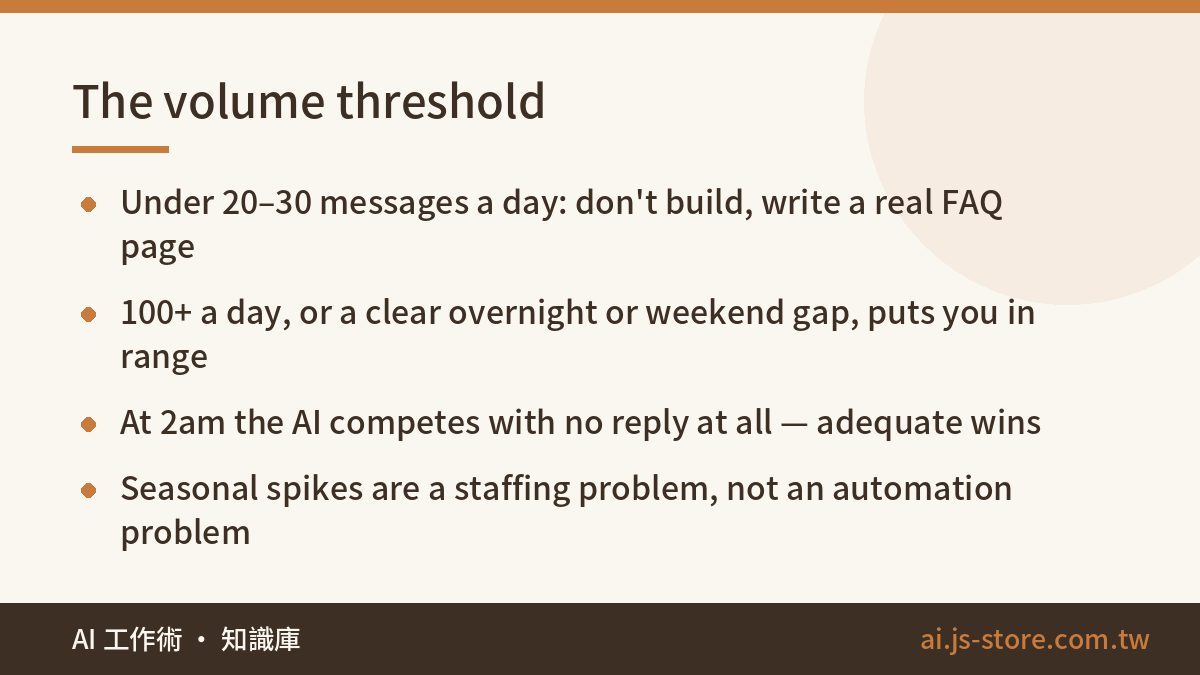
An AI support system trades a fixed build cost for a lower marginal cost per reply. That's the whole economic story. So the first question is always the boring one: how many inbound messages do you get per day?
If it's under twenty or thirty, one person handling support as part of their job absorbs that without breaking a sweat. The labour you'd save doesn't cover the interest on the build cost, let alone the build cost itself. In that situation we tell people to spend the money somewhere with an obvious return, and to spend an afternoon writing a genuinely good FAQ page instead. A well-written FAQ intercepts something like half of repeat questions and costs you nothing per month. Nobody gets promoted for shipping an FAQ page, which is probably why it stays unwritten.
You're in range when you're clearing a hundred messages a day, or when you have an obvious coverage gap — overnight, weekends, or a market eight time zones away from your team. That overnight gap is the single most valuable case for AI support, and the reason is worth understanding: at 2am, the AI is not competing with a good human reply. It's competing with no reply at all. A merely adequate answer at 2am beats a perfect answer at 10am the next morning. During business hours, that same adequate answer is a downgrade your customers will notice.
One trap: make sure the volume is sustained, not a seasonal spike. A three-week peak around a launch or a holiday is a staffing problem, not an automation problem. Solve it with temporary help and saved reply templates. If you want to put an actual number on the trade, we walked through how we calculate this in how to calculate AI ROI.
Check two: repetition — AI is good at the same question, not the hard one
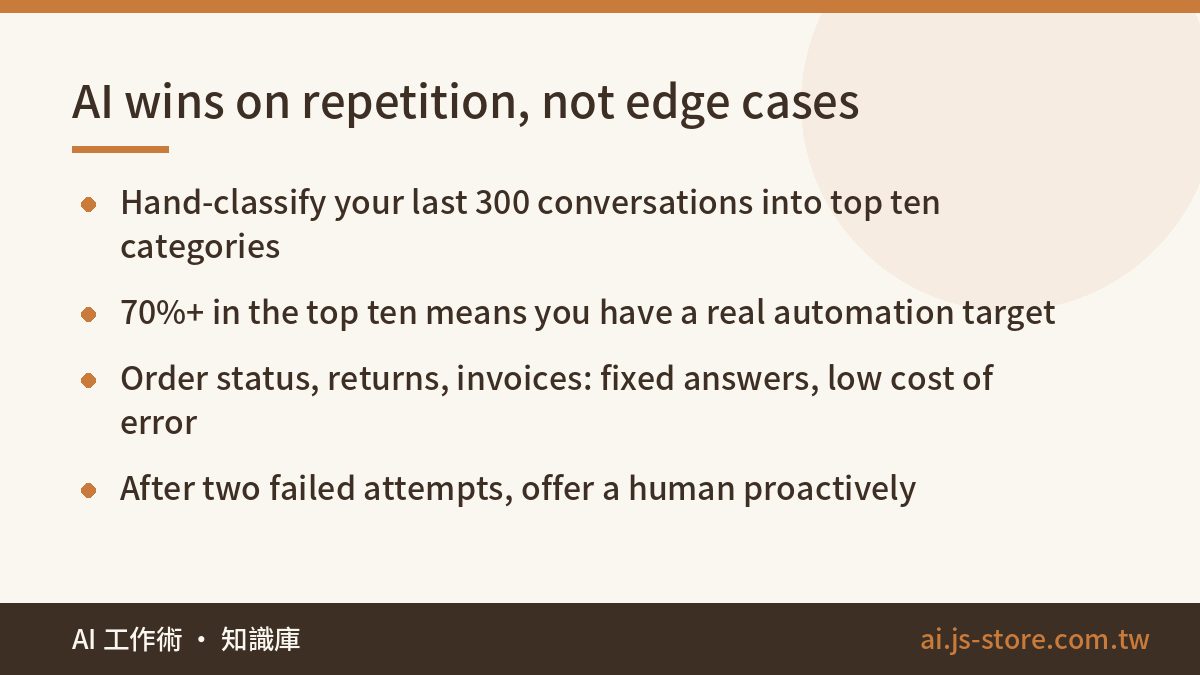
Pull your last 300 support conversations and classify them by hand. Yes, by hand — that is genuinely how we do it, and it takes about two hours. Then look at what share the top ten categories cover.
In our own e-commerce data, questions like "where is my order," "how do I return this," "can you reissue the invoice," and "can I change the delivery address" account for 70–80% of everything. That chunk is exactly where AI is strong: the rules are explicit, the correct answer is fixed, and the cost of a small mistake is low. If your top ten categories cover 70% or more, you have a real automation target.
The remaining 20–30% — complaints, disputed charges, anything that requires checking three internal systems and making a judgement call — is not where you should be pointing an AI. Don't try. Just design the handoff properly. Here's the principle we refuse to compromise on: the path to a human should be cheap and honest. If a customer has asked the same thing twice and the bot is still circling, the third turn should proactively offer a human. Not a hidden menu item. Not "please rephrase your question."
The goal of AI support is not to replace your support team. It's to pull humans out of repetitive work so they can handle the things that actually need a human.
Every cent you save by trapping someone in a bot maze comes back out of brand trust at double the price. People remember being stonewalled far longer than they remember a slow reply.
Check three: your documentation sets the ceiling on answer quality
This is where most projects quietly fail. A language model does not intuit your return policy. It answers from whatever knowledge base you give it. If your actual return rules live in one senior colleague's head, your public policy page is three years out of date, and your internal wiki contradicts both — the bot will start confidently saying wrong things in week one. And customers screenshot wrong things.
The test is simple, and we call it the stranger test. Find someone who knows nothing about your business. Hand them only your existing documentation — no verbal briefing. Ask them ten common customer questions. Whatever they can answer correctly, the AI can answer correctly. Whatever they can't, go fix the documents. That work matters more than any model choice or prompt tuning you will ever do.
Two things we've learned the hard way. First, contradictory documentation is worse than missing documentation: when two pages disagree, the model picks one and states it with total confidence, and you have no idea which. Second, every document that feeds the bot needs a named owner and a last-reviewed date, or it rots inside six months. We wrote up the structure we use in building an AI knowledge base. Worth reading before you build, because the same cleanup also fixes onboarding and internal search — which is how the project earns its keep even if you never ship the bot.
While you're at it, decide where support transcripts go. They contain names, addresses, order histories and occasionally payment complaints. That's a real decision, not a checkbox — see where your company data actually goes.
Budget the monthly bill, not just the build
Two costs get missed in almost every plan we see. The first is the per-conversation model cost. It's small, but it is a real variable expense that scales with traffic, and unlike a one-time build it never ends. Model and tool pricing shifts often enough that quoting figures here would be misleading — check the official pricing page for whatever you're using, including ours, and run your own volume through it.
The second is maintenance. Someone has to read a sample of transcripts every week, find the questions the bot handled badly, and patch the underlying documents. Budget a few hours a week for this, permanently, and put a name on it. A bot without that loop degrades steadily as your products, policies and shipping partners change — and because nothing errors out, nobody notices for months. The failure mode is silence, not alarms.
If all three pass: start with drafts, not autopilot
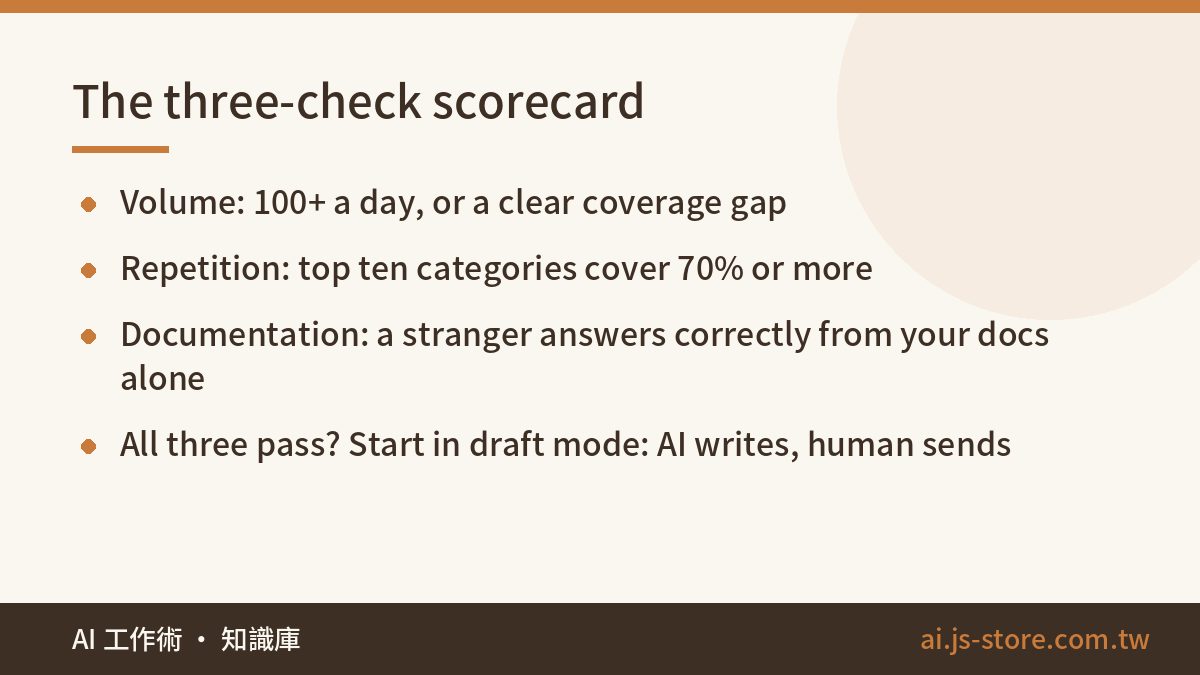
Here's the whole framework in one line. Volume: 100+ messages a day, or a clear coverage gap. Repetition: top ten categories cover 70%+. Documentation: a stranger can answer common questions from your docs alone. Three for three, and AI support is very likely a good investment. Missing one, fix that one first and keep your money.
When you do build, don't go straight to autonomous. Start in draft mode: the AI writes the reply, a human reads it and hits send. This costs you almost nothing in risk and gives you the metric that matters most — the edit rate. If your team is rewriting more than a third of drafts, your knowledge base isn't ready, and you just found that out without a single customer noticing. Once the edit rate drops, auto-send only a whitelist of your safest categories — order status, store hours, return window — and keep everything else in draft. Widen slowly.
Track four numbers from day one: how many conversations resolve without a human, how many escalate, the reopen rate (a "resolved" conversation the customer restarts is a failure, not a success), and first response time in your gap hours. Then agree on a kill condition before launch — ours is a rising reopen rate — so switching off is a planned decision rather than an argument. If you want the general version of deciding what to hand over, which processes to give an AI agent covers the same reasoning applied beyond support.
And if you run the three checks and land on "not yet" — that conclusion just saved you a build, a monthly bill, and a stack of screenshots you'd rather not see.
FAQ
Q: How many support messages a day do I need before AI support pays off?
As a rough floor, around 100 a day of sustained volume, or a clear coverage gap like overnight and weekends where the alternative is no reply at all. Under 20–30 a day, one person absorbs the work and the savings won't cover the build. Seasonal spikes don't count — staff those with temporary help and saved templates instead.
Q: Will an AI support bot make things up about my products?
It will confidently repeat whatever your documentation says, including the outdated and contradictory parts. Most "hallucinations" in support are actually documentation problems. Run the stranger test first: if someone with no context can't answer ten common questions from your docs alone, fix the docs before you build anything.
Q: Should the AI handle complaints and disputes too?
No. Complaints, refunds in dispute, and anything needing a judgement call belong to a human. Point automation at the repetitive 70–80% and invest the saved time in handling the hard cases better. Keep the route to a human cheap and visible — after two failed attempts, offer it proactively.
Q: What's the lowest-risk way to launch?
Draft mode. The AI writes, a human sends. Watch the edit rate for a few weeks, then auto-send only a whitelist of your safest question types and widen from there. You get real data on answer quality before any customer sees an unreviewed reply.
Q: What ongoing work does it need after launch?
A few hours a week, permanently: sample the transcripts, find the bad answers, patch the source documents. Skip that loop and quality decays as your policies and shipping partners change — quietly, because nothing throws an error. Give the job a named owner, not a team.