AI Translation Workflow: Multilingual Content Without the Bill
Published 2026-09-22 · Updated 2026-09-22 · 8 min read · ShooWork (FreeCo Co., Ltd.)
Machine translation alone will embarrass you. Here is the hybrid AI translation workflow we run: glossary, MT draft, LLM self-check, human review.
If you sell across borders, you have probably had this conversation internally. The website and the product catalog need to exist in three languages. An agency quotes you per word. One full site refresh lands somewhere in the five figures, and every product launch after that starts the meter again. So the company translates once, celebrates, and then quietly stops. Two years later the German site still describes a discontinued product line, the Japanese page has no pricing at all, and your newest and best products exist only in your home language.
Large language models changed the math on this, and not by a little. The work that used to be billed per word can now be drafted in bulk for a fraction of the cost, in minutes instead of weeks. We run our own AI tool platform, so we build these pipelines for ourselves before we build them for anyone else — our own learn library, product pages, and ad copy all move between languages through the process described below.
But here is the cold water first: fully automatic machine translation published straight to a live commercial site is still a bad idea. Not because the output is unreadable — it usually reads fine — but because "reads fine" is exactly what makes the mistakes dangerous. The workable approach is a hybrid: machine translation for volume, human review for judgment. This article is the actual shape of that pipeline.
Why LLM translation is a different animal from old machine translation
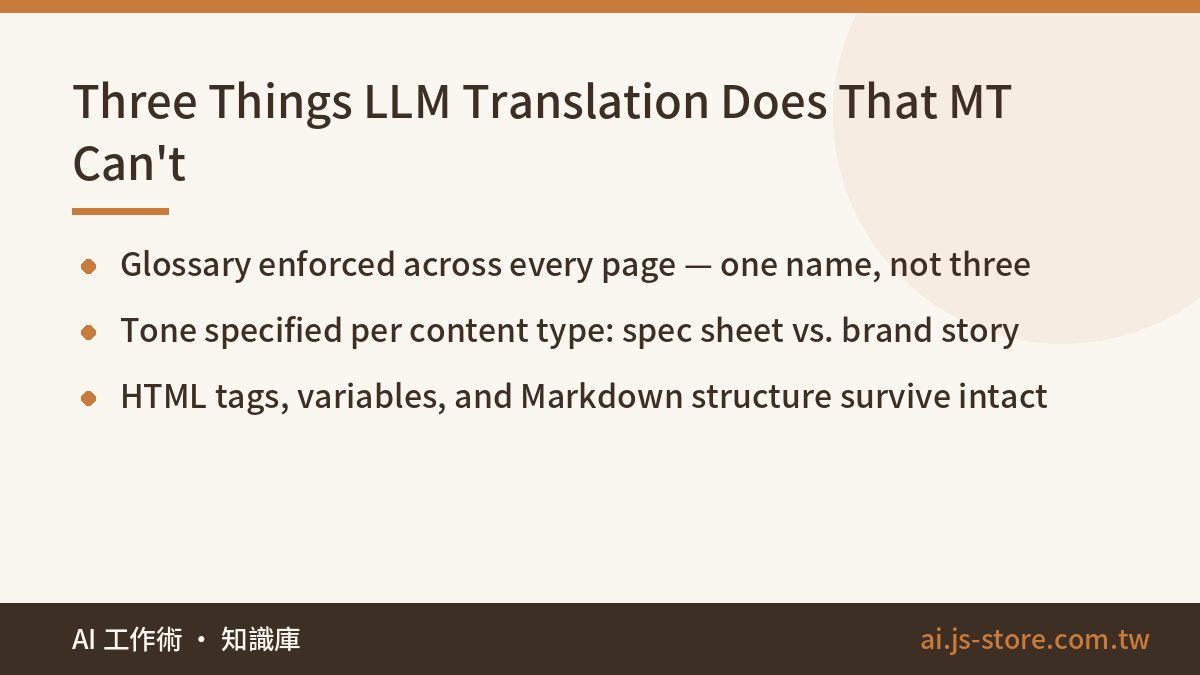
Classic machine translation converted sentence to sentence. It had no memory of the paragraph above and no way to take instruction. An LLM works differently in two ways that matter commercially: it reads context, and it accepts orders. That produces three practical wins.
- A glossary you can actually enforce. Put your brand names, product names, and industry terms into the prompt as a hard mapping and demand compliance. Your flagship product gets one name on every page, not three variations that make your site look like it was built by three different vendors. Traditional MT could not do this at all; translation-memory tools could, but only after somebody paid to build the memory.
- Tone on demand. A B2B spec sheet should be flat and precise. A brand story should have warmth. A checkout error message should be short and calm. The same batch of content can be run with different tone instructions per content type, which is something a single freelance translator working alone genuinely struggles to keep consistent across 400 pages.
- Formatting survives. HTML tags, variable placeholders, Markdown structure, and JSON keys all come back intact if you say so clearly. If you have ever paid an engineer to re-tag a translated file by hand, you know this line item is not small. This is the part that turns localization from an engineering project back into a content project.
The five-step pipeline we actually run
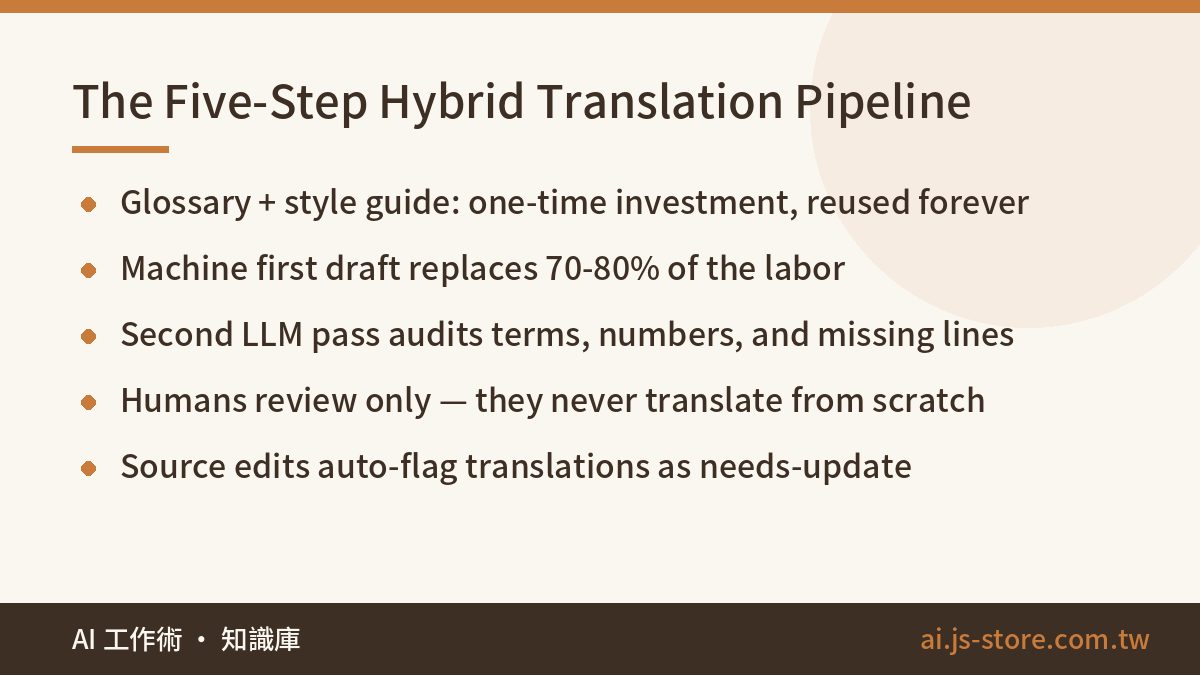
- Build the glossary and style guide first. This is the foundation and it is a one-time investment you reuse forever. Brand terms, do-not-translate terms, unit formats, date formats, currency display, how formal the second person should be in each target language. Write it down. If it only exists in somebody's head, it does not exist.
- Machine first draft. Export content from your CMS, send it to the model with the glossary and style guide attached, and generate drafts in batch. This single step replaces roughly seventy to eighty percent of the labor in a traditional translation job.
- Machine self-review. Run a second pass with a different prompt whose only job is to audit the draft: did any glossary term drift, are all numbers and units identical to the source, is any sentence missing, did any tag break. This pass is cheap and it catches most of the embarrassing low-level errors before a human ever sees them.
- Human review, not human translation. A native or near-native reviewer does exactly two things: fix phrasing that sounds like a machine wrote it, and verify high-risk content — prices, specs, legal statements, claims. Because they are reviewing rather than composing, they move several times faster than a translator working from scratch.
- Write back and version-track. Translations return to the CMS, and every source edit automatically flags its translations as "needs update." Without this step your multilingual site silently rots, which is how you ended up here in the first place.
Notice where the human sits. They were not removed; they were moved to the place where they are worth the most. Machines handle volume, people handle judgment. That is the same design philosophy behind every AI pipeline we build, and you can see it applied to other workloads in scaling marketing assets without diluting your brand.
The reviewer is your quality ceiling — hire accordingly
Teams get this backwards constantly. They spend three weeks tuning prompts and then hand review to whoever on staff happens to speak the language a bit. The prompt tuning has a ceiling; the reviewer does not. A good reviewer who knows your market will catch the sentence that is grammatically perfect and commercially wrong — the product benefit that reads as an unverifiable claim, the tone that sounds condescending in that culture, the call to action nobody in that country would ever click.
Practical advice: give your reviewer a checklist rather than free rein, and cap what they are allowed to rewrite. Otherwise you get a reviewer who quietly retranslates everything from scratch, and you are paying agency rates again with extra steps. Ask them to log every change type they make. After two rounds those logs become new glossary and style-guide rules, the draft quality climbs, and the review time per page drops. That compounding is the whole point of running this as a pipeline instead of as a series of one-off jobs.
Three mistakes that cost more than the translation ever did
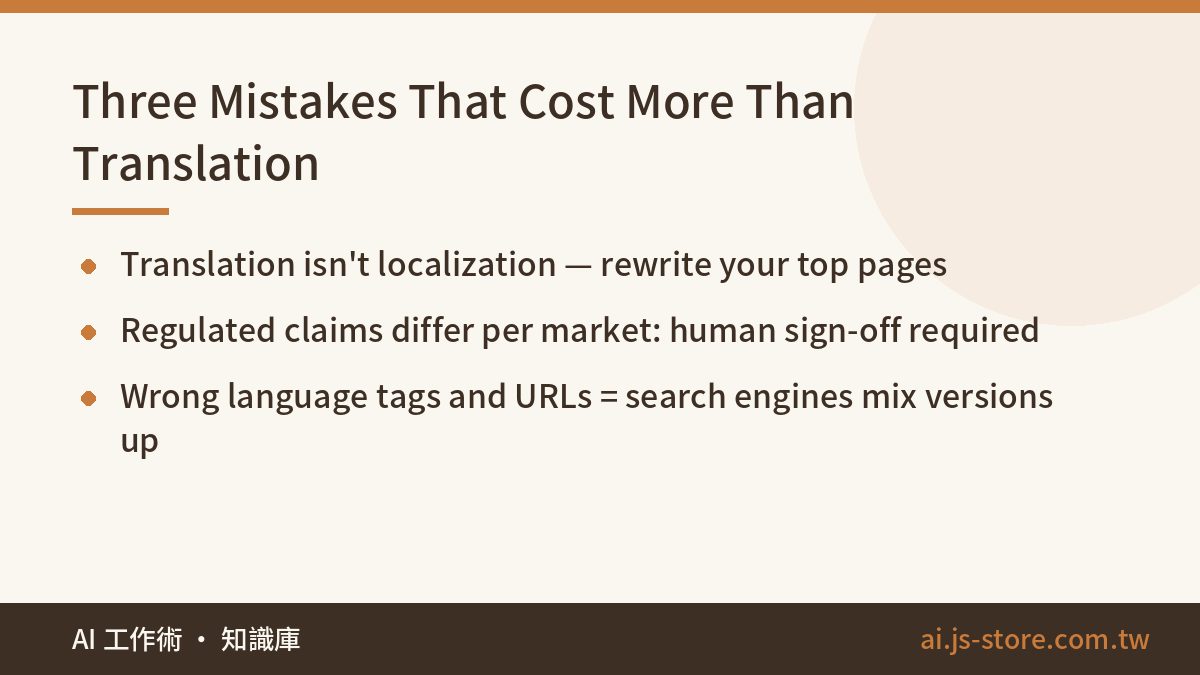
Mistake one: translation is not localization. A free-shipping promotion means something different in every market, because the threshold conventions and the shipping expectations are different. The narrative order of an English product page is not the narrative order of a Japanese one — one leads with the benefit, the other builds to it. For your highest-value pages — homepage, top three product pages, pricing — commission a localized rewrite rather than a translation. Run the long tail through the pipeline. Spending rewrite money on a five-year-old blog post is waste; spending translation money on your homepage is negligence.
Mistake two: regulated claims. Food, supplements, cosmetics, medical devices, and financial products all have different red lines in different markets. A sentence that is fully compliant in your home market can be illegal when accurately translated. The model does not know this and will not warn you. This is non-negotiable human territory, and if you are in a regulated category, get a compliance reviewer rather than a linguistic one. The same instinct applies to what you feed the model in the first place — see the five questions to ask before you roll out AI.
Mistake three: you translated it and search engines never found out. Publishing multilingual content is only half the job. If your language tagging and URL structure are wrong, search engines will mix the versions up, serve the wrong one, or treat them as duplicates. Get the URL structure decided before you translate a single page — retrofitting it later means redirect chains and lost rankings. While you are there, it is worth understanding what actually gets AI content penalized, because thin auto-translated pages published at scale are one of the patterns that draws attention.
The money AI translation saves you is not the translation fee. It is the opportunity cost of "translation is too expensive, so we just won't update it." Content that moves at the speed of your business is the real return.
What it costs and where to start
We will not quote you numbers, because token pricing moves and your content volume is not ours — check the official pricing page for current rates on whichever tools you use. What we will tell you is the shape of the cost: the model draft is the cheap part and gets cheaper every year, the human review is the part that scales with your word count, and the pipeline build is a one-time project cost. If you want to model this honestly before committing, our framework for turning saved hours into real money works here with almost no modification — track hours per thousand words before and after, not the invoice total.
Do not translate the whole site at once. Pick the pages closest to an actual inquiry — product pages, FAQ, contact form, pricing — and run those through the full five steps. Build the glossary while you do it. Measure the review time per page and the number of corrections per thousand words; if both are dropping by round three, your pipeline works and you can widen it to the blog and the catalog. If they are not dropping, your glossary is too thin or your source content is a mess, and translating more of it will not help.
The whole build — glossary, prompts, CMS integration, version tracking — is a small, well-scoped project, not a platform migration. Most teams get the first language live in a couple of weeks and the second one in days, because the second language reuses everything except the reviewer.
FAQ
Q: Can I skip human review if the machine output already looks good?
For internal documentation, support macros, and low-traffic archive content, yes — the risk is low and the volume is high, which is exactly where automation pays. For anything a customer uses to make a buying decision, or anything containing a price, a spec, or a claim, no. The failure mode of AI translation is not garbled text you would spot immediately; it is a fluent, confident sentence that says something slightly wrong. That is much harder to catch and much more expensive when it goes live.
Q: How many languages should I start with?
One. Get the pipeline working end to end in a single target language, including the write-back and the version flagging, before you add a second. The second language costs a fraction of the first because everything except the reviewer is reusable. Teams that launch four languages simultaneously usually end up with four half-finished ones and no working process.
Q: Will AI-translated pages hurt my search rankings?
Machine assistance is not the problem — thin, unreviewed, mass-published pages are. A translated page that genuinely serves a reader in that market is fine. Ten thousand auto-generated pages with no human pass are the pattern that gets flagged. Correct language tagging and a clean URL structure matter more than how the words were produced.
Q: What about our existing translation memory from an agency?
Keep it and use it. Export the term pairs and fold them straight into your glossary — you already paid for that consistency, so do not throw it away. Older full-sentence memory segments are less useful, since the model will usually produce better-flowing text than a segment match from six years ago, but the terminology is gold.
Q: Which content should never go through this pipeline?
Contracts, terms of service, privacy policies, and anything with regulatory exposure. Use AI to produce a working draft so your legal reviewer is not staring at a blank page, but the final text should be signed off by someone qualified in that jurisdiction. The cost of getting those wrong is not a bad customer experience — it is a legal one.