Custom Instructions That Work: 7 Checks to Turn 'Don'ts' Into Actions
Published 2026-10-16 · Updated 2026-10-16 · 8 min read · ShooWork (FREECO CO., LTD.)
Custom instructions that work are actions the AI can do and you can check. A 7-question audit, five rewrites, and a prompt to fix your rules.
The short answer: a rule only works if the AI can do it and you can see that it did. Rules like “keep it short, be warm, sound professional” can only be agreed with. The model reads them and agrees. By the time it hands you the output, it has already decided it followed them. You need to give it a task it can't skip, one that leaves proof behind: “When you finish, list the total word count. If it's over 300, cut it to under 300 before you send it.”
If you're searching for how to write custom instructions, you probably already have plenty of rules. The problem is that the AI keeps drifting back anyway. We've been there. At ShooWork we run our own content pipeline and social accounts. Our rule files for the AI have grown to four documents, about 64,000 characters, with more than a hundred date stamps. Many of those dates mark a day something broke and I went back to patch a rule. Recently I counted. “Don't / never / must not / forbidden” plus the ❌ emoji showed up 93 times. “Check / confirm / verify / sign off” showed up 34 times. I'd written “don't” 2.7 times as often as “check.”
Then I looked at the rules that actually stopped mistakes. Not one of them said “don't do X.” Every one of them said some version of “After you finish, copy Y out and show it to me.” This guide covers why attitude rules fail, a 7-question audit for your own instructions, five rewrites you can paste in today, and a prompt that turns your repeat complaints into rules that stick. You don't need to write any code. Custom instructions are just a text box.
Why Your Rules Don't Stick: Attitude Rules vs. Action Rules
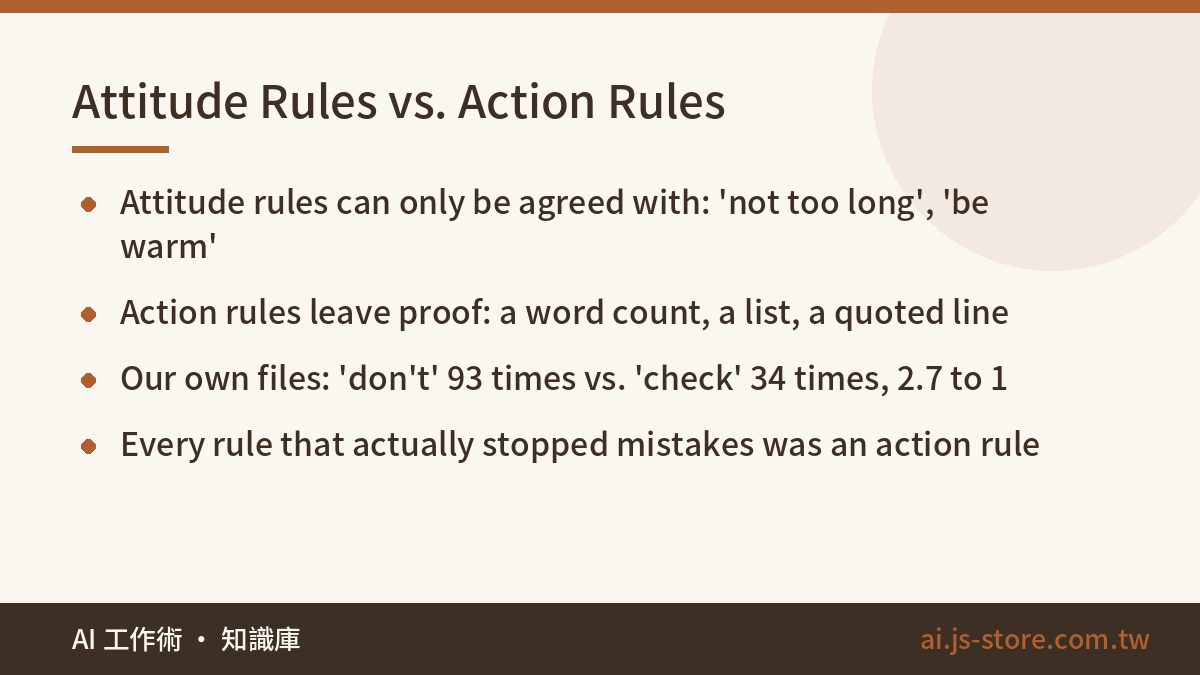
Every rule falls into one of two groups.
- Attitude rules describe a quality or a mood. The AI can agree with them, but there's nothing to actually do. Examples: “Don't be too long.” “Be warm.” “More professional.” “Same format as last time.”
- Action rules name a specific step, and doing it produces something you can see. Examples: “After writing, list the total word count and the count per paragraph.” “Tag each paragraph (from you) or (added by me).”
The difference is how you check them. Take “don't be too long.” The model decides it isn't too long while it's still writing. You'll never agree on that, so you go back and forth. “Give me the word count” is different. The model has to do it, and doing it produces a number like 320. One look tells you whether it kept the rule.
If you've ever built an automation, you know this failure. The job finishes, the status code is fine, the screen looks right, and the thing you needed never happened. Nobody notices. We cover the scheduled-job version in our automation silent failure checklist, and the fix is the same: don't ask “did you do it well?” Ask for proof that only exists if the work got done.
So when you correct the same thing for the third time, don't ask why the AI is so dumb. Ask whether the rule can actually be done, and whether you can see that it was. Mistakes here also add up. Custom instructions apply to every new chat. A badly written rule fails quietly in every conversation, every day.
The 7-Question Audit: Run It on Your Current Instructions
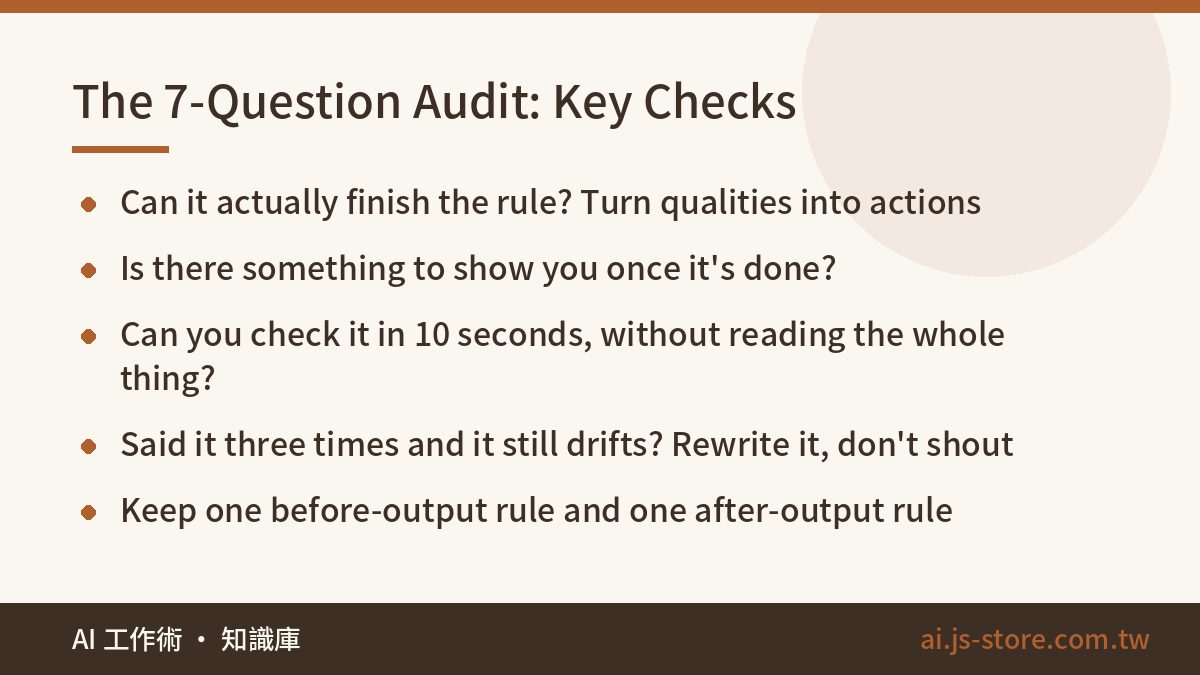
Open your custom instructions, read each rule out loud, and ask these seven questions. Screenshot the table if it helps.
| # | Ask yourself | What failing looks like | Fix |
|---|---|---|---|
| 1 | Can the AI actually complete this rule? | It describes a quality: not too long, warm, professional | Rewrite it as an action |
| 2 | When it's done, is there something to show me? | Done and not done look exactly the same | Ask for a count, a list, or a line quoted back |
| 3 | Can I tell in 10 seconds whether it complied? | You have to read the whole thing | You won't always read it all, so it drifts. Make it checkable at a glance |
| 4 | Is it only adjectives? | Natural, casual, professional, concise, logical | Every adjective needs something countable attached |
| 5 | Does it apply before output or after? | All your rules are on one side | Keep at least one of each |
| 6 | How many times have I said this? | Third time, still drifting | Don't add “ALWAYS” or ⚠️. Rewrite it as an action |
| 7 | Does it conflict with another rule? | “Be brief” next to “give an example for every point” | It will pick one, differently each time. Rank them yourself |
Question 1 matters most. The other six help you confirm you really passed it. People skip question 5 the most. Many custom instructions explain from start to finish how to write, but never say what to hand over afterward. Before-output rules decide how the AI starts. After-output rules are the only place you can catch it.
Five Common Attitude Rules, Rewritten as Actions
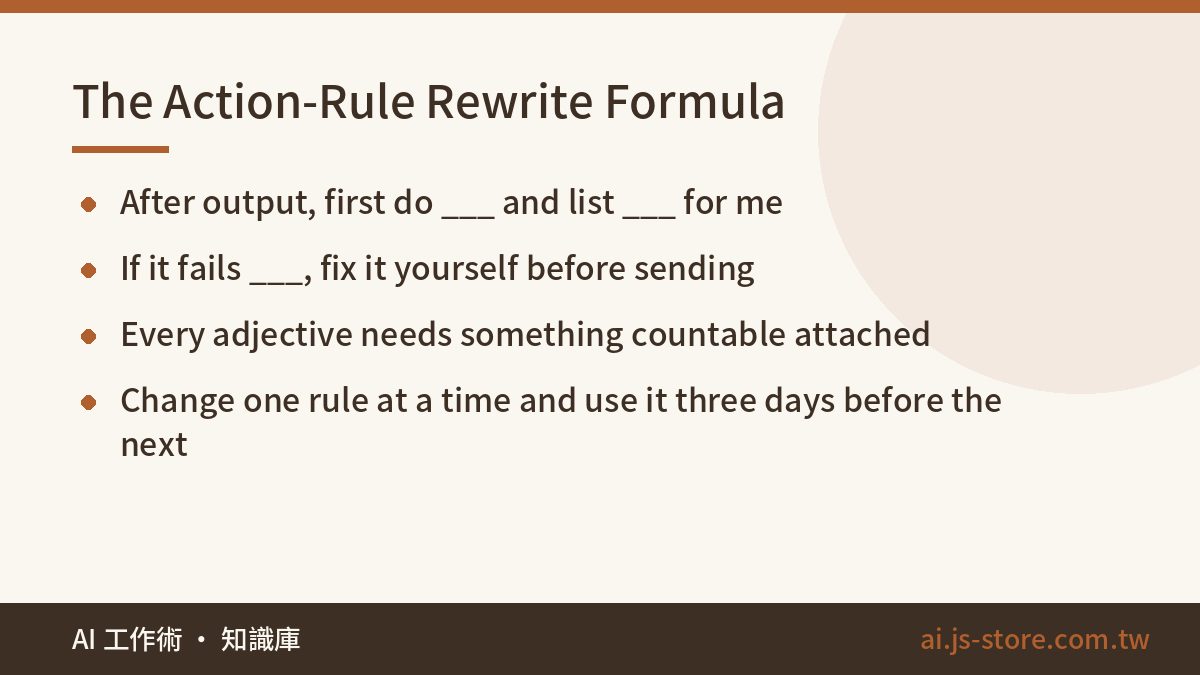
These five came up most often in our own pipeline. You can copy the right-hand column straight into your instructions.
| What you wrote (attitude) | Why it fails | Rewrite (action) |
|---|---|---|
| Don't write too much | It already thinks it didn't | “After writing, list the total word count and per-paragraph counts. If it's over 300, cut to under 300 before sending.” |
| Don't add info I didn't give you | It doesn't notice when it adds things | “Tag each paragraph (from you) or (added by me), and list everything you added separately.” |
| Same format as last time | “Last time” doesn't exist for it | “Before writing, list the fields you'll use. Wait for my OK before continuing.” |
| Highlight the important parts | “Important” is a guess | “Mark the sentences that would make the section unreadable if deleted. Three at most.” |
| Make the steps clearer | “Clearer” has no finish line | “For every step, write two lines: what to do, and what you'll see when it's done. Rewrite any step missing a line.” |
See the pattern? You can check every rule on the right by asking “is it done?” and getting a real answer. The “don't add info” rule is worth fixing first. The AI doesn't notice when it adds things, so telling it to hold back won't work. Have it list what it added. Then you decide what stays.
Tone and voice can be handled the same way. Turn the vibe into features you can count, like a list of banned words or a limit on sentence length. Our guide to fixing AI tone in writing breaks that down.
Turn Your Recurring Mistakes Into Rules (Copy-Paste Prompt)
You don't have to work out the rewrites yourself. Paste this into the AI and swap the two example lines for the correction you make most often.
I want to rewrite a rule that keeps failing into a version an AI can actually execute.

The rule I currently give it:
'Get to the point, don't write too much.'

What actually happens:
I reply 'too long' every time. It takes about 3 rounds to get the length I want.

Do four things, output each separately. No encouragement, no praise:

1. Decide whether this is an attitude rule or an action rule.
   Attitude rule = can be agreed with, not executed.
   Action rule = a specific action that produces something visible.

2. If it's an attitude rule, name the measurable thing I actually care about
   (word count? paragraph count? specific words? order?). No adjectives.

3. Rewrite it as ONE action rule in this format:
   'After output, first do ___, list ___ for me; if it fails ___, fix it before sending.'

4. Give me one before-output version: what to confirm with me before starting.

If my info isn't enough to quantify, say 'I can't measure this; I need to know ___'.
Do not invent a number as the standard.
Keep the last line. Without it, the AI will often make up a “300 words” or “5 key points” standard, and you'll spend weeks arguing with it over a number nobody chose.
Once the new rule is in your custom instructions, add this as a backstop:
At the end of every response, add a [Self-check] section:
list each rule above and mark it 'done' or 'not done'.
For 'done', paste the evidence (a number, a list, a quoted line).
For 'not done', just say 'not done'. No explanation to smooth it over.
When it reports on itself, you find problems much faster than by reading every draft in full. In our experience, the self-check doesn't make the model obey. What it does is show you a miss the moment it happens.
Roll It Out in Three Steps, Plus Five Honest Limits
This takes about ten minutes:
- Copy every rule out of your custom instructions. If you don't have any, write down the three corrections you've repeated most this month. Those are your rules.
- Run each one through the 7-question audit. Expect half or more to be attitude rules on the first pass. Mine were too.
- Fix only the most painful one. Don't rewrite everything at once. Change one rule, use it for three days, and move on to the next if it works. You won't remember a full rewrite, so it might as well not exist.
Read these limits before you start:
- The 64,000 characters, 93, and 34 come from counting my own files. This isn't research. I picked the keywords, and a different set would give a different ratio. The 2.7 doesn't matter. Count your own file. You can do that yourself and don't have to take my word for it.
- “Over a hundred dates” means date stamps in YYYY-MM-DD format. The last recount found 109, and the files keep growing. Some mark incidents and some mark decisions from meetings, and I didn't sort them. Don't read it as “the AI failed 100 times.”
- Action rules won't make the AI follow your rules 100% of the time. It will still slip. You'll just see the slip right away instead of three paragraphs in.
- There's no setup. Custom instructions are a text box. You type the rules in. There's nothing to install or code.
- More rules isn't better. My files grew over months of running a production pipeline. Don't try to write 64,000 characters. The lesson is the opposite: before you add another “don't,” turn the one you already have into an action.
FAQ
Q: What's the difference between custom instructions and the prompt I paste at the start of a chat?
Custom instructions apply to every new conversation automatically. A prompt applies to one task. A bad prompt is obvious and you just redo it. A bad custom instruction fails quietly in every chat. That's why the 7-question audit should go to your custom instructions first.
Q: How many rules should I have?
There's no magic number, but here's a simple test: if you can't remember a rule, it isn't doing anything. Three “here's what to hand me when you're done” rules beat ten “don'ts.” Keep at least one before-output rule and one after-output rule. Add more only when the same problem catches you a third time.
Q: I already wrote “ALWAYS” and “NEVER” and added ⚠️. Why doesn't it work?
Making a rule louder doesn't change what kind of rule it is. “NEVER be too long” and “don't be too long” mean the same thing to the model. If a rule still drifts after three corrections, rewrite it as an action. Shouting won't help.
Q: Once I switch to action rules, can I stop checking?
No. The AI will still slip, and it may even mark something “done” when it isn't. But the self-check gives you something to verify. If it says 280 words, you can confirm that in a second. Action rules help you catch problems early. They don't guarantee correct output.
Q: Can tone and voice go into rules at all?
Yes, but turn them into things you can count: banned words, a maximum number of commas per sentence, sentence patterns to avoid. Voice can be broken into checkable features. Once an adjective comes with a number, the AI can actually follow it.