How to Fix AI Tone in Writing: 7 Tells and a Voice Fingerprint Prompt
Published 2026-10-15 · Updated 2026-10-15 · 8 min read · ShooWork (FREECO CO., LTD.)
AI tone is a rhythm problem, not a word problem. 7 tells to check, a voice fingerprint prompt, and a self-check that makes AI count its own sentences.
Here's the short answer: AI tone isn't a vocabulary problem. It's a rhythm problem. Ask ChatGPT or Claude to “sound more casual” or “cut the corporate fluff” and it will change the words right away. The draft still reads like a machine wrote it, because nearly every sentence is the same length. You can fix word choice by complaining twice. The rhythm stays the same until you give the model numbers.
I learned this by testing myself. I gave an AI 121 of my own posts to learn my voice, then ran a blind test. The model wrote five paragraphs and I wrote five. I shuffled them, waited a day and tried to pick out the machine. I caught 7 out of 10. Three got past me. Then I measured every sentence in all ten paragraphs. The test was in Chinese, so I counted characters. Almost all of the AI's sentences were between 24 and 28. Mine ran from 6 to 41.
This article covers the whole method: a 7-point checklist of AI-tone tells with a fix for each one, a “voice fingerprint” prompt that turns your style into a spec you can measure, how to pick the samples you feed it, and a self-check to run after every draft. You don't need any code. Everything gets pasted into a chat box.
Where AI Tone Really Comes From: Every Sentence Is the Same Length
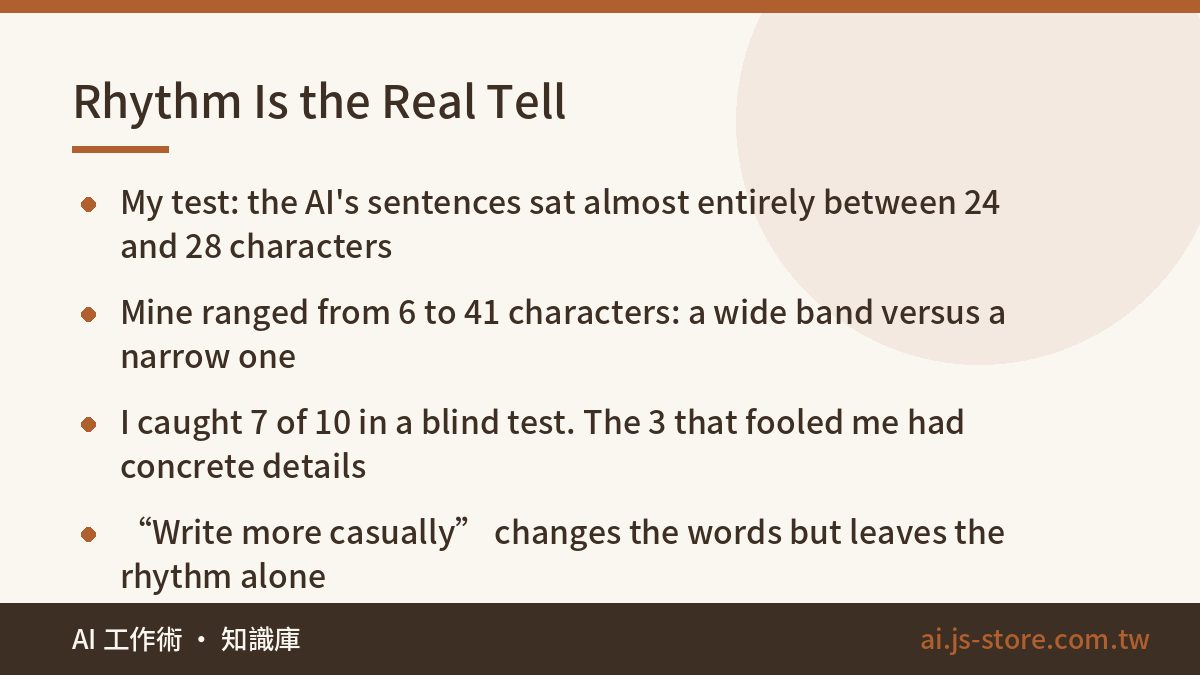
People write unevenly. When you're on a roll, one sentence keeps going, picking up a clause here and an aside there, until you finally run out of breath. Then you stop. Three words. Sometimes you go off on a tangent about something unrelated and then come back. AI doesn't do this. Every sentence comes out at a comfortable medium length. That's why AI text reads as smooth but fake. The smoothness comes from the even lengths, and so does the fakeness. Think of a heartbeat that's too regular.
That's also why “write more conversationally” barely helps. That instruction changes the vocabulary and leaves the rhythm alone. You can check this in two minutes. Paste a paragraph the AI just wrote back into the chat and ask it to count the words in each sentence. You'll probably get something like 18, 21, 19, 22, 20: ten sentences squeezed into a narrow band. Your exact numbers will be different. The band will still be narrow.
Then I looked again at the three paragraphs that fooled me. They weren't better written. One had a proper noun. One had a sentence with no real reason to be there. One used a catchphrase I actually say. What saved them was detail. We see the same pattern in our own content pipeline and social accounts. When readers comment “this sounds exactly like you,” it's almost always because the post mentions something specific that only we would know. Pretty sentences rarely get that reaction. If your AI drafts keep repeating the same ideas instead of the same rhythm, that needs a different fix, covered in our guide to breaking topic sameness.
The 7-Point AI Tone Checklist
Save this table and check every draft against it. The left column names the tell, the middle shows what it looks like and the right column gives the fix.
| # | The tell | What it looks like | How to fix it |
|---|---|---|---|
| 1 | Every sentence is the same length | Ten sentences in a row, all between about 15 and 25 words. Smooth, and obviously fake. | Add two short sentences. Three words is fine. “That's it.” counts as a sentence. |
| 2 | Every paragraph ends with an uplift | “And that's what leadership is truly about.” | Delete the line. A paragraph can end on a plain fact. |
| 3 | Everything comes in threes | Three examples, three parallel clauses, three takeaways, every time | Use two or four. Let one of them be a bit clumsy. |
| 4 | Addicted to “It's not X, it's Y” | Two or more of these contrasts in one paragraph | Keep one in the whole piece. Rewrite the rest as plain statements. |
| 5 | All-purpose adjectives | crucial, key, truly, deeply, essentially, game-changing | Remove them. If the meaning doesn't change, they were filler. |
| 6 | No proper nouns | “one afternoon,” “a friend,” “a restaurant” | “Last Wednesday,” “my cousin,” “the noodle place by the park.” Specifics are the hardest thing to fake. |
| 7 | A straight line with no noise | Never wanders off, never repeats itself, never gets anything slightly wrong | Keep one tangent and one sentence you don't strictly need. Real writing drifts and comes back. |
About #4: I used one of those contrasts in this article's first paragraph. That was my one.
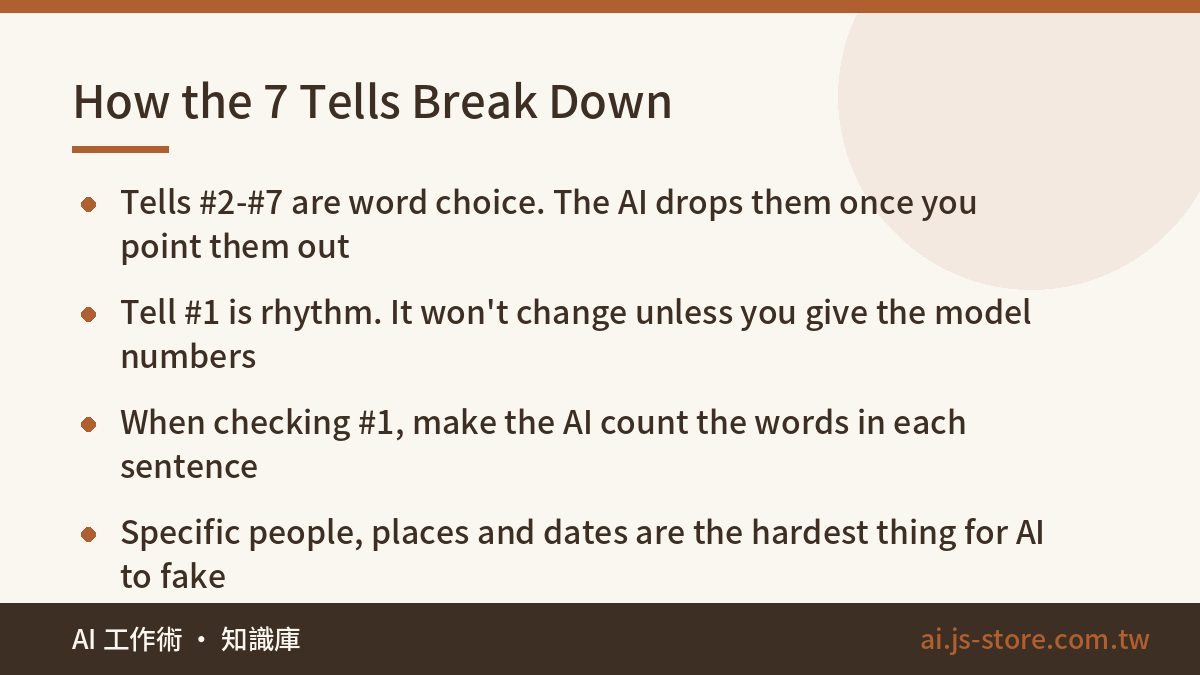
#1 is the hardest tell to fix and the most reliable one to look for. The other six are about word choice, and the AI drops them as soon as you point them out. Rhythm is different. The model won't change it until you state it as numbers. That's why the prompt below focuses on measuring rhythm.
The Voice Fingerprint Prompt: Turn Your Style Into Numbers
The key rule in this prompt is that the model may give only numbers and direct quotes. Adjectives are banned. “Your style is warm and approachable” tells you nothing. “Your average sentence is 14 words, your shortest is 3 and your longest is 38” is something you can use. Copy this and put your own writing at the bottom:
Below are some passages I wrote in the past. Do not praise them,
do not rewrite them, and do not describe them with adjectives.
Measure them instead, and give me numbers for each item:

A. Rhythm
1. How many sentences each paragraph has (list the count per paragraph)
2. How many words each sentence has (shortest, longest, average)
3. Quote my shortest and longest sentence word for word

B. Word choice
4. Words, catchphrases and filler words I use two or more times
5. Sentence patterns I rely on (quote real sentences, don't just name the pattern)
6. Punctuation: how many em dashes, ellipses, exclamation marks, parentheses

C. Structure
7. How I usually open (quote my first sentence)
8. How I usually close (quote my last sentence)
9. Do I go off on tangents? Quote one example

Finally, write a “Writing Spec”: a bulleted list of rules I can paste
straight into custom instructions. Every rule must cite a number or a
quoted sentence as evidence.
If something can't be measured from these samples, write “insufficient
sample.” Do not guess, and do not fill the gap with something that sounds nice.

My passages (paste 5-10 of your own):
Three lines need to stay. Without “do not praise, do not rewrite”, the model starts complimenting you. Without “every rule must cite a number or a quoted sentence”, you get a page of adjectives. Without “write insufficient sample”, it makes up a flattering answer to fill the gap. When it finishes, you'll have a spec. Paste the whole thing into ChatGPT's custom instructions or a Claude Project's instructions, and every new draft will follow it.
Which 10 Samples to Feed It (Get This Wrong and Nothing Else Works)
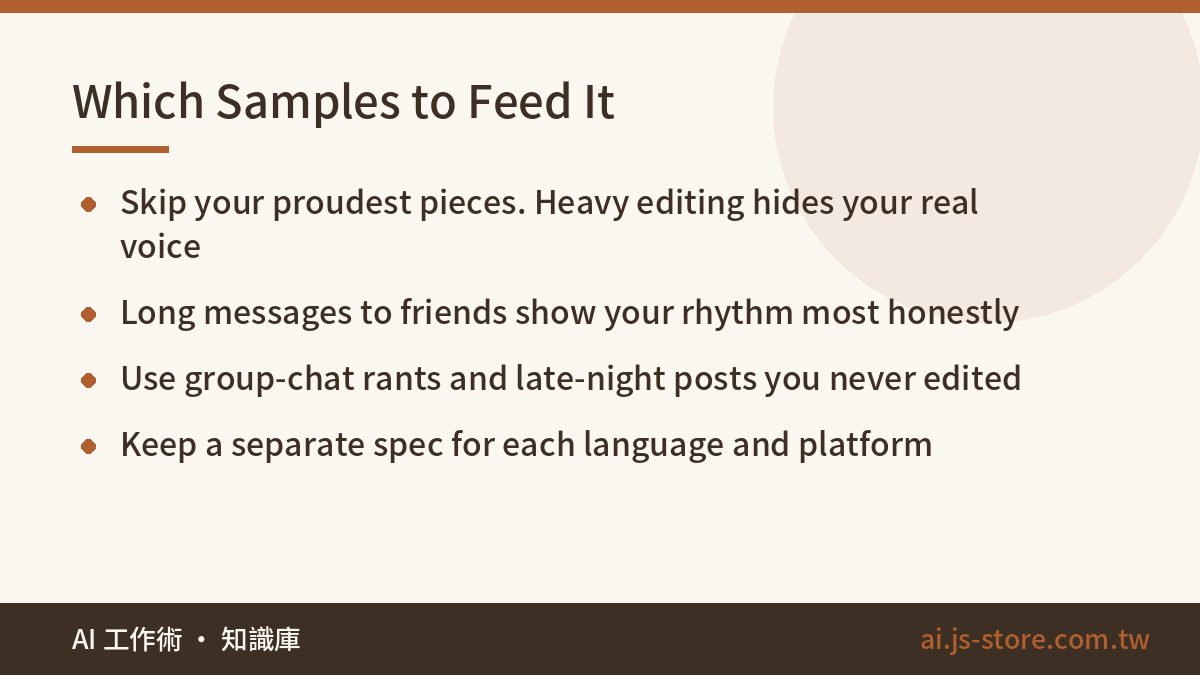
Your choice of samples matters more than the prompt. Don't pick the pieces you're proudest of. Those are usually the ones you edited the most. After enough revisions they stop sounding like you and start sounding like your idea of a “good article.” If the AI learns from those, it will write the version of you that's trying hard to impress.
Pick these instead:
- Long messages you've sent to friends. These are the most honest.
- Group-chat messages where you complained about something.
- Posts you wrote late at night and published without editing.
Four of the ten passages I used were chat messages. The fingerprint from those was far more accurate than the one I got from my published posts, which had each been through about three rounds of editing.
One more tip if you write in more than one language, or for more than one platform: make a separate spec for each. Your rhythm in English isn't the same as your rhythm in your first language, and a social caption isn't paced like a 2,000-word guide. One spec that mixes them averages out the habits you're trying to capture.
After Every Draft: Make the AI Count
The spec only covers what happens before the model starts writing. You still need to check the draft afterward. Paste the 7-point table into the same chat and add this:
Check what you just wrote against these 7 points, one by one.
For each point, answer yes or no. If yes, quote the sentence and give me a fix.
For point 1, actually count the words in each sentence. Do not judge by feel.
The last line is the important one. If you don't make it count, it will judge by feel and tell you “sentence length varies nicely,” and that won't be true. When you make it count, it tells you plainly: “This paragraph has 9 sentences, shortest 16 words, longest 23.” Then you ask it to split two of them into short sentences. In my own runs, it flags #1 almost every time and catches one or two of the other six.
This has more to do with process than with which tool you use. Whether you're using ChatGPT, Claude or a dedicated tool like our own ShooWork Write, the check you run after the draft is what catches the rhythm problem. If you're putting together a full content pipeline, our SEO AI tools workflow shows where a check like this fits between drafting and publishing.
The Honest Limits: Four Things This Method Can't Do
- This was a small personal test, not research. It used ten paragraphs and one person guessing, and I knew what I was testing for, which affects the result. Catching 7 out of 10 is what happened to me. You may not get the same number.
- The 24-28 and 6-41 figures come from my ten Chinese paragraphs, measured in characters. In English you'll count words, and your range will be different. What matters is the pattern: the AI's range is narrow and a human's is wide. You can check that yourself without trusting my numbers.
- The AI can't open your hard drive. It only sees what you paste or upload. Text files, PDFs and Word documents can all be dragged straight in, and you don't need to install anything. If privacy matters to you, check whether your plan uses conversations for model training and turn it off if you can. Always go by each provider's official terms. Our ChatGPT free vs paid breakdown covers how plans differ.
- A spec doesn't last forever. Your writing changes over time, so I redo mine about every two months. A spec also only makes the AI sound like you. It can't give the AI anything worth saying. The ideas still have to come from you.
One last warning: don't use the spec as an excuse to let the AI write the whole piece and hit publish. Readers will spot posts with the right voice and nothing to say within three of them. The fingerprint helps you write faster. You still have to do the writing.
FAQ
Q: What exactly is AI tone, and why is it so easy to spot?
The biggest cause is sentence length that's too even. AI sentences cluster in a narrow word-count band, while human sentences swing between long and short. Word-level habits come second: all-purpose adjectives, uplifting lines at the end of every paragraph, and examples that always come in threes. The AI fixes word choice as soon as you ask. It won't change rhythm until you spell it out with numbers.
Q: Do I need to feed it 100+ posts like you did?
No. I gave it 121 posts to learn my general voice, but the fingerprint itself came from just 10 passages. Five to ten well-chosen samples do more than a hundred badly chosen ones, because the fingerprint measures rhythm and catchphrases, not the amount of text. If you don't give it enough, the prompt answers “insufficient sample,” and you add a few more passages.
Q: If I paste my old writing in, can the AI see other files on my computer?
No. It only sees what you paste into the chat or deliberately upload. It can't open your drive, your photos or your cloud folders. The thing to check is different: some plans use conversations to improve their models by default. Look for the data controls in your settings, and treat each provider's official terms as the final word.
Q: How often should I redo the writing spec?
I redo mine roughly every two months, because writing habits shift slowly. Also redo it whenever you change topic or platform. Short social posts and long guides have different rhythms, so keep a separate spec for each instead of sharing one.
Q: Will Google penalize articles written this way as AI content?
Google judges content quality and how useful it is to readers, not whether AI was involved. This method actually pushes you to add proper nouns, real numbers and first-hand experience, which are all quality signals. The risk is publishing generic text with nothing new in it, whatever wrote it.