AI Content Ideas Keep Repeating? Fix Topic Sameness With Mechanism Tags
Published 2026-10-07 · Updated 2026-10-13 · 8 min read · ShooWork (FREECO CO., LTD.)
AI topic ideas collapse into the same five headlines. Use mechanism tags, a three-part prompt and a 30-to-8 filter to get content ideas nobody else has.
Ask an AI for “20 blog post ideas about X” and you already know what you'll get: What Is X, How to Use X, Best X Tools, X vs Y, Common X Mistakes. Ask a different model the same question and at least three of the top five ideas will overlap. Your prompt isn't the problem. A language model predicts the most likely next line, and “most likely” also means “what everyone has already written.”
Telling it to “be more creative” won't fix this. You get new adjectives on the same angles. What actually works is two changes. First, tag every topic by the mechanism it explains, not the subject it covers. Second, give the model a written record of what you've already published and what you haven't tried yet, so it has something concrete to avoid.
Below is the workflow we use for ShooWork's own content library: how to define mechanism tags, a three-part prompt for generating ideas, a filter that cuts 30 ideas down to about 8, and a quarterly audit that uses numbers to tell you whether your content has already gone generic.
Why AI topic ideas keep collapsing into the same list
A model picks topics the same way it writes sentences: it reaches for the statistically safest option. Ask it what to write about AI video editing and it returns the headline patterns that show up most often around those words. In practice the ideas collapse in three ways:
- Same headline formats. What-is, how-to, best-of, comparison, mistakes and ultimate guide. Those six formats cover roughly 80% of what you'll get back.
- Same depth. Every idea stays at the beginner overview level. None of them goes down into a specific way things fail.
- Same perspective. It's always a teacher talking to a beginner. You never get an operator talking to another operator, or someone who already made the mistake warning someone who's about to.
The bigger reason is simpler: the AI doesn't know what you've already written. Every new chat starts from a blank page, so of course it hands you the safest list. You probably covered three of those ideas last month. It isn't repeating itself on purpose. It just starts from the same place every time.
Switching models doesn't solve this. It only changes how the ideas collapse. When we compared models while maintaining our own knowledge base, the gap in originality was smaller than we expected. Most of the difference was in tone and structure, which we covered in our GPT-6 Astra guide. What actually changed the results was the criteria we gave the model, not which model we used.
Mechanism tags: sort by what a piece explains, not what it's about
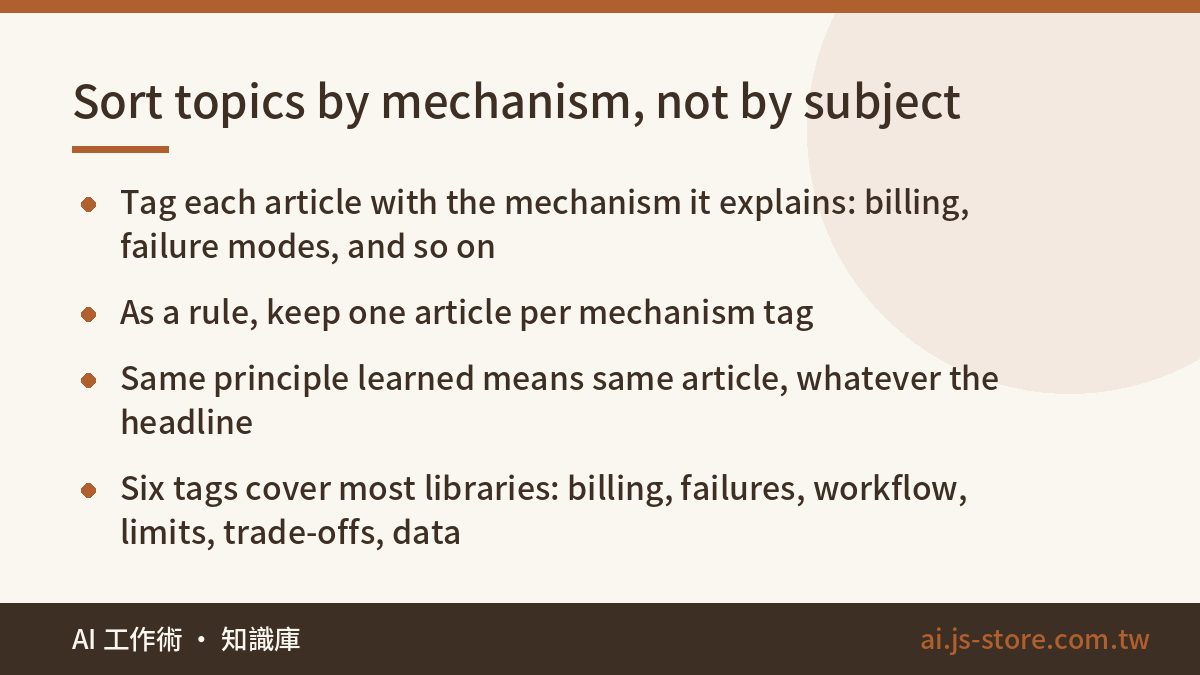
Most people organize their ideas by subject: AI video, AI images, AI customer support. That won't stop repeats. Write ten posts under one subject and all ten end up being about how to use it.
Mechanism tags ask a different question: which mechanism does this article help the reader understand? Use the answer as the tag, and as a rule keep one article per tag. These six tags cover most of what we publish:
| Mechanism tag | What the article answers | What the topic looks like |
|---|---|---|
| Billing | How the cost actually gets calculated | How tokens are counted, why some inputs cost more |
| Failure modes | When and how it breaks | Image models changing numbers, misspelled rare words |
| Workflow compression | Which steps you can delete | Folding a talking-head edit into fewer passes |
| Platform limits | Which outside rules box you in | API quotas, reply rate limits, review policies |
| Trade-offs | Who each option is for | Subtitle tool vs full auto-edit |
| Structuring data | Turning messy input into structure | A chat thread into a one-page to-do list |
Tag your existing articles this way and the problem usually shows up right away. If six of your ten posts land under “how to use it,” you don't have ten articles. You have four, plus five that repeat one of them. Compare our pieces on what an AI token is (billing) and AI images getting text and numbers wrong (failure modes). Both are “about AI tools,” but readers come away with completely different knowledge. That's what real variety looks like.
Use one test. If readers of two topics end up learning the same principle, those topics are the same article, no matter how different the headlines look.
The three-part prompt (and the one line that does most of the work)
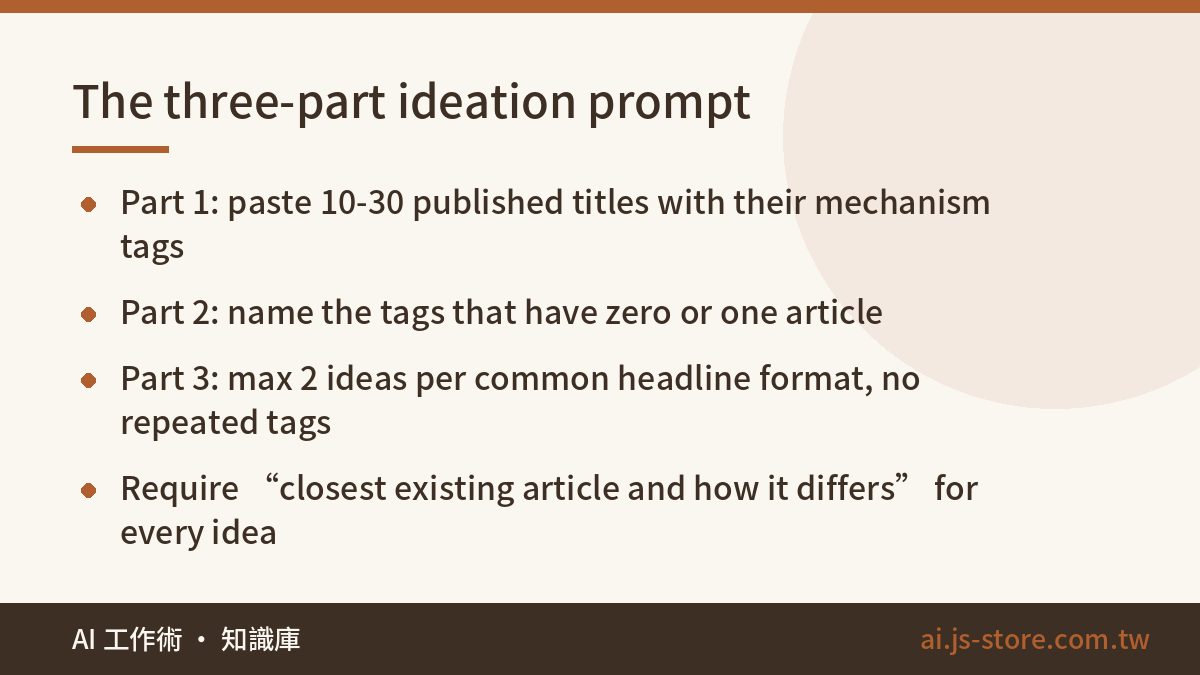
Once you have tags, “give me 20 ideas” isn't good enough. Write the prompt in three parts. The third part matters most.
- What exists. Paste your published titles with a mechanism tag after each one. Ten to thirty titles is enough. Don't paste the whole archive.
- Gaps. Spell them out: “These tags have zero or one article so far: platform limits, structuring data, cost estimation. Prioritize them.”
- Exclusions. Set hard rules. Allow no more than two ideas each in the what-is, how-to, best-of and comparison formats. No ideas under a tag that's already covered. Each idea must include its mechanism tag and say which existing article it's closest to and how it differs.
Here's a cut-down version you can adapt:
Published (title — tag):
- What Is an AI Token — billing
- Fixing Wrong Text in AI Images — failure modes
...
Under-covered tags: platform limits, structuring data.
Give me 30 topic ideas. Rules: max 2 each of what-is / how-to / best-of / comparison.
For every idea, add: mechanism tag, closest published article, and the specific difference.
The “how it differs” line is what makes the whole method work. It forces the model to check for repeats first and explain its reasoning. An idea that can't name a real difference is easy to spot and cut. In our own library, adding that one line raised the share of usable ideas from about 30% to about 60%. Your numbers will depend on your topic area, but we've seen the same improvement every time.
Pasting your existing list uses more tokens, and it's worth it. Generating 20 ideas, throwing out 18 and asking again costs more than giving the model full context once. To keep the cost down, paste only titles and tags, not summaries.
Generate 30, keep 8: the cutting workflow
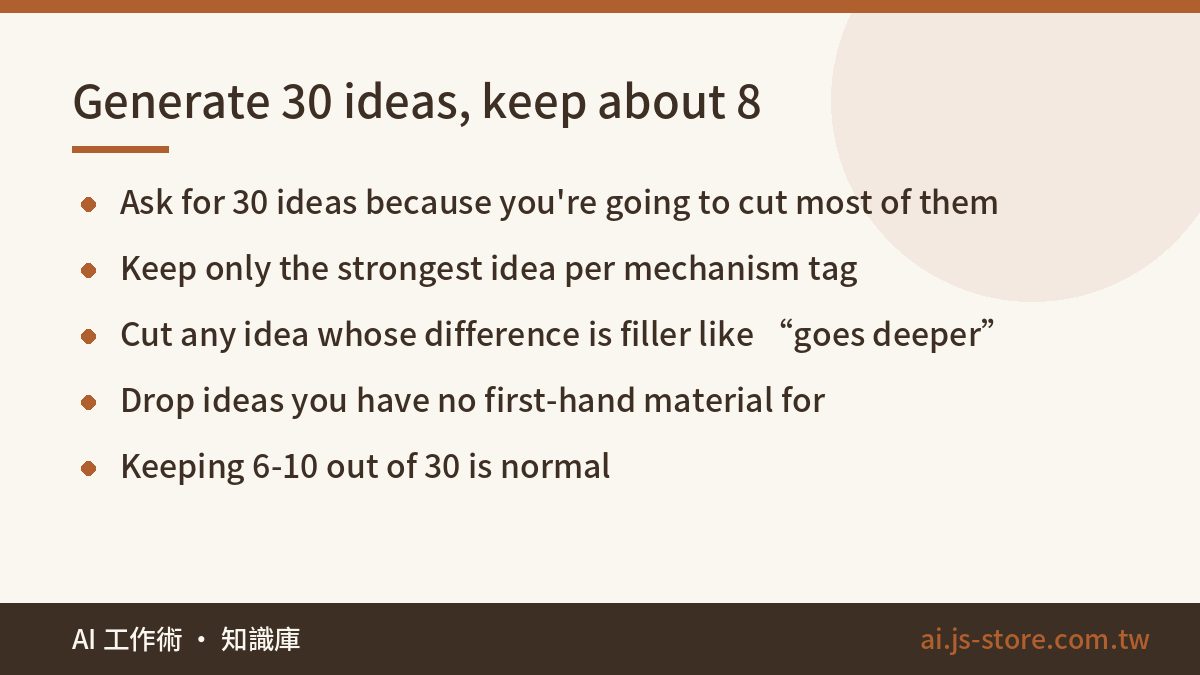
- Build the tag table first. Tag everything you've published. Empty tags are your gaps. This usually takes under half an hour.
- Generate 30 ideas with the three-part prompt. Ask for more than you need because you're going to cut most of them. Every idea needs its tag, the closest existing article and the difference.
- Cut 1: one idea per tag. If three ideas share a tag, keep the strongest and park the rest. Don't get attached.
- Cut 2: read the differences. Cut any idea whose difference is filler like “goes deeper” or “more comprehensive.” A real difference sounds like “that one covers initial setup, this one covers recovery after it breaks.”
- Cut 3: do you have first-hand material? If you haven't done the thing, and you have no numbers and no failure stories, the post will turn out generic. Generic posts are exactly how your content starts to sound like everyone else's.
- Rank what's left. Write first where an under-covered tag overlaps with material you have. Keeping 6 to 10 out of 30 is normal. If you're keeping 20, you didn't cut hard enough.
For ShooWork Clip, our video-editing engine, most of our ideas come from support tickets and product usage data: which step trips up the most users, and which setting people keep reverting. That's ready-made material for failure-mode and workflow-compression articles. AI can rearrange your raw material just fine, but the raw material has to come from your own work. That's also why two people running this same process won't end up with the same topics.
How to tell if your content has already gone generic
You can measure sameness instead of guessing. Run these checks once a quarter:
- Tag concentration. Count the articles under each tag. If any one tag holds more than a third of your library, that's a red flag.
- Opening-line repetition. Put every article's first sentence in one list. If more than half start with “As AI becomes more popular…” or “Have you ever struggled with…”, you're reusing the same prompt for your intros too.
- The swap test. Take two random articles and move paragraph three from one into the other. If it reads fine, they're really the same article.
- Self-cannibalization. Search your target keyword. If two of your own pages show up on the first two pages of results, they're splitting traffic. That doesn't mean you have good coverage.
- First-hand ratio. Count how many articles include numbers you measured, screenshots you took or failures you had. If it's under half, a competitor or a model could easily replace your content.
If the audit shows you've been reusing the same prompt, fixing that prompt does more than rethinking your topics. Start from our prompt templates for work and adapt them. If you need more angles, browse the ShooWork tools directory. Every tool runs on mechanisms that nobody has explained clearly yet.
FAQ
Q: Can't I just tell the AI “don't give me repeated topics”?
No. It has nothing to compare against. The model reads that instruction as “use more varied wording,” so you get the same ideas in different words. It can only avoid what you've written if you paste in your existing list.
Q: How many mechanism tags should I use?
Use six to ten. With too few, everything piles into the same tags and they stop telling articles apart. With too many, every article gets its own tag and the method stops catching repeats. Start with the six above and add a tag only when an idea really doesn't fit any of them.
Q: Isn't generating 30 ideas at once a waste of tokens?
It's cheaper than you think. Generating topic ideas produces short output. Even with tags and difference notes, 30 ideas cost far less than drafting one article. The real waste is getting a useless list and asking five more times.
Q: Does one mechanism tag mean only one article, ever?
No. The rule is one article per tag per audience. A billing explainer for individual users and one for someone planning a team budget meet different needs, so both can exist. Write the audience next to the tag, or six months from now you won't remember how they differ.
Q: Will a stronger model fix repetitive topic ideas?
Only a little. A stronger model writes neater, better-structured headlines, but the ideas still collapse into the same list because it doesn't have your existing content as context. That's a missing-information problem, not a capability problem. Add your list and exclusion rules and even an average model's ideas will improve noticeably.