Deepfake Fraud Detection: Spot Fake Video, Support & Investment Scams
Published 2026-10-23 · Updated 2026-10-23 · 8 min read · ShooWork (FREECO CO., LTD.)
Deepfakes no longer look fake. Learn to catch AI voice clones, fake support agents and investment scams by checking the process, not the face.
Here's the short answer: you can no longer catch a deepfake scam by asking “does this look and sound real?” Voice cloning needs only a few seconds to a few tens of seconds of sample audio. Real-time face swapping runs on an ordinary laptop. The face on your screen and the voice in your ear no longer prove who you're talking to.
What works is moving verification away from your eyes and ears and into a process. Hang up and call back on a channel you already trust. Agree on a code word in advance. Refuse any request that says money has to move right now. Cloned bosses, fake relatives, fake customer support and fake investment gurus all fail against those three moves, however polished the production is.
We know this from the inside. At ShooWork we run our own AI tool platform, including a video-editing engine and the voice and image generation pipelines behind it, and we use these models every day. We've watched the cost of a convincing fake fall close to zero. So we won't tell you to “look closer.” That was reasonable advice three years ago. Today it gets people robbed.
The three deepfake scams you're most likely to meet
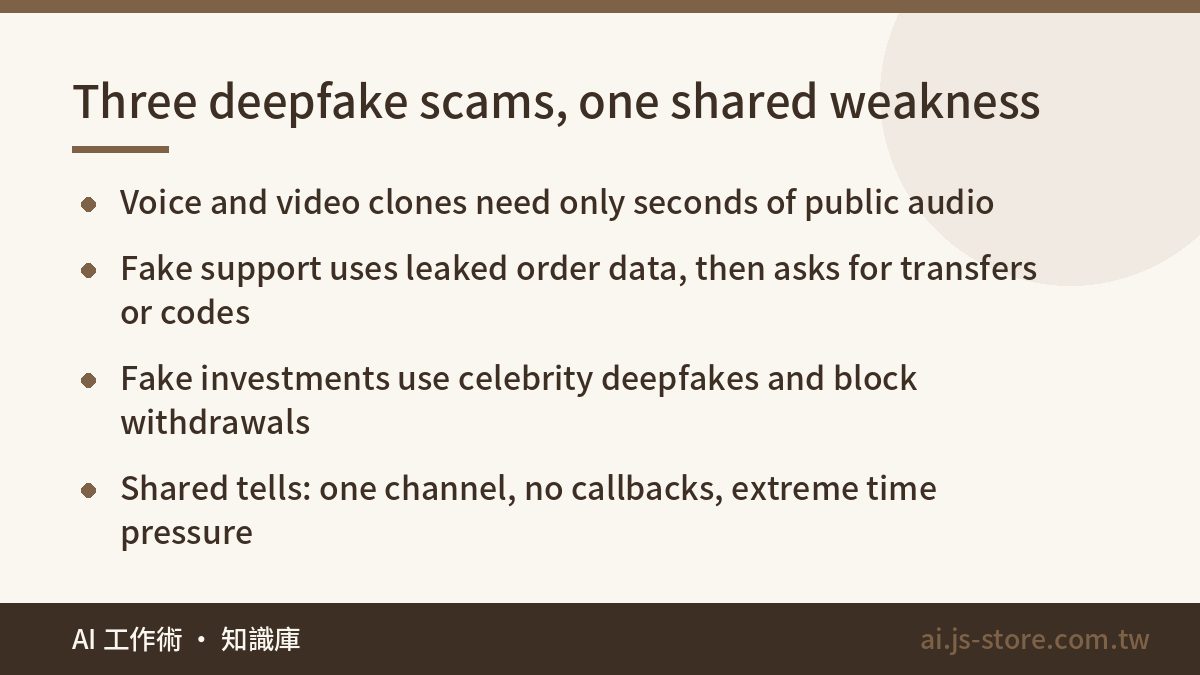
Most AI-powered fraud today falls into three families. Look at what each one needs and where it gives itself away. The giveaways are almost never technical. They're procedural.
| Scam type | What the scammer needs | Typical setup | The real giveaway |
|---|---|---|---|
| Deepfake voice or video | A few seconds to a minute of public audio or video: social posts, livestreams, interviews, conference talks | The “CEO” needs an urgent wire, a “family member” is in trouble and needs cash, a “colleague” on video asks you to update a supplier's bank details | Only one channel, won't let you call back, asks for secrecy, extreme time pressure |
| Fake customer support | Leaked order data or customer lists | “Your order was set to a recurring charge by mistake,” “unusual activity on your account,” “your parcel is held until you pay a fee” | Asks you to transfer money, read out a one-time passcode or install an app. Real support never does this. |
| Fake investment | Public footage of a celebrity, fake profit screenshots, an AI-generated “analyst” persona | Celebrity-endorsement ads, invite-only chat groups, a “mentor” calling trades, a small early win to hook you | Money goes to a personal or unrelated account, and withdrawals need a “tax” or “deposit” first |
These three are now being combined. Investment groups use deepfaked celebrity videos to build trust. Fake support lines use synthetic voices to handle your follow-up questions. Fake-boss scams start by studying your company's public material and the way your executives talk. The packaging keeps getting more convincing. The procedural tells stay the same, and those tells are what you can rely on.
Spotting video and voice deepfakes: visual tells, and what beats them
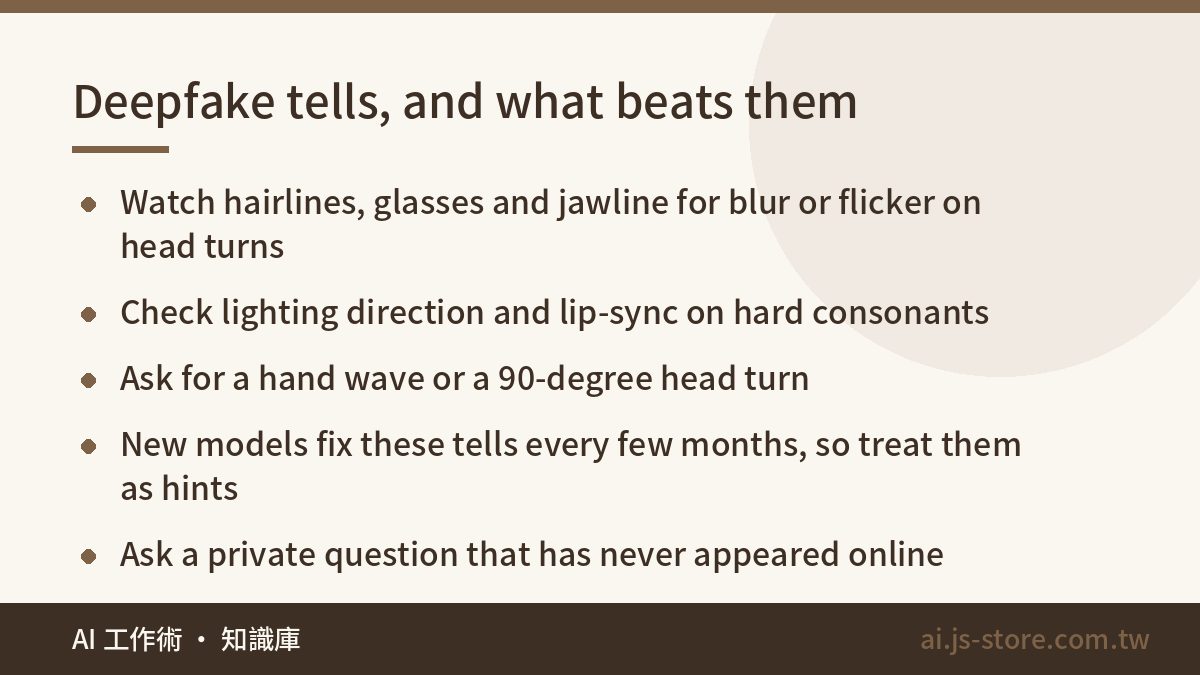
Visual tells are still worth knowing. Most fraud crews don't use the best models. They use cheap versions they can run at scale. These are the flaws we see most often when we test generation tools ourselves:
- Edges and hairlines. Hair, glasses frames and the jawline tend to blur or flicker when the head turns.
- Lighting mismatches. The light on the face comes from a different direction than the light in the room, or the face's brightness doesn't change as the head moves.
- Lip-sync lag. Real-time face swapping takes compute time, so mouth movement often trails the audio slightly. It shows most on hard consonants like p, b and m.
- The occlusion test. Ask them to slowly wave a hand in front of their face, turn their head 90 degrees, or cover half their face with a sheet of paper. Many real-time swaps break for a second or two.
- Audio that's too clean and too flat. Synthetic voices often have no breathing and no room noise, a narrow emotional range, and odd reactions when you interrupt.
Keep two caveats in mind. First, new model releases fix a batch of these tells every few months. “Watch the blink rate” was solid advice two years ago and is mostly useless now. Second, real scam calls usually come as compressed phone video with background noise, and the caller says “sorry, bad connection.” The conditions hide the flaws for them. Treat visual checks as a hint, never as a verdict.
A better test is to ask something only the real person would know that has never been online. Don't ask “where did we last meet?” because that might be on someone's social feed. Ask “what was the book you borrowed from me last month?” Pick a detail that is specific and has no digital trail. If they dodge, change the subject or say “I don't have time for this,” treat that as a fail.
Fake support and fake investments: the script never changes
Fake support and fake investment scams don't really depend on deepfake technology. They depend on a script. AI makes the script smoother and more personal to you, but the structure stays the same. Once you know the structure, the polish stops working.
Fake support runs in four steps:
- Build credibility. They quote your real order number, the item and your shipping address. That data came from a breach. It doesn't make them official.
- Create a problem. “The system set you up for installments,” “a staff member made an error,” “your account was compromised.” The problem is never your fault, but you have to help fix it.
- Hand you to an authority. “Let me transfer you to your bank” or “to a regulator's fraud officer.” It's the same crew on a different line.
- Get you to act. Make a transfer, read out a verification code, or install a remote-access app.
You only need one rule: any “support agent” who asks you to move money, share a one-time passcode or install an app is a scammer. Legitimate companies don't have that process. This isn't about probability. A real support agent simply never asks for these things.
Investment scams play a longer game, usually one to three months. A deepfaked celebrity video or an AI-generated “analyst” in an ad pulls you into a chat group. Most accounts in the group are accomplices posting profit screenshots and thanking the mentor. You're encouraged to start small, and your first withdrawal actually works. Once you've put in serious money, the story changes: “withdrawals require tax paid upfront,” “your account is frozen until you add a margin deposit.”
Investment fraud consistently ranks among the costliest scam categories in police and regulator reports. The way to spot it is to follow the money. A legitimate platform never has you pay into a personal account or a company with an unrelated name, and never charges a fee before releasing your own funds. If you see any one of those signs, you don't need to work out whether the celebrity is real.
Three habits that protect you and your family
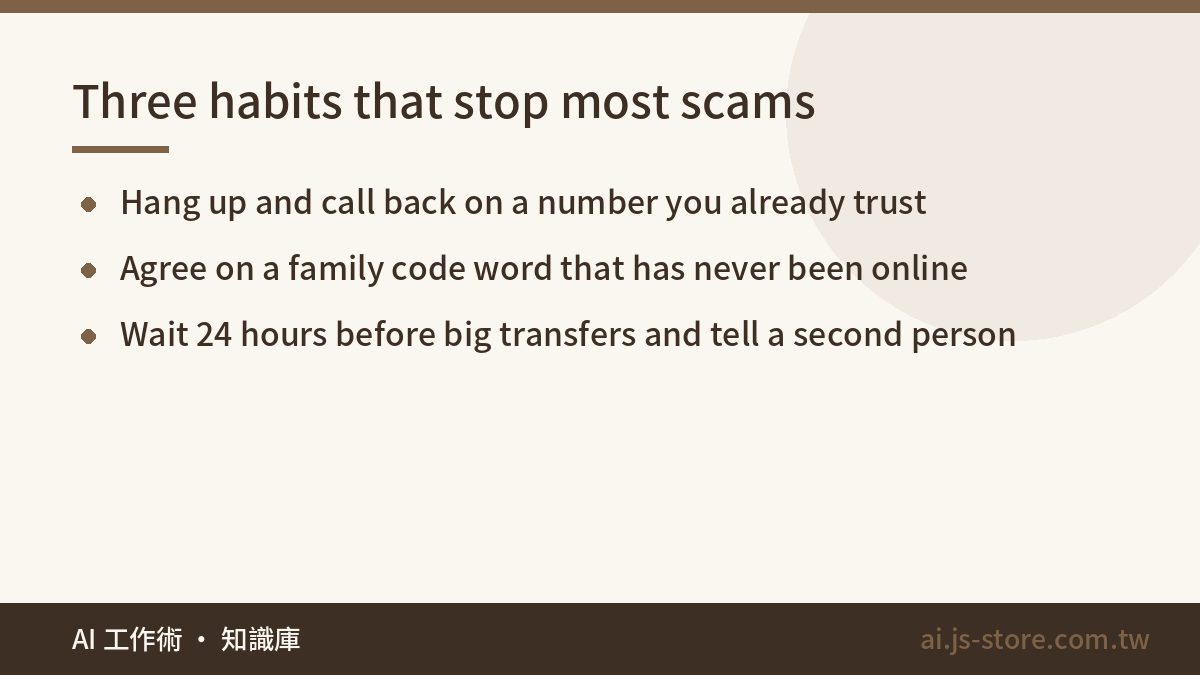
Set up these three habits with your family or small team before anything happens. In the moment you'll be under pressure and won't think clearly.
- Call back on a different channel. However real the call, video or message looks, hang up and reach the person through the number you already have saved, the official app, or the phone number on the official website. Caller ID can be spoofed and messaging accounts get hijacked. Never use the channel they contacted you on to verify them. A callback takes thirty seconds and stops most deepfake scams.
- A family code word. Agree on a word, question or shared story that has never been posted, texted or emailed. When someone calls saying “I'm in trouble, I need money,” ask for it. If they can't answer, hang up. For older relatives who struggle with memorizing, make the answer something they know by heart.
- A mandatory cooling-off period. For any transfer above a threshold you set, wait 24 hours and talk to a second person first. Every scam script depends on “do it now or it's too late,” and a cooling-off rule takes that weapon away. A real emergency can almost always wait a day. Money sent to a scammer almost never comes back.
Two small moves also help. Limit your video and voice posts to friends only, so there's less public material to train a voice clone on. And turn on your carrier's spam and fraud call labeling. It won't catch everything, but it adds one more warning. The same idea applies to text: the less personal data you scatter around, the fewer hooks a scammer has. Our 3-second personal data check covers the habit for AI chat tools.
For businesses: put verification in the process, not in people's instincts
Companies lose far more to deepfakes than individuals do, because the targets are finance, procurement and HR, the people who can move large sums. The usual scripts are a fake executive on video demanding an urgent payment to a new supplier, or a fake colleague asking to change bank details. Staff vigilance won't reliably stop these. Written rules will:
- Verify bank-detail changes on a second channel. Confirm any change to supplier or payroll account details by calling the number already on file. Never use contact details supplied in the change request.
- Dual approval for payments. Payments above a threshold need two people to sign off independently, and never on the same call or video meeting.
- “The boss said so” is not approval. State in writing that no executive instruction, verbal or on video, can bypass the payment process. Have the CEO sign it personally. Otherwise employees won't feel safe saying no.
- Fixed customer channels. Send important notices only through your official app, website or verified SMS sender, and tell customers publicly: “We will never call you to request a transfer or a verification code.”
- Drill it. Once a quarter, have a simulated deepfake voice call your finance team and see whether the process holds. An SOP you've never tested might as well not exist.
If your company is rolling out AI tools, staff accounts, data and model habits become part of your attack surface too. We cover that, with policy templates you can adapt, in AI Security for Business.
One last point from building ShooWork Clip, our AI video-editing engine. A five-minute clip with natural lip movement and a voice that's nearly indistinguishable from the real person now takes an ordinary computer and a few minutes of source footage. The technology won't get harder to use. Your defenses have to sit in the process.
FAQ
Q: Is there an app or tool that can reliably detect deepfake videos?
Some detection tools and browser extensions exist, but their accuracy drops whenever generation models update. Most scams also happen on live calls, where you can't stop to run an analysis. Use detectors as a second opinion at most. Your real protection is still process: call back on a trusted channel and use a code word.
Q: I already sent the money. What should I do first?
Call your bank's fraud line right away, using the number on your card or the official app, and ask them to freeze or recall the transfer. Speed matters, because funds that haven't moved on yet can sometimes be stopped. Then contact the police and your national fraud-reporting service. Keep every message, receipt and account number. Ignore anyone who offers to “recover your funds” for a fee, because that's usually a second scam.
Q: How do I protect older parents who aren't comfortable with technology?
Teach rules, not technology. Three are enough: hang up on any call asking for money and phone a family member to check, anyone who asks you to transfer money or read out a code is a scammer, and always talk to your kids before sending money. Write the three rules on a card and keep it by the phone. That does more than explaining how deepfakes work ten times.
Q: If someone passes the hand-wave test on a video call, are they definitely real?
No. The latest real-time face-swap models handle occlusion and side profiles much better, and poor video quality or dim lighting hides flaws anyway. Passing the test only means you didn't catch anything. If the conversation involves payments, account changes or confidential information, still verify with a callback.