GEO Software in 2026: What AI Search Tools Can and Can't Do
Published 2026-10-01 · Updated 2026-10-13 · 7 min read · ShooWork (FREECO CO., LTD.)
There is no GEO tool that guarantees AI citations. Here are the three categories of GEO software, the names worth knowing, and a free audit that covers most of it.
If you typed "GEO software" into a search box, you were probably hoping for a tool you install, switch on, and then watch ChatGPT and Perplexity start recommending your site. Let me save you the research time: that software does not exist. Nothing on the market today can guarantee you a citation in an AI answer. Every product flying the GEO flag (Generative Engine Optimization) does one of two jobs — it measures how often your brand turns up in AI answers, or it helps you reshape content so a model finds it easy to quote. What decides whether you actually get cited is the content itself.
That isn't an argument against buying anything. It's an argument for knowing which problem each category solves before you put a card down, because the failure mode here is specific and expensive: you pay a monthly fee for a beautiful dashboard plus a list of recommendations nobody on your team has time to act on. We run our own AI tool platform at ShooWork, which puts us on both sides of this — we're a site trying to get cited, and we build the tooling other people use to ship content at volume.
So here's the honest breakdown: the three categories of GEO software, the international names that come up most often in the conversation, and then a zero-budget audit that covers most of what the paid tools do. That audit isn't theory — it's what we run on our own site every month.
GEO software splits into three categories
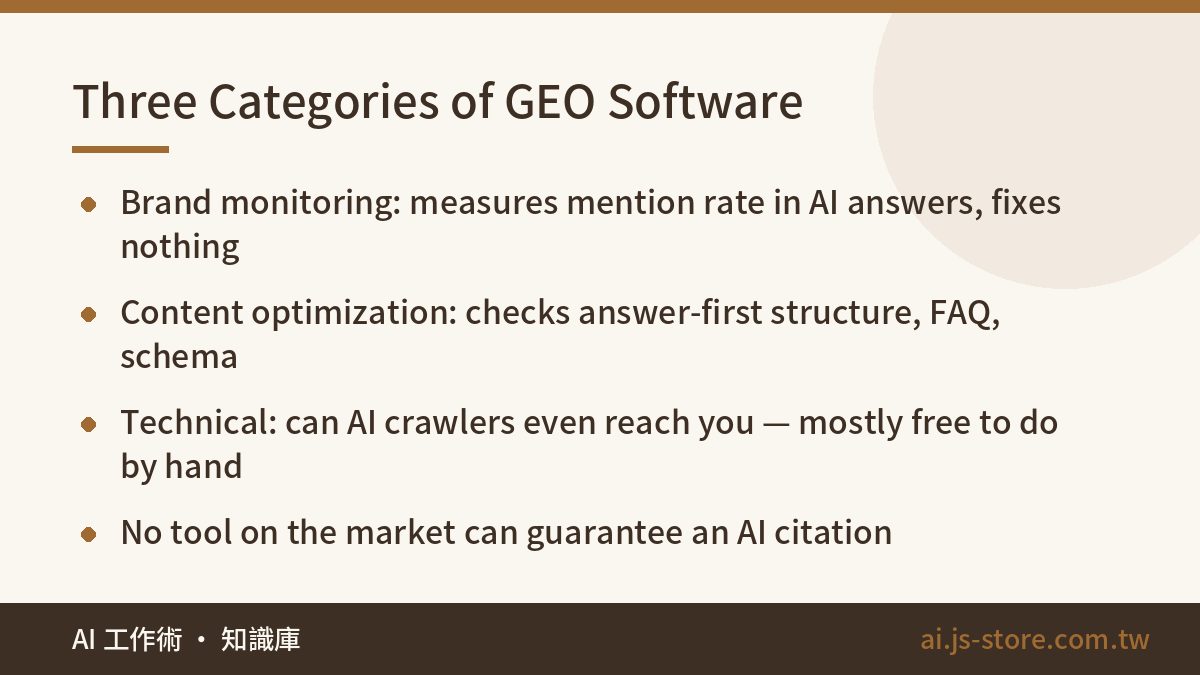
Category one: brand monitoring. These tools fire a large batch of questions at ChatGPT, Perplexity, Gemini and others on a schedule, then count how often your brand appears in the answers, where it ranks, and which sources got cited alongside you. Trend charts, share-of-voice, the works. This is the mainstream of what people mean by "GEO software" right now, and it answers exactly one question: am I being mentioned at all? Note the limit — it measures. It does not improve anything. Buying a monitor and expecting visibility to rise is like buying a bathroom scale and expecting to lose weight.
Category two: content optimization. These check whether your pages are shaped the way models like: is there a paragraph near the top that answers the question directly, is the FAQ block complete, is structured data (schema) marked up, are your claims specific enough to quote. Increasingly this shows up as an "AI module" bolted onto the SEO tool you already pay for, which means you may not need a separate subscription at all. Check your current stack before you shop. If you're also weighing how to produce the content itself, we broke the landscape down in AI article writing tools: writer vs generator vs pipeline.
Category three: technical crawlability. Can AI crawlers actually reach your site? Is robots.txt blocking GPTBot? Does your main content only exist after JavaScript runs? Is there an llms.txt file? Almost all of this you can check by hand in an afternoon, so it carries the least value as a paid product — and it's where the fatal mistakes live. If the door is shut, everything you do in categories one and two is worth exactly zero.
The tools people actually talk about
On the monitoring side, Profound gets the most discussion at the enterprise end, focused on AI answer tracking and source attribution. Otterly.AI and Peec AI are the lighter-weight options — they track how your brand surfaces across AI search surfaces, and they're the realistic place for a small team to dip a toe in. The established SEO vendors have moved in too: Semrush ships AI visibility tooling, and Ahrefs has Brand Radar for seeing where a brand gets mentioned on AI platforms.
On pricing, check the official pricing page for whichever one you're considering. I'm not writing numbers down, and you should distrust any article that does — this market reprices every quarter, so a figure published today is probably wrong by spring. What's worth remembering instead is the shape of the market: monitoring tools skew toward enterprise pricing, and what they hand you is a diagnosis, not a treatment. If you're a solo brand or a team of five, don't reach for the card yet. Run the free audit in the next section first; you'll know which piece you're actually missing. This is the same discipline we argue for in AI adoption: audit your processes before you buy a tool — tooling bought before diagnosis almost always ends up shelfware.
The zero-budget GEO audit that covers 80% of it
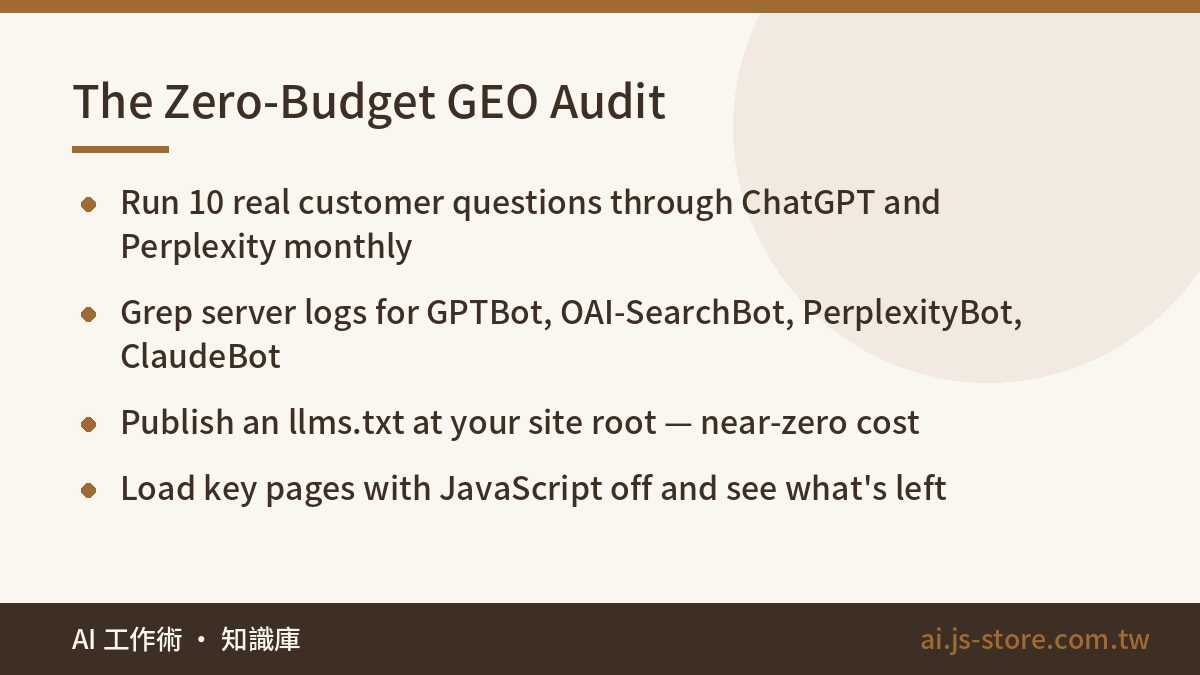
For a small or mid-sized site, a manual process covers nearly everything a paid tool does. Here's ours, four steps, about ninety minutes a month.
1. The brand prompt test. Write down 10 questions your actual customers would ask an AI — not your brand name, but the problems they have ("how do I cut editing time on talking-head video", that sort of thing). Run each one through ChatGPT with search enabled and through Perplexity. Record two things: were you mentioned, and whose site got cited instead. Repeat monthly with the same 10 questions. That spreadsheet is your monitoring dashboard, and because you wrote the questions, it's better targeted than a generic batch.
2. The crawler health check. Open your server logs and grep for these user agents: GPTBot, OAI-SearchBot, PerplexityBot, ClaudeBot. If they're hitting you, your content can enter the pipeline that feeds AI answers. If there's nothing at all, go read your robots.txt before you do anything else — you have probably been blocking them by accident, possibly for years.
3. Publish an llms.txt. A plain text file at your site root that tells models who you are and what your key content is. Cost: close to zero. It's not a magic ranking factor, but it's the cheapest signal you will ever ship, and there's no reason to skip it.
4. Check your render path. Some AI crawlers don't execute JavaScript. If your article body only materializes after client-side rendering, those crawlers see a blank page. Disable JavaScript in your browser, load your three most important pages, and look at what's left. This one catches people with modern frameworks constantly.
What matters more than tooling: whether your content deserves the citation
Models are surprisingly honest about what they like to quote: a paragraph that answers the question immediately, a complete FAQ block, named first-hand experience, and conclusions with numbers in them. What they skip is the corporate article that spends three paragraphs clearing its throat before arriving at the point — because the model is looking for material it can lift straight into an answer, and preamble is not material.
This is the same direction Google has been pushing with E-E-A-T. Content that shows real experience and verifiable credibility wins in classic search and in AI search, which is convenient, because it means you are not maintaining two content strategies. The highest-return move available to you is boring: take the topic you know best, and write it as answer-first intro, then concrete method, then an FAQ at the end. That one format serves human readers, Google, and AI answer engines at the same time.
The constraint is volume, not format. One well-structured article gets cited for one cluster of questions; getting cited broadly takes a library. We wrote up how a single person keeps that cadence in AI content pipeline: how one person ships a team's worth of posts, and if you're weighing whether to hire this out instead, website content outsourcing: the real cost of 3 routes has the honest math on agencies versus freelancers versus in-house.
Three free metrics that tell you if GEO is working
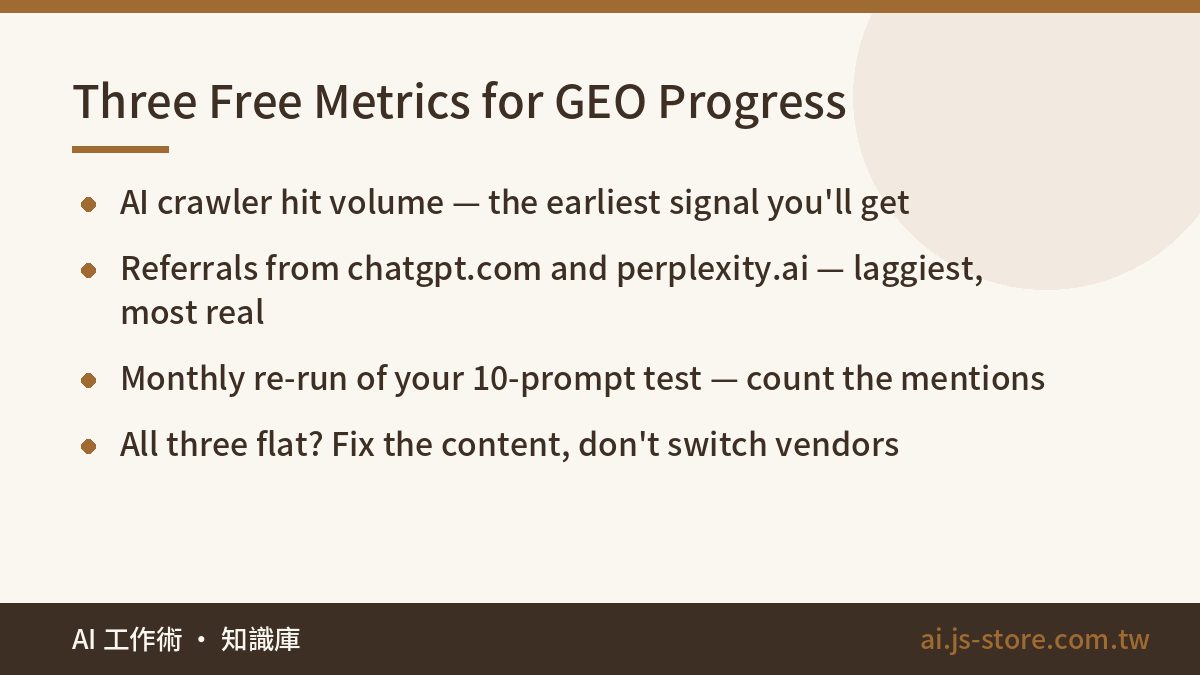
GEO has a slower feedback loop than SEO. Do not expect a signal in two weeks, and do not let anyone sell you a two-week case study. Three metrics are enough:
1. AI crawler hit volume. Daily requests from GPTBot and OAI-SearchBot in your logs. This is the earliest signal you'll get. On our own site, crawlers went from occasional visitors to daily regulars once the content library crossed a certain depth — nothing changed technically, there was just more worth fetching.
2. Referral traffic from AI surfaces. Sessions in your analytics with chatgpt.com or perplexity.ai as the source. This is the laggiest metric and also the only one that's unambiguously real revenue-adjacent movement.
3. Movement in your brand prompt test. Re-run those same 10 questions monthly. Are you mentioned in more of them than last month?
If all three are flat, the answer is almost never "switch tools." It's that you don't have enough content worth citing yet, or the content you have buries its answers. Go fix that first. Switching monitoring vendors while your content stays the same changes the chart, not the outcome.
FAQ
Q: Is there a free GEO software?
There's no complete free monitoring platform, no. But the four steps in the zero-budget section above — the brand prompt test, the crawler log check, llms.txt, and the render check — are the manual version of what the paid tools' core features do. For a small site, that's genuinely enough, and it costs you about ninety minutes a month.
Q: How is GEO software different from an SEO tool?
SEO tools measure Google rankings and keywords. GEO tools measure how often you appear in AI-generated answers and which sources get cited with you. Underneath, the logic overlaps heavily: good content that's technically crawlable wins on both surfaces. That's exactly why the major SEO vendors are absorbing GEO features into their existing products rather than letting a separate category grow.
Q: Does a small site need to buy GEO monitoring?
Usually not. Monitoring pays off at scale — big brand, many product lines, a boss who wants a monthly report. If that's not you, your budget and your hours return far more when spent reformatting content so it's easy to quote than on a dashboard that tells you what you could already check by hand.
Q: How long until GEO shows results?
Crawler activity can respond within a few weeks of publishing. Getting cited consistently in AI answers usually takes months, and it scales with how competitive your topic is. Treat it as a long-term asset you're compounding, not a sprint with a launch date.
Q: Should we run a small test before committing to a GEO tool?
Yes, and define what success looks like before you start — which 10 prompts, what counts as improvement, how long you'll wait. We laid out that process in why your AI project needs a PoC first; it applies just as well to buying a monitoring subscription as it does to building something.