Website Content Outsourcing: The Real Cost of 3 Routes
Published 2026-09-30 · Updated 2026-10-13 · 7 min read · ShooWork (FREECO CO., LTD.)
Website content outsourcing costs more than the quote. Here's the real monthly math on writers, AI tools and managed pipelines — plus the one question to ask.
Every content site owner hits the same wall eventually. You started writing the posts yourself, it worked, then the site grew and you ran out of evenings. So you search for website content outsourcing and discover there are really only three roads: hire freelance writers, buy an AI writing tool and do it yourself, or pay someone to run the whole production line for you.
Short version, before the details: writers cost money, AI tools cost you time, and a managed pipeline converts both into a fixed monthly fee. The quote you get is never the real number — the real number is the quote plus the hours you spend briefing, chasing, checking, rejecting and re-editing. On a site that publishes daily, those hidden hours usually cost more than the invoice.
We're not writing this from the sidelines. We operate our own AI tool platform, our own video-editing engine and our own ads tooling, and our knowledge base has close to 200 published articles that came off a pipeline we built ourselves. Everything below is what the three routes actually felt like from the inside — including the parts we got wrong.
What Outsourcing Website Content Actually Costs
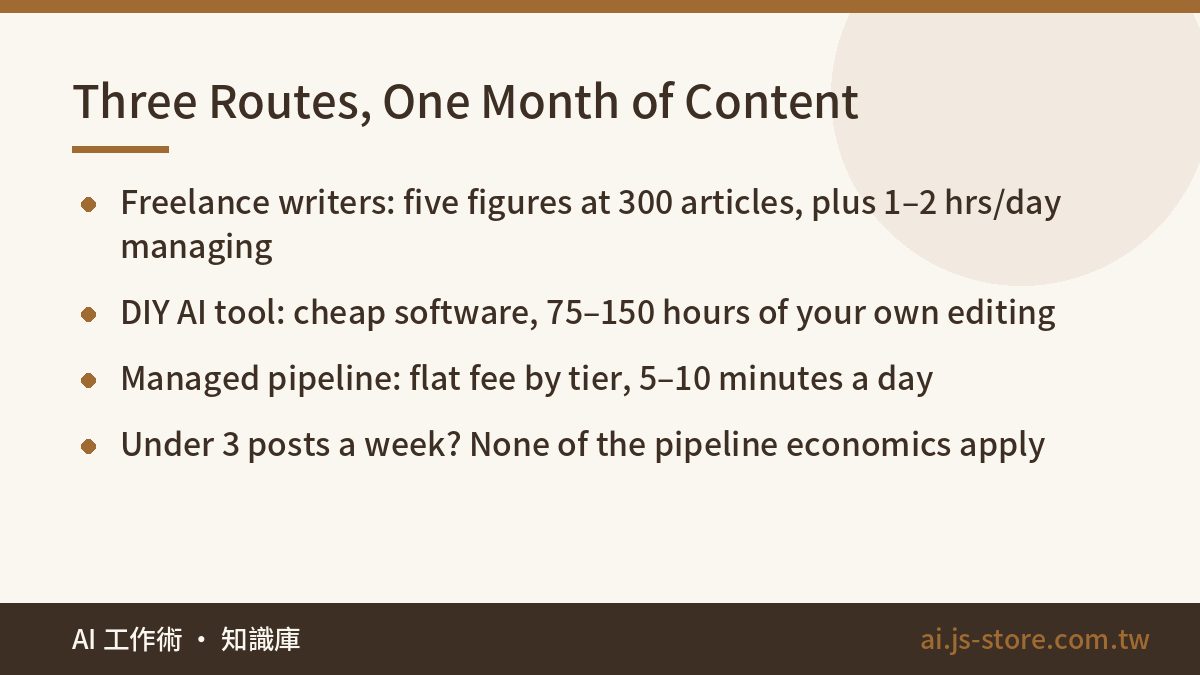
Let's use a concrete baseline so the comparison means something: 10 articles a day, roughly 300 a month. That's a real media or e-commerce content target, not a hypothetical. Scale the numbers down proportionally if you publish less.
| Route | On the invoice | Hidden cost | What it really costs per month |
|---|---|---|---|
| Freelance writers | Typically $40–150 per article, so roughly $12,000–45,000 at 300 articles | Briefing, chasing late drafts, editing, sending work back, and re-onboarding every time a writer leaves. Images and licensing almost always stay your problem. | Five figures, plus 1–2 hours of your day, every day |
| AI tool, DIY | $40–100 a month for a subscription | You become the full-time editor. Fact-check, run a duplication check, source an image, confirm the license, format, publish. Call it 15–30 minutes per article. | Cheap software, plus 75–150 hours of your own labour |
| Managed pipeline | A flat monthly fee by volume tier — see /en/pricing for current numbers | One proper onboarding conversation about what you sell and who buys it. After that, spot-checking the audit report. | Fixed fee, plus 5–10 minutes a day |
The pattern is the point. Writers are expensive in cash and moderately expensive in time. AI tools are almost free in cash and brutally expensive in time — that 15–30 minutes per article is the cost nobody puts in the spreadsheet, and it's the reason most DIY content plans quietly die in month three. A pipeline's whole argument is that it moves you from cost = people × volume to cost = fixed fee.
Which also tells you when a pipeline is the wrong purchase. If you publish two posts a week, the per-unit economics never kick in — you're buying capacity you won't use. Write those yourself with AI assistance and spend the money on something else. We'd rather say that up front than sell you a tier you'll cancel.
The Real Risk Isn't the Price — It's Publishing Something Embarrassing
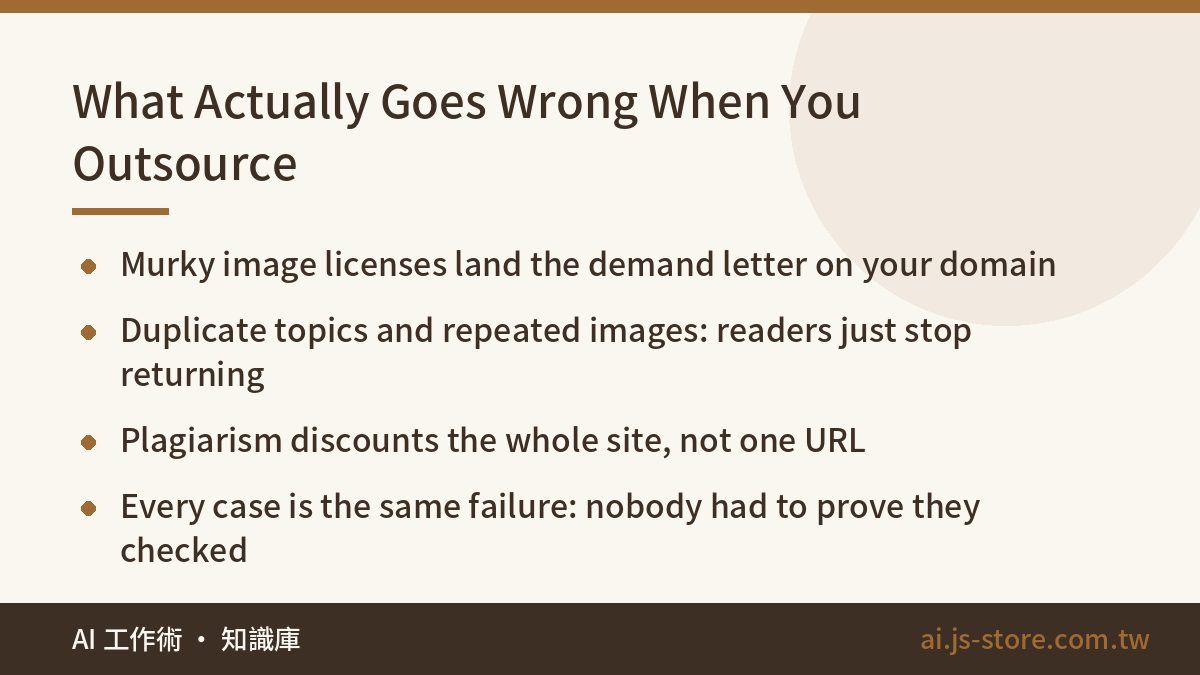
We've asked a lot of site owners why they haven't outsourced yet, and the answer is remarkably consistent. It isn't budget. It's that when the quality goes wrong, it's your domain wearing the consequences, not the vendor's. Three specific failures:
- The copyright letter. A writer or a tool grabs a convenient image, the license is murky, and eight months later a demand letter arrives. Your purchase order does not protect you. You published it.
- Readers noticing. A caption that doesn't match the photo. Two articles arguing opposite things. The same stock image on four posts in a row. Nobody emails to tell you — they just stop coming back, and the traffic drop looks like an algorithm update.
- Search engines discounting you. Plagiarised or lightly-reworded content doesn't damage one URL, it teaches a search engine something about the whole domain. The cheap articles end up taxing the good ones.
All three are the same failure mode: nobody checked, and nobody was required to prove they checked. That's what you're actually buying when you outsource — not words, verification.
One Question That Separates Real Vendors From Resellers
When you evaluate any content supplier — freelancer, agency, software, us — ask exactly this: "When you deliver, can you attach the evidence?"
Evidence means specific artefacts, not reassurance:
- An originality score per article, as a number, from a named check.
- A license chain per image: where it came from, under what terms, and confirmation it carries no watermark.
- A duplication check against your existing archive, not just against the open web — self-cannibalisation is the most common problem on sites past 100 posts.
- Samples pulled from the vendor's own live site, not a slide deck. If their pipeline is good, they're running it on themselves.
If a supplier can't produce those, the low price isn't a discount — it's the cost of the risk, moved onto you. That's also the honest lens for judging AI tools, and it's why we split them into categories in AI article writing tools: writer vs generator vs pipeline. A generator that hands you raw text has silently made you the QA department.
How We Run It — And Who Shouldn't Buy It
ShooWork Write is the pipeline we built for our own knowledge base, packaged for other people's sites. Each day it picks topics based on your industry and your audience, drafts original articles, generates a cover image that passes a watermark scan and a relevance check against the article's actual subject, adds an FAQ block with structured data so Google and AI assistants can quote it cleanly, runs the audit, and delivers into your WordPress or as a downloadable bundle — with a line-by-line audit report you can verify yourself.
The architecture matters more than the branding, and we've written up the ugly parts of building it in how one person ships a team's worth of posts. Short version: the generation step was the easy 20%. The checking, the deduplication and the delivery were the other 80%, and that's precisely the 80% a bare tool subscription leaves on your desk.
We take new sites by appointment: we run one day's batch on your actual topics first, you look at it, and you decide. We don't promise rankings — anyone who does is guessing on your behalf — and we turn down volume-padding jobs. Content is for readers. That's the only version of this that survives more than a year. Pricing by tier is on /en/pricing; if you want to see how we handle tooling generally, /en/free is a reasonable place to start.
The Pre-Outsourcing Checklist
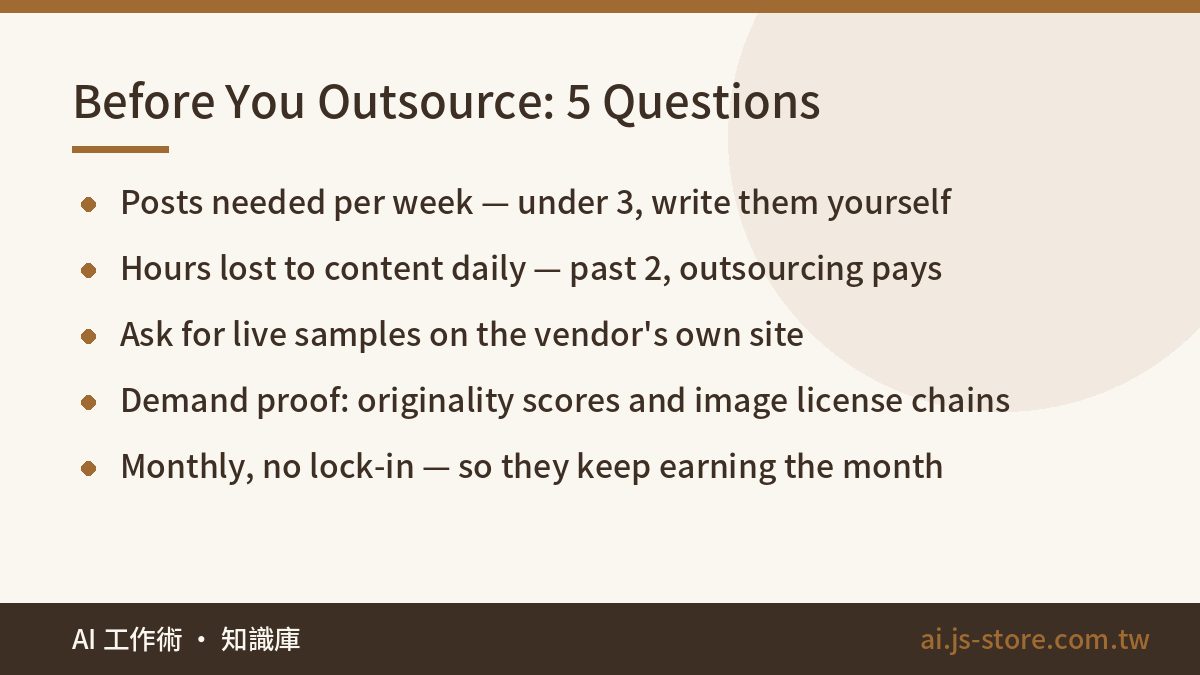
Five questions, in order. Answer them honestly and the decision usually makes itself.
- How many posts does my site genuinely need per week? Under three, keep writing them yourself with AI assistance. Outsourcing overhead will eat the gain.
- How much time do I lose to content each day right now? Past two hours, outsourcing starts paying for itself. Under one, you're optimising the wrong thing.
- Can the vendor show me output running on their own site? Live URLs. Watch what they do, not what they present.
- Does the delivery include proof? Originality numbers, image license chain, archive dedupe. No proof, no deal.
- Is it monthly with no lock-in? A vendor you can leave at any time has a reason to keep earning the month. A twelve-month contract removes that reason.
One more, which isn't about cost but bites later: know where your brief, your product data and your customer information end up when you hand them to a supplier or a tool. We covered that in where does your company data actually go. Ask before onboarding, not after.
FAQ
Q: Is outsourcing website content cheaper than hiring an in-house writer?
At low volume, no — a part-time writer who understands your product beats any outsourcing arrangement. The crossover comes with volume and consistency. One in-house writer realistically produces a handful of solid articles a week; if you need daily output across several topic clusters, you're comparing one salary against a pipeline that doesn't take holidays. Do the math on your actual publishing target, not your aspirational one.
Q: Will AI-written articles get my site penalised?
Not for being AI-written. Search engines target unhelpful, duplicated, low-value content regardless of how it was produced — and a lot of AI output is exactly that, which is why the reputation exists. The controllable variables are originality, factual accuracy, whether the article answers a real question, and whether it duplicates something you already published. Enforce those and the production method stops being the issue.
Q: How do I check an outsourced article before publishing?
Five minutes, in this order: does the opening answer the search query in the first two paragraphs; are the specific claims and numbers verifiable; is the cover image licensed and actually relevant; does it overlap an existing post on your site; does it sound like your brand or like nobody in particular. Anything a vendor can't automate here, you'll be doing 300 times a month — price it accordingly.
Q: What's a realistic monthly budget for outsourced website content?
It depends entirely on volume and on how much verification is included, so the honest answer is to define your output target first, then compare. Freelance rates vary widely by language and niche; tool subscriptions look cheap until you count your own hours; managed pipelines quote by volume tier. Check the official pricing page of anyone you're evaluating, including ours, and compare total cost of ownership rather than the per-article figure.
Q: Can I mix approaches instead of picking one?
Yes, and most mature sites do. The pattern that works: a pipeline handles breadth — the informational and long-tail articles that need to exist consistently — while you or a specialist writer personally handle the ten or fifteen pages that carry your positioning, pricing and original research. Automate the volume, keep the voice. Trying to automate the voice is where content operations lose their audience.