How to Learn From the Pros With AI: A 10-Minute Teardown Method
Published 2026-10-02 · Updated 2026-10-13 · 7 min read · ShooWork (FREECO CO., LTD.)
Stop admiring great copy and start dissecting it. A 4-step AI teardown method, a copy-paste prompt, and the line between learning and plagiarism.
The fastest learners you know usually aren't more talented than you. They just take things apart. When most people see a sharp landing page, a LinkedIn post that blows up, or a pitch deck that actually closes, they think 'that's good' and keep scrolling. People who improve fast stop and take it apart. They work out the skeleton, then rebuild it with their own material.
AI makes that habit cheap. Paste a piece of work into Claude or ChatGPT and ask the right questions in the right order. In about 10 minutes you get a labeled breakdown of what each part is doing, the reusable principles behind it, and a blank template you can fill with your own topic. Below is the four-step method we use, a prompt you can copy, and the mistakes that turn this into either plagiarism or wasted time.
One rule comes first: you're borrowing the technique, not the content. Technique means structure, pacing and the way the piece persuades. If you change two words in someone's paragraph and post it, that's copying. If you take the structure and fill it with your own experience, that's learning. Everything below assumes you're doing the second.
Why Taking It Apart Beats Reading It Twice
Reading tells you something is good. Taking it apart tells you why it's good and how to do it again. Those are very different skills, and only the second one builds over time.
Most of what makes a strong piece work is structure you don't notice on a first read. How does the opening hook you? In what order does the information arrive? Where does the emotional push land? How does it close without feeling like a sales pitch? On a casual read you take in the effect and miss how it was built. That's why you can read a hundred great posts and still stare at a blank page when it's your turn.
AI is good at this kind of analysis for one reason: the topic doesn't pull it in. When you read a great post about something you care about, you get absorbed in the ideas and stop noticing the scaffolding. The model doesn't. It just labels the parts, so it's usually more detached and objective than you'd be on your own. It's also fast. In the time it takes to properly analyze one piece by hand, you can tear down five.
Don't trust its analysis blindly, though. Models sometimes invent a clever-sounding reason a paragraph works when the real reason is simpler. Every time it labels a section, glance back at the original and check that the label fits. That habit also trains your own eye, which is the real goal.
The 4-Step AI Teardown (10 Minutes, Start to Finish)
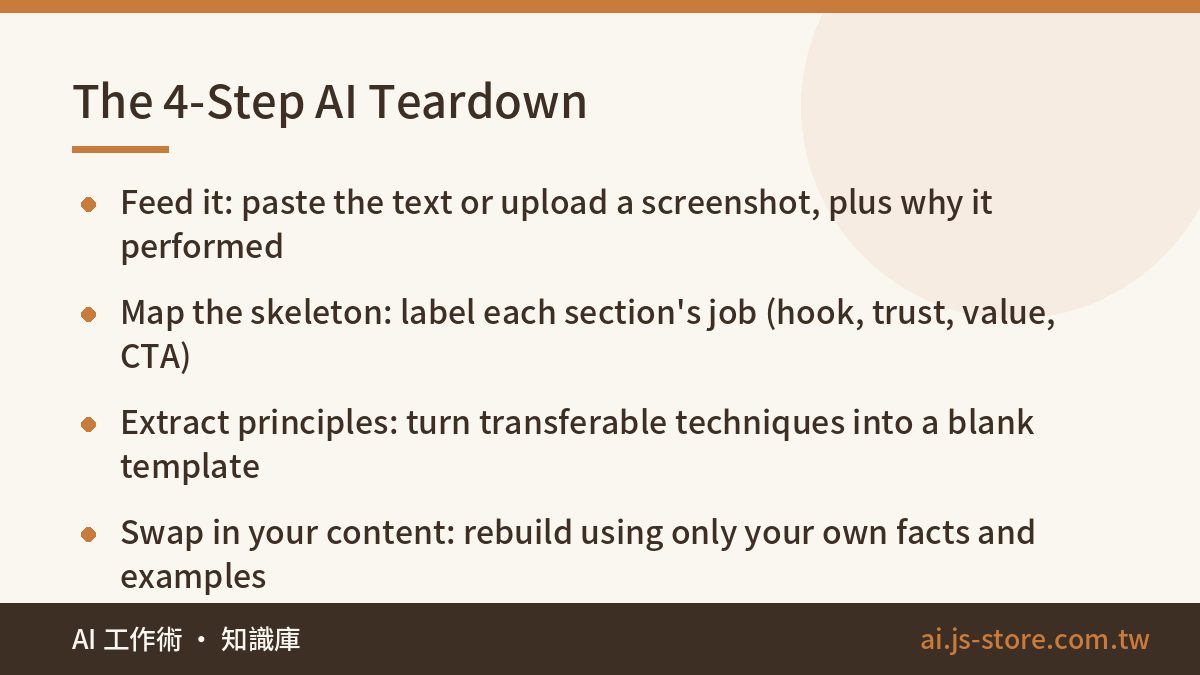
You don't need any special tooling. The regular web version of Claude or ChatGPT is enough: paste text or upload a screenshot. Go in this order and don't skip ahead:
- Feed it the raw material (about 2 minutes). Paste the copy, post or slide text, or upload a screenshot. Current models read text in images without trouble. Add a line of context: where it ran, who it was for, and why you think it performed (shares, comments, conversions, if you know). Tear down one piece at a time. If you paste five at once, you get a mushy average.
- Map the skeleton (about 3 minutes). Ask it to go section by section and label the job of each part: hook, credibility, value, example, call to action. It should also explain what each section is doing for the reader. This is the X-ray.
- Extract the principles (about 2 minutes). Ask which techniques would carry over to a completely different topic, and have it turn them into a reusable template with blanks.
- Swap in your own content (about 3 minutes). Hand it your topic and your raw notes, and say: 'Use this structure for my subject, but every fact, example and opinion has to come from my notes.' If you don't have notes yet, fill in the template yourself first and use the AI only to tighten it.
Here's what this looks like in practice. Tear down a handful of high-share social posts and you'll see the same rhythm almost every time. The first line hooks with a contrast or a specific number. The middle tells one real example that builds trust. The end asks for something low-effort, like a comment, a save, or tagging a friend. Most people walk away remembering 'that was a good post.' You walk away with a rhythm you can reuse next week on a different topic.
A Teardown Prompt You Can Copy
Paste this into the chat, then add the piece you want to analyze:
“This piece performed well. Please do three things: (1) Break down its structure section by section and label the job of each part: hook, build trust, deliver value, or call to action. Explain why each section is there. (2) Pull out 3 techniques or principles I could reuse on a completely different topic. (3) Turn it into a blank fill-in template I can use for my own subject. Do not rewrite it into new content yet. Give me the template first.”
That last line matters more than it looks. Without it, most models skip straight to writing a 'version for you.' What you get is a lightly paraphrased clone of the original, which is exactly what you're trying to avoid. Asking for the template first keeps the model on the structure and keeps your own content separate from the source.
Two follow-ups are worth adding once you have the template. First, ask 'Which of these techniques would backfire with my audience, and why?' A hook that works for consumer lifestyle content can come across as cheap to a B2B buyer. Second, ask 'What's the weakest part of this piece?' Great work still has flaws, and copying those along with the strengths is a common trap.
Which model you use matters less than how you ask, but there are real differences in how they handle long documents and screenshots. Our guide on choosing between Claude and GPT covers the practical checks. If you'd rather start from tools that are already set up, browse ShooWork tools.
How We Use This Inside ShooWork
We run our own AI tool platform: ShooWork Clip for video editing, ShooWork Write for SEO articles, and ShooWork Ads for Google Ads. Most of the content that has done well for us started with a teardown. We weren't copying. We were borrowing structures the market had already proven and filling them with our own first-hand experience and data.
A few places it shows up in our own work:
- Ad copy. Before we write responsive search ad headlines, we look at the competitor ads that keep holding the top spots. We don't lift their lines. We want to see which angles they rely on: speed, price, proof, risk reduction, or specificity. Then we pick angles they aren't covering. Our RSA ad copy guide covers what to do with those angles once you have them.
- Video hooks. While building our video-editing engine, we studied how talking-head videos that hold attention open their first few seconds. The patterns were consistent: a claim, a question, or a result shown up front. That shaped how we think about where a clip should start.
- Articles. Before writing on a competitive topic, we tear down the structure of the pages that already rank: what they answer first, how they break up sections, what they leave out. Then we write our own version with our own numbers. It's built into the content pipeline we use to ship consistently.
The biggest saving isn't time. It's the trial-and-error you skip. Every time you start from a structure that has already worked, you avoid a round of publishing something, watching it flop, and guessing why.
Mistakes That Waste the Whole Exercise
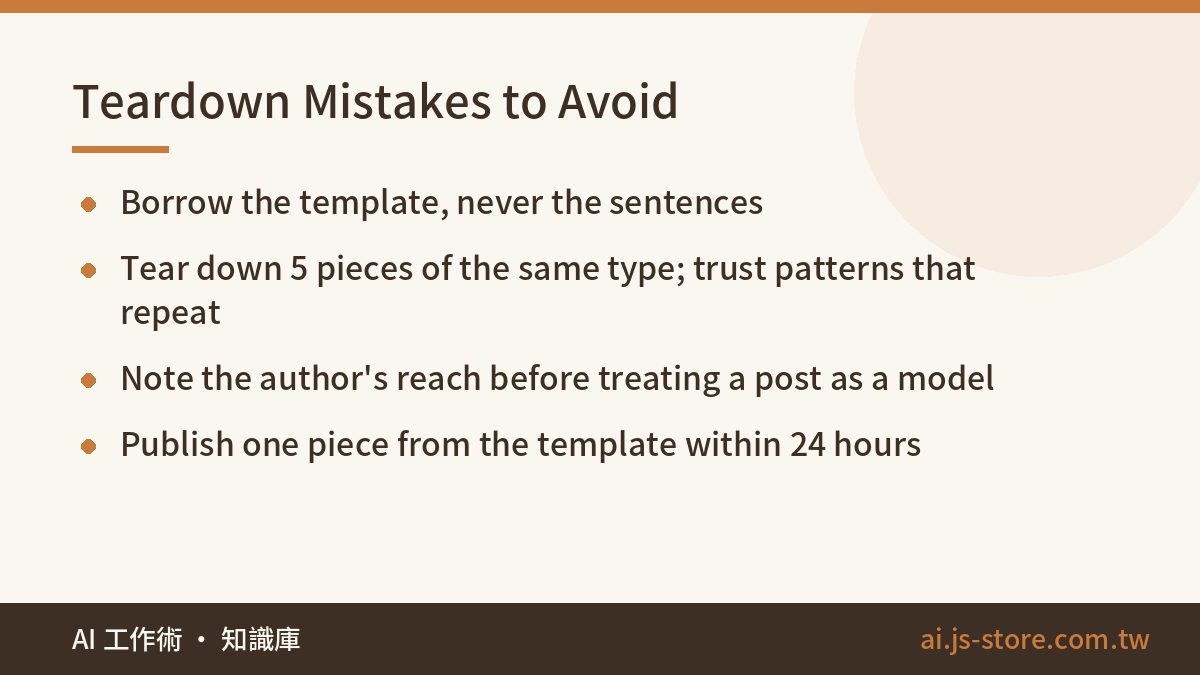
The method is simple, which makes it easy to do badly. These are the mistakes we see most often:
- Copying content instead of structure. Borrow the template, never the sentences. If your version only works because of the original author's examples, phrasing or opinions, it isn't yours. It's also worth less, because readers who have seen the original will notice, and so will search engines.
- Tearing down only one piece. A single post can do well for reasons that aren't on the page: timing, the author's existing audience, or luck. Tear down five pieces of the same type. Patterns that show up in four of the five are the real formula. One-offs are just noise.
- Ignoring context. A post from an account with a huge following doesn't prove the structure works for a brand-new account. Write down who made each piece and how big their reach was before you treat it as a model.
- Analyzing and never shipping. A teardown only gives you input. It doesn't become a skill until you use it. Give yourself 24 hours: take the template, write one piece on your own topic, and publish it. Ten teardowns you never act on are worth less than one you actually use.
If you only change one thing, make it the last one. People who get good at this aren't the ones with the biggest swipe files. They're the ones who close the loop: tear down, rebuild, publish, check results, repeat.
FAQ
Q: Is using AI to deconstruct someone else's work plagiarism?
No. Analyzing structure to learn from it isn't plagiarism. Copying the content is. The rule is to borrow the technique and replace the content. Anyone can learn a structure, but what you fill it with has to be your own topic, examples and point of view.
Q: Do I need a technical background to do this?
No. The web versions of Claude and ChatGPT let you paste text or upload a screenshot and ask questions in plain language. There's no code involved. It works like a normal chat.
Q: Do I need a paid AI plan for teardowns?
For analyzing a single post or page, a free plan is usually enough. If you want to tear down many pieces at once, upload long documents, or work with lots of screenshots, a paid plan handles long inputs more smoothly. Check each provider's official pricing page for current limits.
Q: How can I tell if I've crossed from learning into copying?
Put your finished piece next to the original. If the sentences or examples look alike, you've copied. If the only thing they share is the shape, say 'hook, then value, then call to action', and every line of content is yours, you've learned the technique the right way.