Meta Ads vs Google Ads: Where to Spend a Small Budget First
Published 2026-10-19 · Updated 2026-10-19 · 8 min read · ShooWork (FREECO CO., LTD.)
Meta Ads vs Google Ads on a tight budget? A three-question test to pick your first platform, how to split spend as you grow, and the mistakes that burn cash.
Short answer: if people are already typing your product category into Google, put your limited budget into Google Search ads first. If nobody searches for what you sell, or it only makes sense once someone sees it in action, start with Meta. Neither platform is simply better. What matters is whether demand for your product exists yet.
Most small businesses don't struggle with the choice itself. They struggle with committing to one side. So they take $1,000 a month and split it, half to Google and half to Meta. Neither side gets enough conversions for the bidding algorithms to learn. After four weeks both look terrible, and the founder decides that ads don't work. That's the wrong conclusion. On a small budget, the most expensive cost isn't the click. It's chopping your data into pieces too small to mean anything.
We see this from both sides at ShooWork. People actively search for our tools platform, so search ads do most of the work. ShooWork Clip, our video editor, is something people only want once they know it exists. For Clip, Meta creative testing is the engine. It's the same team with the same tracking and opposite strategies, because demand for the two products is in a different state. Here's how to work out which state your product is in.
Google Catches Demand, Meta Creates It
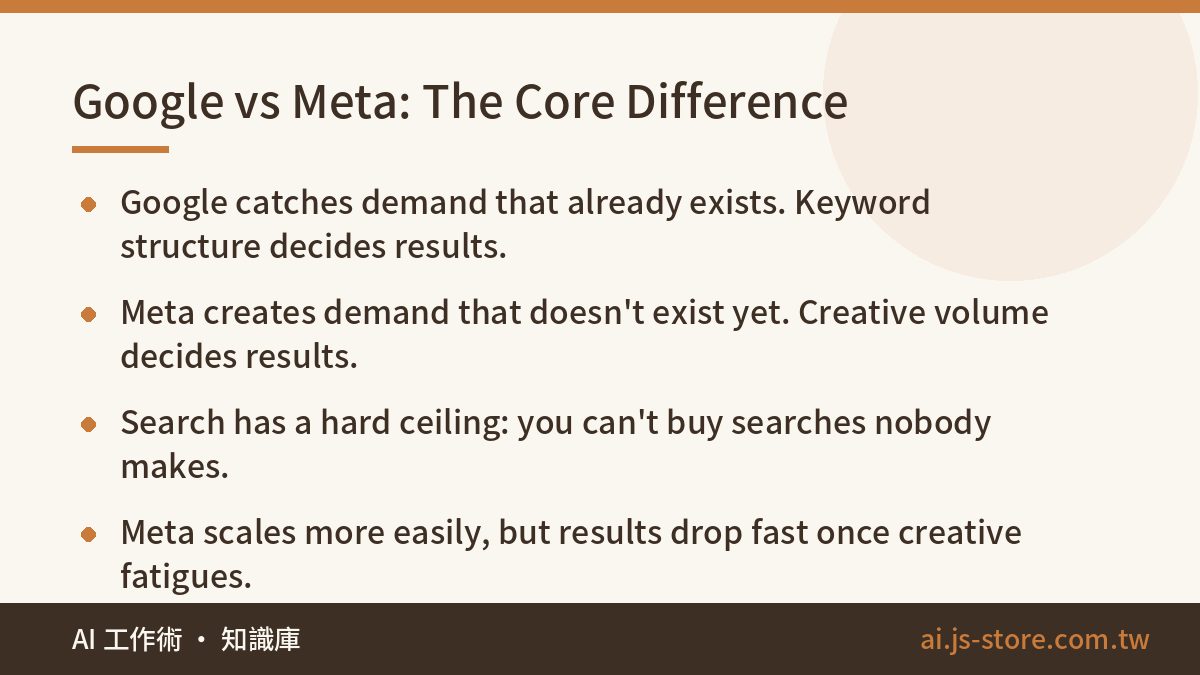
Google Search ads catch demand that already exists. When someone types “best air purifier for a small apartment,” they already have a problem and they're heading toward a solution. Your ad just has to be there when they search. Success comes down to choosing the right keywords and writing copy that matches what that person wants right now.
Meta ads work where there's no demand yet. People are scrolling, not shopping. Your ad has one or two seconds to make them stop. It has to spark interest first, and only then can that interest turn into wanting the product. That's why results on Meta depend almost entirely on creative. Advantage+ placements and broad audiences are now the default, so audience settings matter far less than they used to. The ad itself does the targeting.
| Dimension | Google Search ads | Meta ads |
|---|---|---|
| Demand | Already exists, people are looking | Not formed yet, has to be sparked |
| Trigger | Keywords matched to search intent | Algorithm predicts interests and behavior |
| What decides results | Keyword structure, negative keywords, landing page | Creative volume and creative angle |
| Creative needs | Mostly text, one set can last for months | Video and images, new angles every week |
| Time to results | Faster if search volume exists | Needs a testing period until a creative hits |
| Scale ceiling | Capped by search volume | Capped by creative and market size, easier to scale |
| Typical weakness | Useless if nobody searches the category | Performance drops fast once creative fatigues |
The most important row is the scale ceiling. Search has a hard limit: you can't buy searches nobody makes. We often see accounts with great search results, 5x ROAS or better, where the owner tries to add budget and the platform simply won't spend it. Better optimization won't fix that, because the pool of searchers is only so big. Past that point, growth has to come from a channel that creates demand, and Meta is usually the first one to try.
Which One First? A Three-Question Test
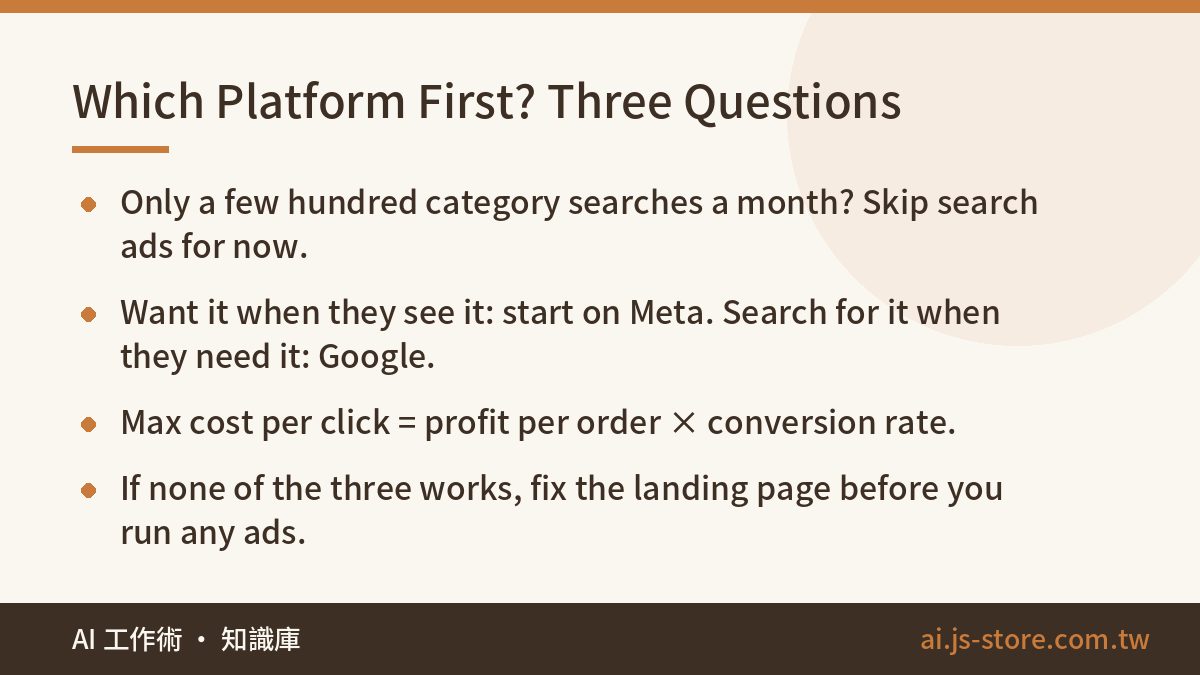
Don't go on gut feel. Answer these three questions and the choice is usually obvious.
- Does your category get searched? Put your category terms, problem phrases (“how to fix…”, “best X for Y”) and competitor names into Google's Keyword Planner. If they add up to only a few hundred searches a month in your target market, very few people are looking, and search ads will bring almost no traffic. If you fail this question, skip search for now and don't bother with the other two. If you've never done this properly, our guide to keyword research with AI explains how to group keywords by intent.
- Do people want your product when they see it, or search for it when they need it? For designer jewelry, specialty desserts, fitness programs and new kinds of services, the visual does the selling, so Meta has a clear edge. For spare parts, consumables, repairs, certification courses and supplements, people search when the problem shows up, so search is the more direct route.
- Can your margin cover the cost per click? Do the math: gross profit per order × site conversion rate = the most you can pay per click and still break even. Say you make $40 profit per order and 2% of visitors buy. Anything above $0.80 per click loses money. If bids for your category's keywords run well above that, search won't pay off yet. Raise your order value, improve your conversion rate, or start on Meta.
Most people end up in one of four situations:
- Search volume and a high-intent category: Put 100% into Google Search first. Get your category terms and long-tail question keywords stable before you add anything else.
- No search volume and a visual product: Put 100% into Meta. Spend your effort on making more creative, not on splitting audiences.
- Both could work but the budget is tiny: Pick the side where you already have material. A library of video footage points to Meta. Clear product copy and a landing page that already converts point to Google.
- Neither works: This happens more often than you'd think. The cause is usually a low order value or a landing page that doesn't convert. Fix the site first. Ads amplify whatever is already there, problems included.
How to Split the Budget as You Grow
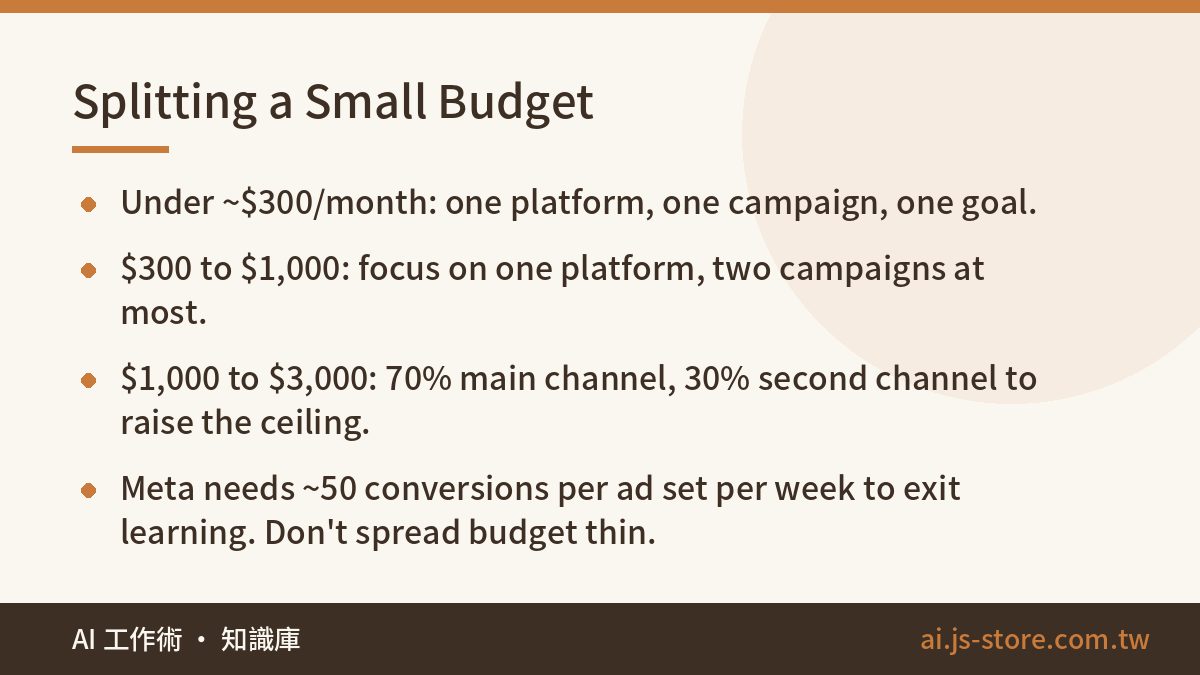
There's no fixed ratio. The split changes as you grow.
Stage 1: Prove it. You have one goal here: get one channel to a steady cost per acquisition (CPA) you can trust. Put 90% or 100% of the budget on one platform. The reason is how the bidding works. Automated bidding on both platforms needs enough conversions before it stabilizes. Meta's own guidance is about 50 conversions per ad set per week to exit the learning phase, and Google's Smart Bidding has similar data needs. Split $1,000 into two $500 halves, then split each half into three campaigns, and each campaign gets only a handful of conversions a week. The algorithm never gets enough data to stop guessing.
Stage 2: Expand. Once your first channel's CPA has held steady for two to three weeks, move 20 to 30% of the budget to the second one. The point of the second channel isn't to spread risk. It's to raise the ceiling. If you started on search, Meta now reaches people who don't know you exist yet. If you started on Meta, start Google with your brand terms. People who see your Instagram ad will search your name later. If you're not bidding on your own name, a competitor can be, and those customers go to them.
Stage 3: Mature. Search protects what you have and converts people who are already looking. Meta finds new customers and grows your audience. Retargeting follows up with the people both channels bring in. The split usually lands between 60/40 and 40/60, depending on how much search demand your category really has.
| Monthly ad budget | What to do |
|---|---|
| Under ~$300 | One platform, one campaign, one conversion goal. Skip retargeting because you won't have enough traffic for it. |
| $300 to $1,000 | Focus on one platform, with two campaigns at most. |
| $1,000 to $3,000 | 70% to your main channel, 30% to the second. Start bidding on your brand terms and add retargeting. |
| $3,000+ | Run both, each with its own goals and metrics. Meta finds new customers, search converts existing demand. |
One exception: big sales events don't follow this gradual pace. During a Black Friday push, put more money into combinations you've already proven. Save new experiments for later.
Where the Money Actually Goes: Keywords vs. Creative
The two platforms spend your money in different ways, and that changes what you have to put in besides the ad budget.
On Google Search, you pay for keywords. Advertisers bid on the same terms, and the price depends on competition and ad quality. The hidden cost is upkeep. You have to keep adding to your negative keyword list and check the search terms report regularly. Otherwise a chunk of your budget quietly goes to searches that have nothing to do with you. The upside is that a well-written ad can run for months without changes.
On Meta, you mostly pay for impressions, and the hidden cost is producing enough creative. After two or three weeks with the same video, people see it too often, your audiences overlap and results drop. It happens to every ad, so it doesn't mean you did something wrong. To keep results steady, you need several new creatives going into testing every week, and they need to be genuinely different. A new caption or different opening music doesn't count. You need a different pain point, a different situation or a different way into the story.
That's exactly why we automated our own editing. Editing one video by hand took about two hours, and we needed five new angles a week. Making creative took up the whole team's time. Now ShooWork Clip handles the repetitive parts, like subtitles, aspect ratios, intros and outros. People only decide which angle to try next. That's how we started producing creative as fast as Meta wears it out. If you run a one-person business, plan this before you launch on Meta, or you'll run out of fresh creative by week three.
Attribution: Why Meta's Dashboard Always Looks Better
Once you run both platforms, you'll see something like this. Meta says it drove $30,000 in revenue, Google says $20,000, and your store shows $35,000 in total. Together the platforms claim more than you actually made. Neither platform is lying. They use different attribution windows and models, so the same orders get counted twice.
By default, Meta credits itself with purchases made within a set window after someone clicks an ad. Depending on your settings, it also counts purchases from people who only saw the ad. Google uses its own attribution model. Say a customer sees you on Instagram, searches your brand on Google three days later and buys. Both platforms claim that order. Since Apple's App Tracking Transparency, a meaningful share of the conversions Meta reports are also estimated by its model instead of directly tracked, which makes the gap even bigger.
So what should you do? Don't compare ROAS between the two dashboards. Use a blended number instead: total actual revenue divided by total ad spend, often called MER (marketing efficiency ratio). Then shift some budget between the platforms and watch which way that number moves. Use each platform's own numbers only to compare things within that platform, such as which campaign or creative is winning. Base decisions about moving money between platforms on the blended number. That tells you far more than the dashboard numbers do.
Four Budget Mistakes to Avoid
- Spending a little on both, so neither gets out of the learning phase. We covered this above, and it's the most common and most expensive mistake on a small budget. Get one side stable before you start the second.
- Moving budget because Meta's ROAS looks higher than Google's. The platforms use different attribution rules, so that comparison doesn't hold up. People who move the money usually find total revenue stayed flat or dropped.
- Bidding only on brand terms in Google and trusting the ROAS. People who search your brand name were going to buy anyway. Much of that spend just pays for visitors who would have come through organic results for free. Keep bidding on brand terms, but don't count them as growth. Judge Google by your CPA on non-brand keywords.
- Changing audiences instead of creative when Meta results drop. In our experience, about nine out of ten drops come from creative fatigue. Changing audiences, bids or budgets mostly just restarts the learning phase. The numbers look different for a couple of days and then drop back.
One last trap is a mindset one. Don't treat your first platform as a permanent decision. It's only a starting point. What matters is whether you get clean enough data within three to four weeks to decide whether to spend more or pull back. That's the reason to put everything on one side: with clean data, you can decide quickly. If you don't have time to make daily adjustments yourself, you can hand campaigns and new creative to ShooWork Ads. We compare the options in agency vs. in-house vs. AI. Whoever runs your ads, the same logic applies.
FAQ
Q: Is $300 a month enough to run ads at all?
Yes, but it's only enough for one thing. Choose one platform, one campaign and one conversion goal, and run it for at least three full weeks before you judge it. At this budget, skip retargeting, don't split audiences and don't test five creatives at once, because you won't have enough data. The goal this month isn't profit. It's a cost-per-acquisition number you can trust.
Q: Meta's ROAS is clearly higher than Google's. Should I move all my budget there?
Not yet. The two platforms use different attribution windows and methods, so you can't compare their ROAS numbers directly. Instead, divide your actual total revenue by total ad spend, move a small amount of budget, and see whether that blended number improves. If you move 30% of the budget and total revenue doesn't change, Meta's higher ROAS was mostly double-counting.
Q: Can Google Performance Max replace Meta?
We wouldn't plan on it. Performance Max does serve ads beyond search, on YouTube and Discover for example, so it overlaps with Meta somewhat. But its creative still works differently from native social content. It also mixes people searching with people just browsing in one campaign, so you can't tell where results come from. On a small budget, we prefer to get search working well first and then decide whether to expand into Performance Max or Meta.
Q: How long should a new campaign run before I decide whether to kill it?
Judge by conversions, not days. Wait for at least 30 to 50 conversion events before you decide. If conversions are rare in your category, track earlier steps like add-to-cart or form starts instead. In practice, we review campaigns in three-week blocks. Don't touch a campaign in its first three to five days, because those numbers tell you almost nothing.
Q: For B2B or high-ticket services, which should I start with?
In most cases, start with Google Search. B2B buyers usually search with a specific problem in mind, so the intent is clear, and a high order value can cover more expensive clicks. Meta works better in B2B for retargeting with content and staying in front of leads you already have. It rarely closes deals with people who have never heard of you.