AI for Small Businesses: 3 Myths and 3 Real Opportunities
Published 2026-09-23 · Updated 2026-10-14 · 7 min read · ShooWork (FREECO CO., LTD.)
Most small-business AI projects fail for three predictable reasons. Here's what we got wrong running our own company, and the three places that pay back.
When we talk to owners of small and mid-sized companies about AI, we hear two opposite reactions, and both of them cost money. The first is "that's a big-company thing, we don't have engineers, we can't play that game." The second is the mirror image: someone watched three success stories in a short-form feed and now wants to go "fully AI" across the whole business by next quarter. Group one does nothing for two years. Group two spends a lot, hits a wall, and quietly abandons the whole thing in four months, having concluded that AI doesn't work.
Here's the short answer if you read no further. You do not need to hire an AI team. You should not start with your hardest problem. And buying software licences is not adoption. Pick one boring, repetitive, high-frequency process. Validate it in two weeks with off-the-shelf tools and a well-written prompt, no code involved. Only pay for a real integration after you have watched the time savings happen with your own eyes. The whole experiment should cost you a few hundred to low four figures, not a six-figure transformation project.
We write this as a small company ourselves, not as consultants with a slide deck. ShooWork is a lean team running an e-commerce operation, an AI product line and a SaaS platform at the same time. We build ShooWork Clip for video editing, ShooWork Write for SEO articles, and ShooWork Ads for campaign management. Every mistake below is one we paid for first.
Myth 1: You Need to Build an AI Team First
You don't. The large language models everyone is talking about are services you call over an API. Nobody at your company is going to train one, and nobody should try. You are not buying machine learning capability, you are buying access to somebody else's model and wiring it into your workflow.
What a small company actually needs is two things. First, someone who genuinely understands your processes — which steps are slow, who checks what, where the rework comes from. That person already works for you and cannot be hired from outside, because the knowledge is specific to how you operate. Second, someone who can connect systems: read an API doc, move data between your CRM and a model, handle errors. That one is a commodity. You can contract it, use a freelancer, or in a surprising number of cases avoid it entirely by using tools that already have the integration built.
The companies that get this backwards treat AI like an ERP rollout. They hire a consultancy, scope a twelve-month program, and end up with an expensive system nobody uses because the people who understood the process were never in the room. If your first AI conversation is with a vendor rather than with your own operations lead, you are already off track.
Myth 2: Starting With Your Hardest Problem
Ask an owner what they want AI for and you usually get the grandest possible version: "I want it to make purchasing decisions," "I want it to predict demand," "I want it to tell me which customers are about to churn." These are legitimate goals. They are also the hardest, fuzziest, most judgment-dependent tasks in your business, they need clean historical data you probably don't have, and there is no obvious way to tell whether the output is right.
Use one of those as your first project and you have maybe a one-in-ten chance. Worse, when it fails, the entire company draws the wrong conclusion — not "we picked a bad first project" but "AI doesn't work for us." That belief is expensive and it sticks around for years.
The right first project is boring. Look for work that is repetitive, has clear rules, eats human hours, and happens often enough that a 50% time saving is visible within a month. Reformatting supplier quotes. Writing first-draft product descriptions. Sorting inbound enquiries into categories. Turning a meeting recording into action items. None of it is impressive at a conference. All of it pays.
Frequency matters more than difficulty. A task that takes 20 minutes and happens 40 times a week is worth far more than a task that takes four hours and happens once a quarter. Before you commit, put a number on it — our guide to calculating AI ROI walks through turning saved hours into actual money so you can tell a real win from a fun demo.
Myth 3: Confusing a Subscription With Adoption
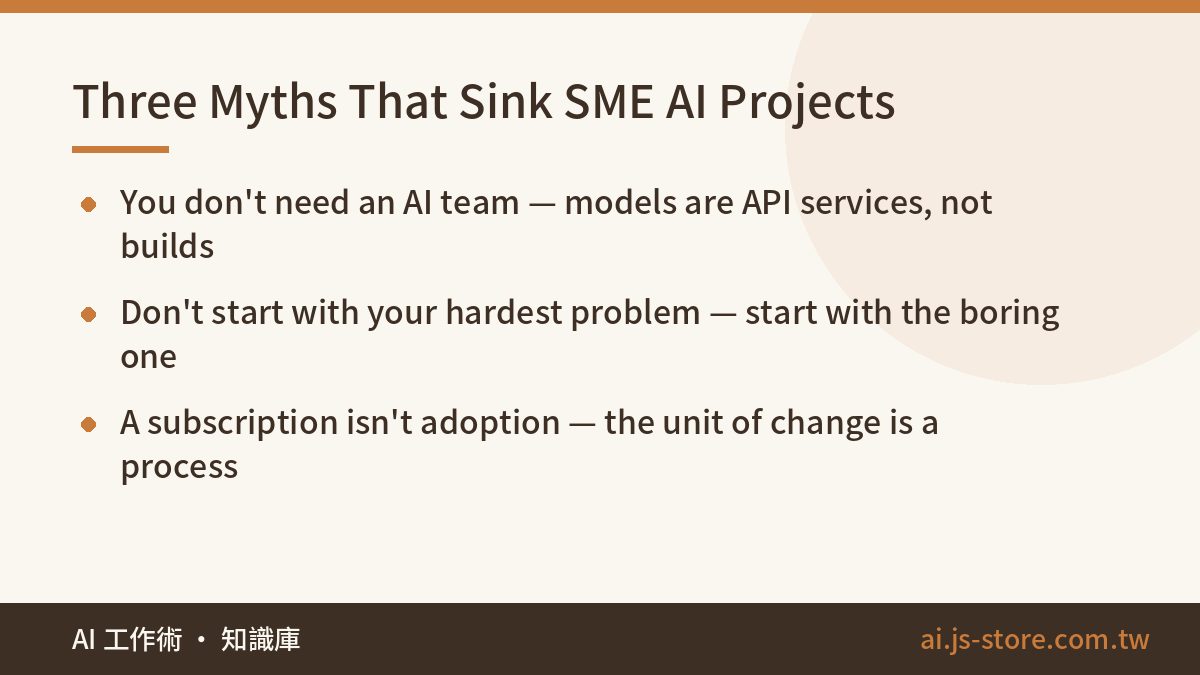
Buying a handful of seats and emailing the logins to your team is procurement. It is not adoption, and the difference is where most of the failure happens.
Adoption means you changed a process. Someone decided at which step the tool gets used, what exactly goes in, what good output looks like, who reviews it before it reaches a customer, and what happens when the model gets it wrong. Without those five answers, the predictable outcome is that three people try it for a week, two of them get a mediocre result, and in three months nobody remembers the password. You keep paying the subscription for another year because nobody cancels it.
The unit of AI adoption is a process, not a tool. Write the new process down in five lines. Assign one owner. Give it a review step. If you can't describe the new workflow in a short paragraph, you haven't adopted anything — you've just added a browser tab.
The AI dividend for small companies isn't in the flashiest technology. It's in the most boring processes you already run every single day.
The Three Highest-ROI Places to Start
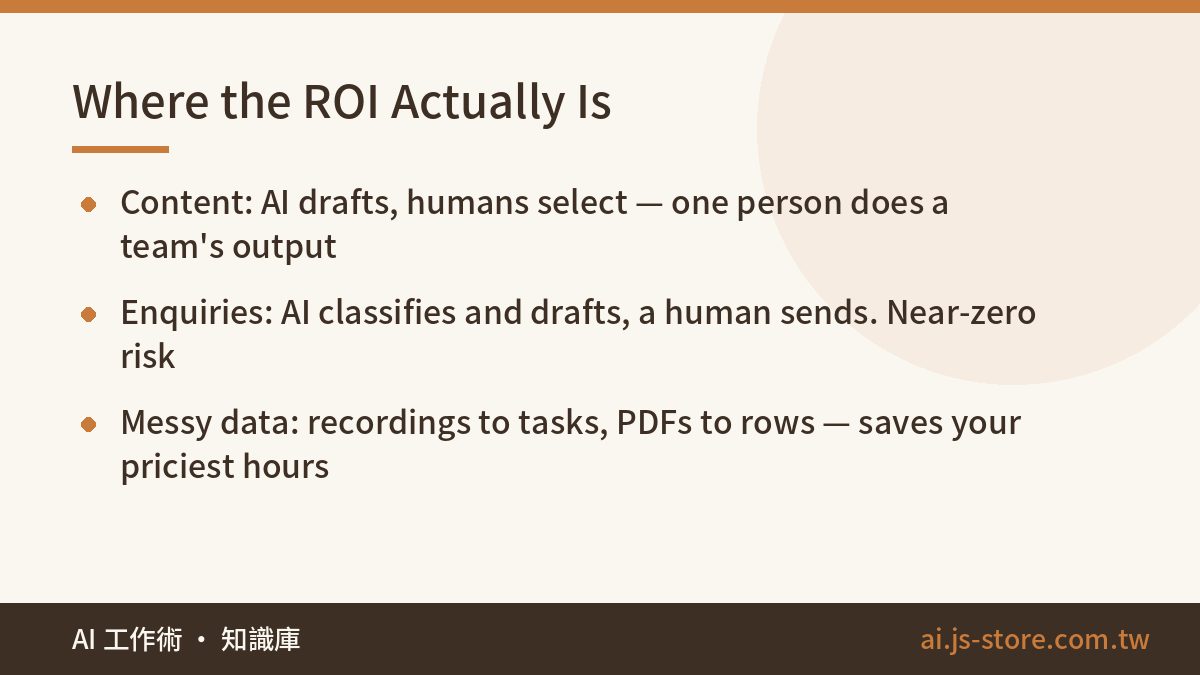
Content production. Product copy, social posts, email campaigns, blog articles — every small company is short on marketing capacity, and this is the single most mature use of language models. The pattern that works: write a proper brand voice document first, let the model produce drafts, and have a human select and edit. One person can produce what used to take a small team. The failure mode is publishing raw output at volume, which dilutes your brand and reads like everyone else's. We cover how to keep quality up while scaling in scaling marketing assets without diluting your brand.
Front-loading customer enquiries. You do not need a full AI support agent, and we often talk people out of it — the failure modes are public and expensive. The near-zero-risk version is semi-automatic: AI classifies the incoming message, drafts a reply, a human reviews and sends. Nothing reaches a customer unread. For a company with a high enquiry volume, classification plus drafting alone can save several hours a day, and it gets your response times down without adding headcount.
Turning messy input into structured data. Meeting recordings into task lists. Quote PDFs into spreadsheet rows. Customer emails into CRM fields. Language models are fast and reliable at making unstructured things tidy, and this category has a hidden bonus: the person currently doing that cleanup work is usually a manager or the owner. You're not saving cheap hours, you're saving your most expensive ones. Our walkthrough of going from recording to action items in 15 minutes is the version of this we run internally.
A Two-Week Pilot That Costs Almost Nothing
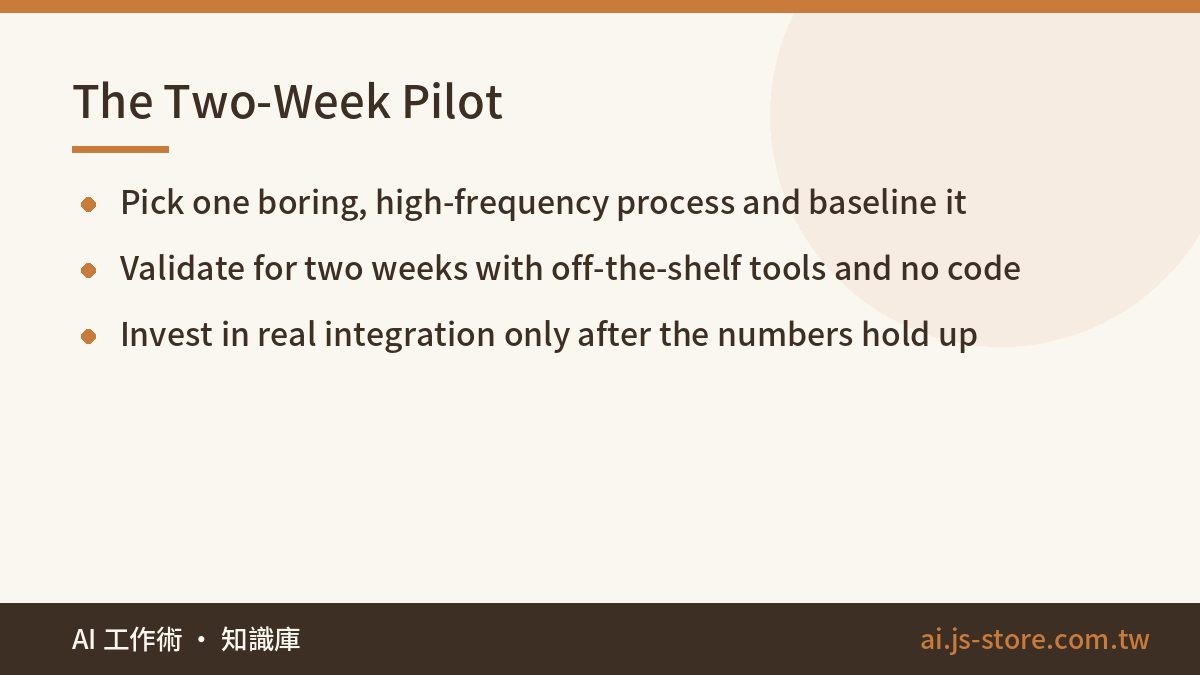
Here's the standard advice we give, and it has three steps.
Step one: pick one boring, high-frequency process. One. Not a portfolio. Write down how long it currently takes and how often it happens, because without a baseline you can't tell whether anything improved.
Step two: validate for two weeks at minimum cost. Use existing tools and a carefully written prompt. Don't write code. Don't integrate anything. Have one person run the new version manually alongside the old one and keep a simple log: how long it took, how much editing the output needed, what it got wrong. Two weeks is enough to see whether the gain is real or a novelty effect. You can test a lot of this on free tools before you spend anything at all.
Step three: invest only if the numbers hold. Now it's worth paying for the proper integration — connecting it to your systems, removing the copy-paste, giving it to the whole team. By this point you know the time saving, you know the error rate, and you're buying something you've already tested.
Every step has a stop button. If week two says it isn't working, you've spent a small amount and two weeks of one person's partial attention. Compare that to a six-figure "digital transformation" proposal that you can only evaluate after it's finished. This path isn't glamorous, but it survives contact with reality — and if you're running things solo or near-solo, the same logic applies at even smaller scale, which we cover in running a one-person company without drowning.
FAQ
Q: We have fewer than 20 employees. Are we too small for AI?
No — if anything, small teams see results faster because there's no committee between deciding and doing. The thing that matters is process frequency, not headcount. If your team repeats any task dozens of times a week, there's something here for you. A 10-person company that automates one daily two-hour task gets a bigger relative gain than a 500-person company running a pilot in one department.
Q: How much should our first AI project cost?
The validation phase should cost close to nothing beyond a few tool subscriptions and two weeks of one person's partial attention. Real integration work comes later and depends entirely on what you're connecting; check the official pricing page of any tool you're evaluating rather than trusting a number in an article. The rule of thumb: if the first proposal you receive is a large fixed-fee project before anyone has validated the use case, walk away.
Q: What if our data isn't clean enough?
This is the most common excuse for never starting, and it's usually wrong. The three entry points above — content, enquiry triage, unstructured data cleanup — barely depend on historical data quality. They work on what's arriving today. Prediction and forecasting projects do need clean history, which is another reason not to start there. Fix your data as a side effect of automating a process, not as a prerequisite.
Q: How do we stop people from quietly going back to the old way?
Give the new process an owner and a visible number. If nobody is accountable for the workflow and nobody reports the time saved, drift is guaranteed. We review our own usage monthly and cut anything that isn't earning its keep. Also make the new path genuinely easier than the old one — if using the tool means five extra clicks and a login, people will revert, and they'll be right to.
Q: Should we build our own tool or use something off the shelf?
Off the shelf until it demonstrably doesn't fit. Building means you now own maintenance, model updates and security forever. Build only when the process is core to your competitive position and no product covers it — and even then, validate manually first. We build our own tooling for video editing and ad management because those are our product; for everything else internally, we buy.