Learn English With AI: Speaking Practice, Essay Feedback & Role-Play
Published 2026-11-04 · Updated 2026-11-04 · 8 min read · ShooWork (FREECO CO., LTD.)
AI makes a great English tutor only if it catches your mistakes instead of fixing them. Prompts and a weekly plan for speaking, writing and role-play.
Short answer: learning English with AI works, but only if you treat it as a tutor who points out your mistakes, not a tool that translates for you. Most people who say ChatGPT didn't improve their English used it to translate and polish. The AI did all the thinking. They never opened their mouth or struggled to find a word, so their English stayed exactly where it was.
Three uses actually make a difference. Speaking practice: 15 minutes a day in voice mode, with the AI listing your mistakes at the end of each round. Essay feedback: the AI flags your errors but doesn't give you the fixes, so you correct them yourself. Role-play: you rehearse the interview, client call or trip you actually have coming up next month. Below you'll find the setup for each one, prompts you can copy, and a one-week practice plan.
This is for people with a few years of school English behind them. Maybe you can read it but freeze up when you speak, or you can write it but it doesn't sound natural. If you're starting from zero, AI helps less than you'd hope. Learn the basic sentence patterns from a structured course first, then come back.
Why Most People Don't Improve When They Learn English With AI
Looking at friends and at our own team, the reason people stall is almost always the same: the AI does too much and you do too little. Language sticks through retrieval, which means making your brain dig out a word or a sentence pattern on its own. When the AI hands you the answer, you skip the one step where the learning happens.
| Common habit | What goes wrong | Do this instead |
|---|---|---|
| Write in your native language and ask for English | You learn to copy and paste | Write in English first, then ask it to find your mistakes |
| "Polish this for me" | You get a nice version but no idea what you got wrong | Ask for errors flagged sentence by sentence, with reasons |
| Chatting, and it never corrects you | AI is polite by default and just keeps the conversation going | Ask for "my 3 biggest mistakes at the end of every round" |
| Practicing whenever you remember | Nothing builds up, and it's gone by next week | Set a fixed time slot and keep your mistakes in your own notes |
One more thing to expect: AI English is correct, but it isn't always the kind of correct you need. Its sentences tend to be formal and long. Paste them into a Slack chat with a colleague and you'll sound like you're reading out a press release. Whenever you ask it for an example, tell it who you're talking to and where.
Speaking Practice: How to Set Up Voice Mode So You Actually Improve
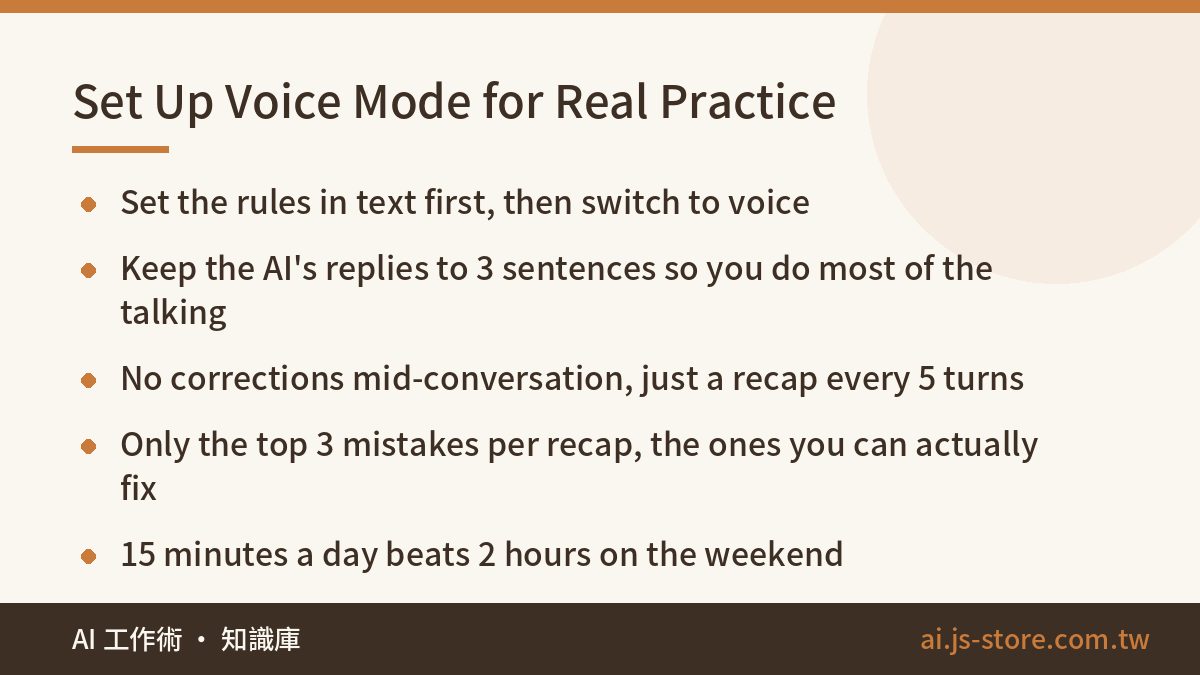
ChatGPT, Gemini and the other big chat AIs all have voice conversation now. That's a volume of speaking practice that used to require a paid human tutor. But if you just open it and start chatting, you'll mostly get a very polite partner who never corrects anything. Set the rules in text before you switch to voice. It makes a huge difference.
Copy this opener. Writing it in English also keeps the AI from slipping into your native language:
You are my English speaking coach. My level is around intermediate. Talk with me about daily topics, keep your replies under 3 sentences, and ask me one follow-up question each time. Do not correct me during the conversation. After every 5 turns, list my 3 most important mistakes (grammar, word choice, or unnatural phrasing), show the corrected version, and explain briefly.
Three parts of this prompt do the real work:
- Cap the AI's reply length. Without a cap, every answer is a full paragraph and you end up listening instead of speaking. You should be the one doing most of the talking.
- No interruptions, with a recap every 5 turns. Getting corrected mid-sentence makes you stop wanting to talk, and fast.
- Only the top 3 mistakes. A list of 15 is useless because you won't remember it. Three mistakes that keep coming back are something you can actually fix.
An honest limitation: don't use AI voice mode to grade your pronunciation. We run a captioning engine for ShooWork Clip, so we see this from the other side every day. Speech recognition relies heavily on context to guess what you meant. Say "sink" when you mean "think" and the model will usually still hear "think" and reply as normal. You'll never find out you got it wrong.
Here's a more reliable trick. Record yourself reading a list of unrelated words, so the software has less context to guess from. Then run the recording through a transcription tool and compare the result to what you read. The words it gets wrong are usually the ones you aren't saying clearly. Our transcription tools comparison covers which tools to try. If you want to change your accent, though, a human teacher is still faster.
As for how much to practice: 15 minutes a day beats 2 hours on Saturday. Tie it to something you already do every day, like your commute or the dishes. Put your headphones in, turn on voice mode, go.
Essay Feedback: Flag the Errors, Fix Them Yourself, Then Check
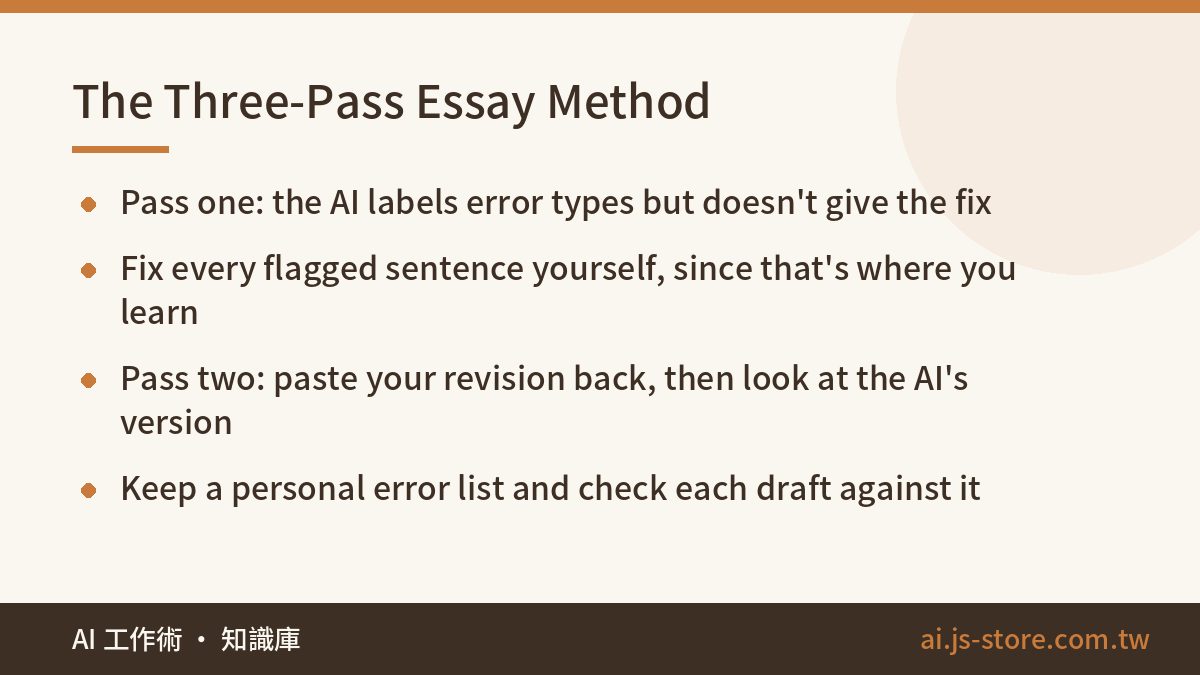
Writing feedback is where AI is strongest. It catches grammar, word choice and paragraph logic. But "just give me the corrected version" is the most wasteful way to use it. You read a nicely written essay, then make the same mistakes next time. Do it in three passes instead:
- Pass one: errors only, no answers. Have the AI mark each problem sentence with the type of error (tense, article, preposition, collocation) but not write the correction.
- Fix it yourself. This is the step where you actually learn. It should feel a little uncomfortable.
- Pass two: check. Paste your revision back in and ask what's still wrong. Only then look at the AI's version.
Please review my writing below. Mark each sentence that has problems and label the error type (tense, article, preposition, collocation, word choice, logic). Do NOT give me the corrected sentence yet. I will try to fix them myself first.
After a few rounds, you'll see that most of your mistakes fall into a few types. If your first language doesn't have articles, like Chinese, Japanese, Korean or Russian, a/the will be near the top. Plurals, keeping tenses consistent, and literal translations from your own language ("open the light" instead of "turn on the light") are the other usual ones. Keep these in a personal error list and check every new draft against it before you give it to the AI. Ask the AI to update the list each time. After a month, you'll know exactly what to work on.
Preparing for IELTS or TOEFL? You can ask for feedback based on the published scoring criteria, but don't take the score it gives you seriously. Submit the same essay in two new chats and the score can change by half a band or more. Résumés and cover letters are a different job: you need to quantify results and match the job description. We cover that in AI resume writing.
Role-Play: Rehearse the Conversation You Actually Have Coming Up
Chatting with AI without a goal gets old within a week. Role-play works differently. Pick a situation you'll really face soon, have the AI play the other person, and make it hard for you.
Here's what worked for us. We run an AI tool platform, a video-editing engine and ads tooling, so we write a lot of English emails back and forth with overseas vendors, platform support teams and API providers. Memorizing business email templates didn't help much. What did help was writing the real email first, then asking the AI to play the person receiving it. We had it find weak spots, ask follow-up questions, and misread things the way a busy person would. After two or three rounds of that before hitting send, we were misunderstood far less often.
| Situation | The AI plays | What to practice |
|---|---|---|
| Job interview | A strict interviewer who asks follow-up questions | Introducing yourself, behavioral questions, concrete results |
| Client meeting | A client unhappy with your quote | Saying no politely, negotiating, agreeing on next steps |
| Travel | Hotel front desk, restaurant server | Booking mix-ups, refunds, asking for directions |
| Handling complaints | An annoyed customer | Apologizing without groveling, offering a fix |
| Visa interview | A consular officer | Short, clear answers with nothing extra |
For the AI to play the part well, tell it these four things:
- Role and personality: "a busy procurement manager who talks bluntly" works far better than "a client".
- Your goal: for example, "I need to push the delivery date back two weeks". Then it knows how to make things difficult.
- When to stop: for example, "After 8 turns, step out of character and tell me whether I hit my goal and which lines were weak."
- Speed and tone: in voice mode, ask it to talk faster or speak more casually so it's closer to real life.
Let's role-play. You are a busy procurement manager who is unhappy with our price. I am the sales rep and my goal is to keep the price but offer faster delivery. Push back hard. After 8 turns, step out of the role and tell me which of my sentences sounded weak and how to say them better.
Save the transcript. Copy down 5 phrases from the better versions the AI suggests. The next time you face a real person, you'll have them ready to use.
A One-Week Practice Plan and Which Tools to Use
You don't need a pile of tools. The chat AI you already use is enough. All the major ones write English well enough to tutor you. What matters is whether the voice mode feels smooth and whether the free plan gives you enough minutes. Limits change often, so check the official pricing page for each one. If you're deciding whether to pay, our guide to AI subscriptions explains how to budget and which plans to combine.
| Tool type | Best for | Keep in mind |
|---|---|---|
| General chat AI (ChatGPT, Gemini, Claude, etc.) | Essay feedback, role-play, grammar explanations | Voice features and free limits vary, so check the official docs |
| Chat AI voice mode | Speaking and listening practice | Not a pronunciation grader |
| Gamified learning apps | Vocabulary, basic patterns, a daily habit | Mostly input, with no real conversation |
| Human tutor or online class | Pronunciation, accent, final exam prep | Expensive, so save it for when you have a specific deadline |
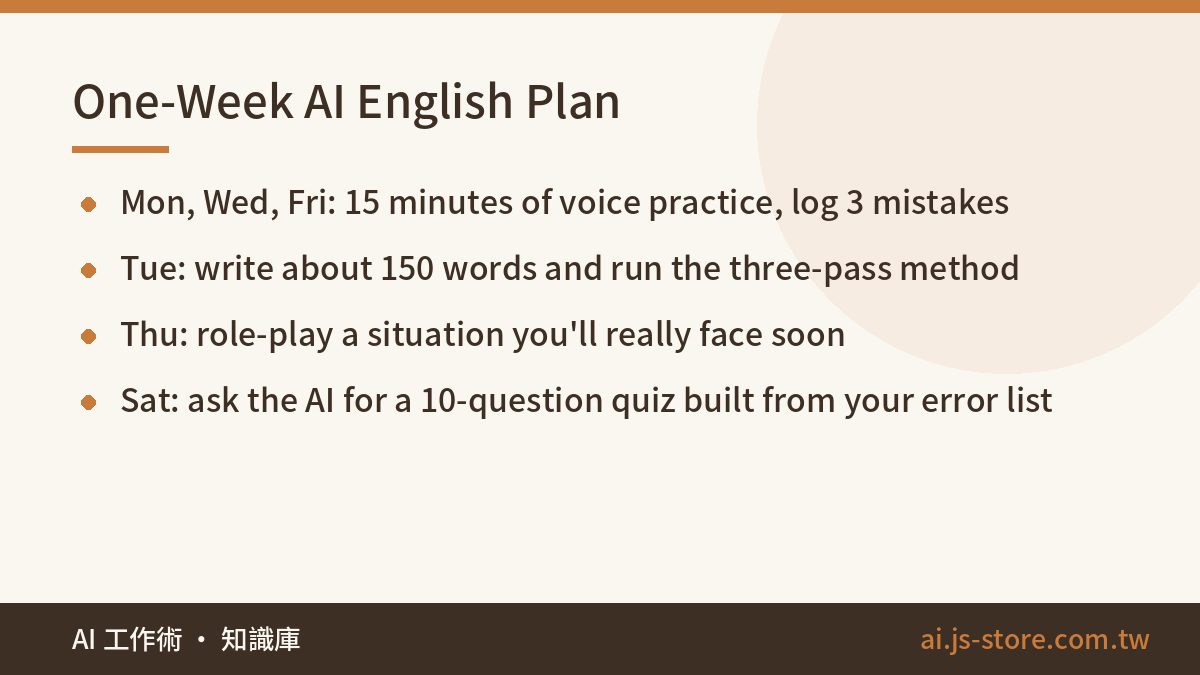
Here's a plan to start from, at 15 to 20 minutes a day:
- Monday, Wednesday, Friday: 15 minutes of voice practice. Copy the 3 mistakes the AI lists into your error list.
- Tuesday: write about 150 words in English, like a work log or a few thoughts on something you read, and run it through the three-pass method.
- Thursday: one role-play, using a situation you'll really face soon.
- Saturday: give the AI this week's error list and ask for a 10-question quiz on your weak spots.
- Sunday: rest, or watch an episode of a show you like with English subtitles or none at all.
One last warning: if you already have three English courses you bought and never finished, don't add another tool. First figure out what's actually stopping you: time, difficulty or motivation. A new app fixes none of those. Once you know, use AI for the part that's missing.
FAQ
Q: Is the free version of AI enough to learn English?
For essay feedback and text-based role-play, the free plan is usually enough. Voice conversations use up your limit faster, and on a free plan you may get cut off after a short session. If you plan to practice speaking every day, that's when a paid plan makes sense. Limits change often, so check the official pricing page.
Q: Can AI fully replace an English tutor?
For the amount of practice you can get, and being available any time, AI already beats most human tutors. What it still doesn't do well is fix your pronunciation or accent, or keep you accountable the way a real person does. The practical mix is to build up practice with AI day to day, and book a human teacher for key moments like a final exam push or the week before an interview.
Q: Is English corrected by AI always right?
The grammar is mostly reliable, but sometimes it rewrites a sentence that was already fine, which makes you think you were wrong. When you don't understand why something changed, ask directly: "What was wrong with my original?" If it says the original was fine too, keep it. For important documents or exam work, have someone fluent check it too. Our guide to AI hallucination explains why AI can sound confident even when it's wrong.
Q: Can a beginner learn English with AI?
Yes, but adjust how you use it. Ask it to reply with simple words and short sentences, with translations into your native language when you need them. Start with easy topics like introducing yourself or describing your daily routine. If you're at absolute zero, learn the basic sentence patterns from a structured course or app first, then use AI to practice.