Bought Courses You Never Finished? A Course-Hoarding Audit With AI
Published 2026-10-20 · Updated 2026-10-20 · 8 min read · ShooWork (FREECO CO., LTD.)
Never finish the online courses you buy? Hide the titles, let AI group what you were worried about, and find the one spot you've been stuck for years.
If you searched for what to do about courses you bought and never finished, you probably don't want another list of tips for raising your completion rate. You want to know what you've actually been buying for the past few years, why every one of them stalls halfway, and what to do now.
The short answer is this: your courses usually aren't too scattered. They're too similar. The theme that keeps coming back is the place where you're stuck. So your first step isn't a study schedule, a refund request or forcing yourself through the backlog. Lay the list out like evidence, then use AI with the course titles hidden, so all that's left is what was bothering you on the day you clicked “buy.” Course titles can fool you. The worry behind them is the part that tells you something.
You don't need any code or anything to install. Filling in a four-column sheet takes about ten minutes. Below you'll find the audit sheet, a prompt you can copy and paste, a table that maps where you stopped to the kind of stuck you are, and a plan that uses 20 minutes a day for three weeks to rescue exactly one course.
Why “I Buy Too Many Courses” Is the Wrong Diagnosis
Here are the numbers from my own sheet. Over three years I bought 14 courses and finished 3. My first conclusion was the obvious one: I buy too much, across too many topics, and I need to cut back. Then I hid the entire course-title column and kept only the second column, “what was bothering me when I bought it.” I pasted that into an AI model and asked one question: are these all trying to solve the same problem?
It sorted them into 4 groups. The biggest group had 9 courses. None of the 9 had a similar name. They covered video editing, copywriting, negotiation, personal branding and presentation skills, which looks like five different fields. Underneath, the same sentence showed up every time: I want to land clients on my own, but I'm scared to name a price.
The next part was worse. 7 of those 9 stopped at chapter 2 or 3, which is exactly the chapter where you have to start doing the thing. I didn't love learning. I had been stuck at the same door for three years, and every year I bought a new course to put it off again.
To be clear, 14, 3, 9 and 7 are counts from my own sheet. They aren't statistics, and they aren't what you'll find. Your list will look different, and it may not have a repeating group at all, which would be good news. The one thing I'm asking you to do is make your own sheet. You don't need to trust me on any of this, because you can count your own rows.
The mechanism is still worth understanding. Your anxiety drops the moment you buy a course, because you've “decided to deal with it.” Your brain closes the case when the payment goes through. Whether you watch the course has nothing to do with whether the anxiety went away. That's how one sticking point can survive for three years: each time it comes back, you pay to push it down again.
The Course Audit Sheet: Four Columns, Ten Minutes
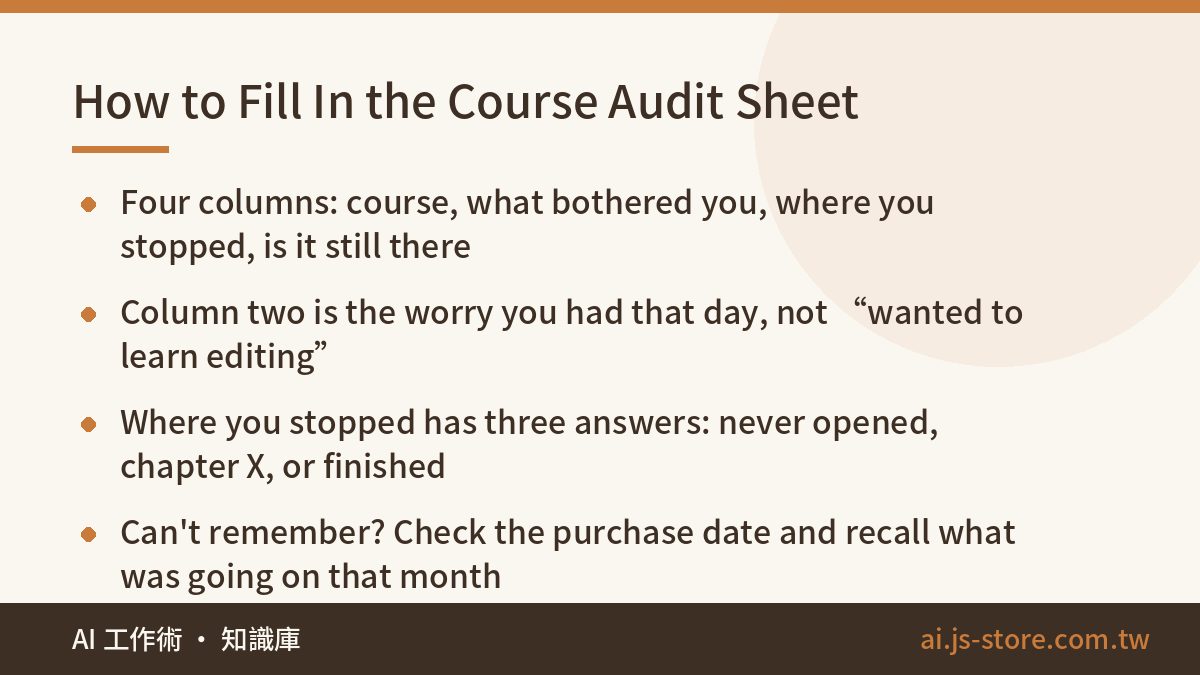
Open every place you've bought learning from: Udemy, Skillshare, Coursera, a creator's cohort program, a membership you forgot about. Books you bought and never opened count too. Give each one a row:
| Course | What was bothering me when I bought it | Where I stopped | Is that worry still there? |
|---|---|---|---|
| Short-form video editing bootcamp | Wanted freelance work but had no portfolio | Chapter 2, the first editing lesson | Still there |
| Copywriting for income | Wanted clients but too scared to quote a price | Never opened | Still there |
| Negotiation and pricing | Got haggled down and froze | Chapter 3 | Still there |
| Personal branding | Nobody knows what I do | Finished, never applied | Still there |
| Excel pivot tables | Monthly report kept me up past midnight | Finished | Solved |
The second column matters more than the rest of the sheet. Don't write “wanted to learn editing.” That just repeats the course title and tells you nothing. Write what was worrying you on the day you bought it. If you can't remember, check the purchase date and think about that month: what you were working on, who you were arguing with, what you were afraid of. The date is your most reliable clue, because it brings back what was going on around you at the time.
Don't bother with percentages in column three. Use one of three answers: never opened, stopped at chapter X, or finished. Column four only needs “still there” or “solved.” It shows you which problems are still open and which ones already went away.
Filling in the sheet gets you halfway to the answer. When people on our team tried this, many of them stopped around the fourth row and laughed, before they had even opened an AI tool. It works because it makes you turn “I'm learning” into “I'm worried about this.” The space between those two sentences is where the last few years went.
The Audit Prompt: Hide the Course Titles, Then Ask
Once the sheet is done, paste it into ChatGPT, Claude or Gemini along with this prompt:
I want to run a “course hoarding audit.” Below is the list of online courses I've bought over the past few years.

[MY LIST]
Short-form video editing bootcamp | wanted freelance work but had no portfolio | chapter 2 | still there
Copywriting for income | wanted clients but too scared to quote a price | never opened | still there
Negotiation and pricing | got haggled down and froze | chapter 3 | still there
Personal branding | nobody knows what I do | finished, never applied | still there
Excel pivot tables | monthly report kept me up past midnight | finished | solved
(The five lines above are examples. Replace them with your own sheet.)

Do these five things, one at a time. Don't encourage me, don't praise my love of learning, don't cheer me on:

1. [IGNORE COURSE TITLES] Look only at column two, “what was bothering me when I bought it,”
   and group the rows into “problems I'm trying to solve.”
   Name each group as one plain sentence in my own words
   (e.g. “I want to land clients on my own but I'm scared to name a price”),
   not course categories like “marketing / skills / software.”

2. Tell me how many courses are in the biggest group, which ones, and why you grouped them together.

3. Look at the “where I stopped” column for that group. Do the stopping points have something in common?
   If most stopped at the same kind of chapter (e.g. where I have to start doing it,
   or where I have to publish something), say so directly.

4. In one sentence, tell me what I'm actually stuck on.
   Infer only from words in my list. No psychology terms, and don't add motives I didn't write.

5. From the biggest group, pick the SHORTEST course (not the most expensive, not the best reviewed)
   and explain why. For the rest, say clearly: leave them alone this round.

If my list is too short or column two is too vague, say “I can't infer this. I need to know ___.”
Don't force a conclusion.
A few parts of this prompt are doing important work. Keep them when you adapt it:
- Ignoring the course titles is what makes it work. Titles lead you and the AI to the same conclusion: these are different fields. That's the conclusion that fooled you for years.
- Banning encouragement is practical. Models tend to cheer you on by default, and cheering waters the conclusion down into a warm paragraph you can't use. If you want to understand why turning “don'ts” into concrete instructions works better, read Custom Instructions That Work.
- Banning psychology terms keeps labels out. Without that rule, you'll get labels like “perfectionism” or “impostor syndrome.” They sound right, but they don't give you anything to do.
- Letting it say “I can't infer this” keeps it honest. If it has no way out, it will make up a conclusion, and you'll nod along because it sounds convincing.
Where You Stopped Tells You What Kind of Stuck You Are
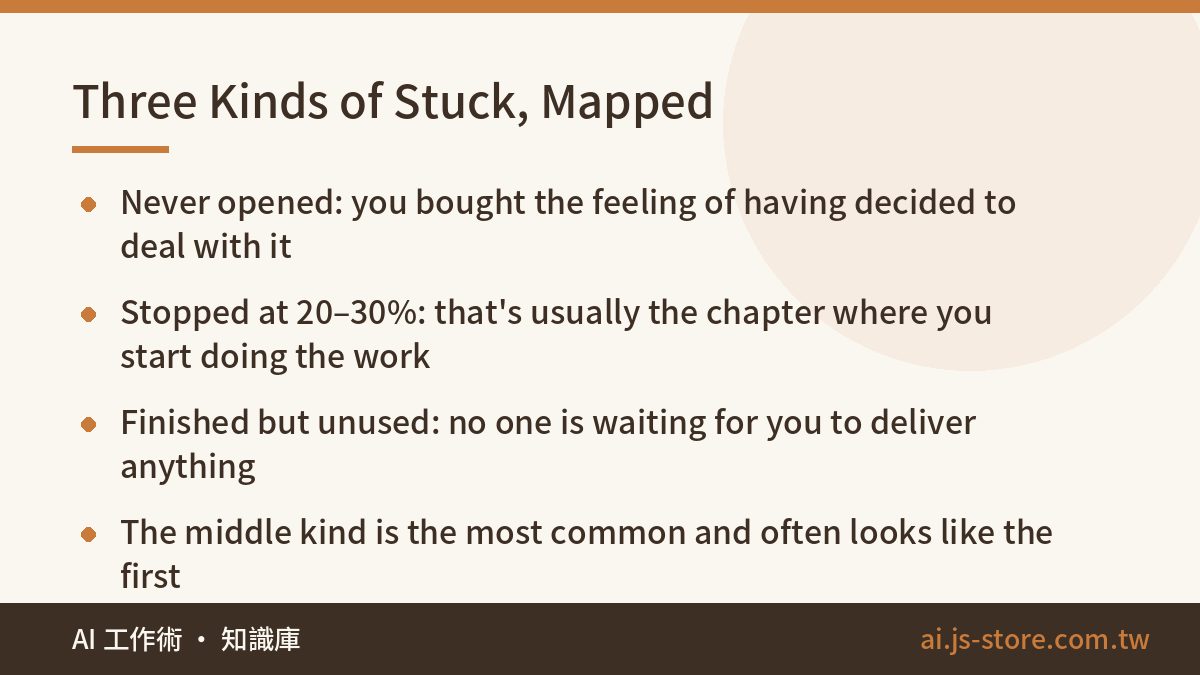
After the grouping, go back to the “where I stopped” column. Where you stopped tells you more than what percentage you finished:
| Where you stopped | What it doesn't mean | What's actually going on | Do this first |
|---|---|---|---|
| Bought it, never opened it | You're lazy | What you really bought was the feeling of having decided to deal with it. Your anxiety dropped when the payment went through | Skip the study schedule. Go to that purchase month, write down what was bothering you, and admit the problem is still there |
| Stopped around 20–30% | The course is too hard | This is usually the chapter where you start doing the work and have to produce something | Don't watch further. Do that chapter's exercise and produce one ugly result. It's fine if it's ugly. What matters is that it exists |
| Finished, never used it | You didn't study hard enough | You don't need more knowledge. You need someone who is actually waiting for you to deliver | Find a recipient (a client, a coworker, a friend or a public post), commit to a delivery date, and then use what the course taught |
The middle row is the most common, and it often looks like the first row. You sit at chapter 2 long enough, then buy a new course and never open it. On paper you look like a “never opened” person, but you're stuck at the same point where you have to start. To tell them apart, check column two. If two courses share the same worry, the second one was another way of running from the same problem.
Rescue One Course: 20 Minutes a Day for Three Weeks
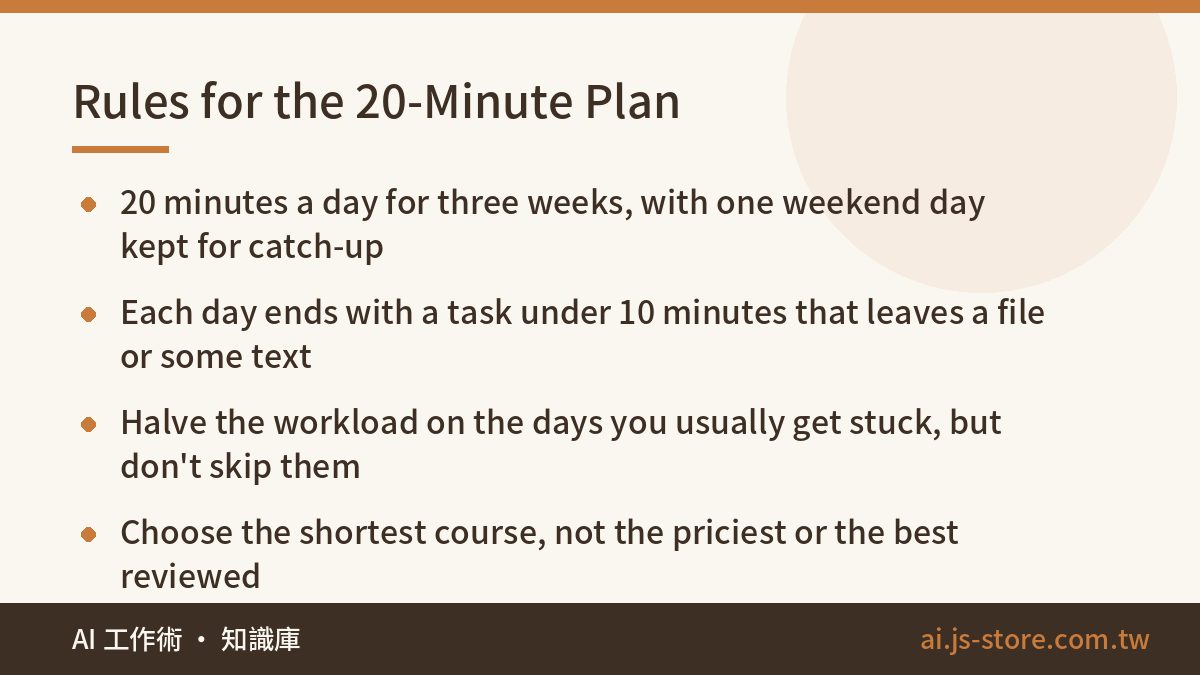
After the audit, work on one course only this round. Choose the shortest one, not the most expensive or the best reviewed. The reason is practical: your goal is to start the work and succeed once, not to take in the most valuable material. Copy that course's chapter list and pair it with this prompt:
I want to finish the course below in three weeks, with only 20 minutes a day.

[COURSE OUTLINE]
(Paste the full chapter list from the course page. No need to clean up the formatting.)

[MY SITUATION]
I previously stopped at chapter 2. What I get stuck on is the “start actually doing it” step.
My 20 minutes are in the evening, and I'm tired.

Please:
1. Split the outline into 20-minute daily chunks and lay them out as a three-week plan
   (leave one weekend day empty for catch-up).
2. After each day, add an “output task”: a small action that takes under 10 minutes
   and leaves behind a file or a piece of text.
   Output tasks can't be “review” or “think about it.” Nothing without an artifact.
3. On the days that cover the step where I get stuck, cut the workload in half.
   Better to run two days late than to skip it.
4. End with one sentence stating exactly what I'll have in hand after three weeks.

No motivational quotes. Don't tell me “you've got this.”
These three rules matter more than the schedule itself:
- Fill in the sheet before you ask the AI. The sheet does half the work, and a lot of people see the answer before they finish it.
- Hide the course titles before you ask. If the titles stay in, the AI will reassure you that these are different fields.
- Work on one course this round. Leave the others alone. You don't need refunds, deleted courses or guilt. Courses you haven't watched don't go bad. The problem you're stuck on gets worse the longer you leave it.
What This Method Can't Do
We run our own AI tool platform, including the video editing engine behind ShooWork Clip and our ads tooling. A lot of our daily work is using AI to sort messy input into one plain sentence, so we know where this kind of approach stops working. Read these before you start:
- AI can't log in to your course platforms or see your progress. It only reads what you paste into the chat. Either type out the sheet yourself or upload a screenshot of your course library page. ChatGPT and Claude can both read images. You don't need any code.
- It sorts and infers, but it can't diagnose you. The vaguer column two is, the more it has to guess. The prompt tells it to use only your words, but you still need to read the final sentence and decide whether it sounds like you. If it doesn't sound like you, don't agree just because it makes a good story.
- This won't raise your completion rate. It does one thing: it narrows a dozen options down to one course worth saving. Whether you keep up 20 minutes a day for three weeks is something you'll only find out by doing it. I won't promise you a number.
- Letting a course go isn't wasting money. That money is already spent, and pushing through a course you don't need right now won't bring it back. It will cost you three weeks.
- Don't respond to this article by buying a course on how to learn. That would be course number 15, and it would be a textbook case of the first kind of stuck.
One last thing: your unfinished courses aren't a record of failure. They're a list of worries you've been keeping without realizing it. Take the list and leave the guilt.
FAQ
Q: Can AI read my progress directly from my course platforms?
No. It can't open Udemy, Skillshare or similar platforms, and it can't see your watch percentage. Type the sheet yourself and paste it in, or upload a screenshot of your course library and let the model read the image. You don't need to install anything or write code. The only work is the ten minutes it takes to fill in the sheet.
Q: I've only bought three or four courses. Will this still work?
Yes, but the conclusion will be weaker. With so few rows, AI can easily make up groups that sound convincing, which is why the prompt tells it to say when it can't infer anything. If you get that answer, the model is being honest, not failing. Add books you bought, webinars you saved and workshops you signed up for but skipped, then run it again.
Q: Should I use ChatGPT, Claude or Gemini?
All three can handle this, because the task is sorting and summarizing and doesn't need special features. The free tiers are usually enough too. If you're unsure whether paying would help, see ChatGPT Free vs Paid. The main difference is tone. Some models like to comfort you, so if the answer starts to soften, repeat the “don't encourage me” instruction more firmly.
Q: The AI's conclusion doesn't match what I thought. Should I trust it?
Don't just accept it. It can only reason from the words in your list, and your second column may not be accurate. Read the conclusion out loud and ask yourself whether it sounds like you. If it doesn't, rewrite column two and run the prompt again. The usual problem is that the worry column ended up describing the course instead of the worry.
Q: Should I get refunds for unfinished courses or delete them?
I wouldn't spend your energy on refunds. The money is gone, and the list isn't useful because it's tidy. It's useful because it shows what you reached for each time you felt anxious. Work on one course this round and leave the rest untouched. The record will still be there the next time you run an audit.