How to Choose a Google Ads Agency: 9 Questions to Ask Before You Sign
Published 2026-10-10 · Updated 2026-10-13 · 8 min read · ShooWork (FREECO CO., LTD.)
Two agencies, same fee, ten times the difference in work. Ask these 9 questions before you sign, and learn which answers mean you should walk away.
Before you compare quotes, compare answers. Two Google Ads agencies can charge you exactly the same monthly fee and deliver very different work. One is in your account every week, cutting wasted search terms and rewriting ads. The other logs in once a month to export a PDF. You pay the same invoice and might get a tenth of the value. The fee is the easiest thing to compare and the least useful.
So here's the short answer to “how do I choose a Google Ads agency”: ask nine specific questions before you sign, and notice how vague the answers get. If you only have time for three, ask these: whose name is the ad account under, how long am I locked in, and what exactly will the reports show me? Those three decide whether you can leave, and what you get to take with you when you do.
We've seen this from both sides of the table. We run our own AI tools platform, we buy Google Ads for our own products, and we build ads automation into ShooWork Ads. Below are the nine questions, grouped into six topics. Each one comes with the answers that should make you nervous.
Question 1: Whose Name Is the Ad Account Under?
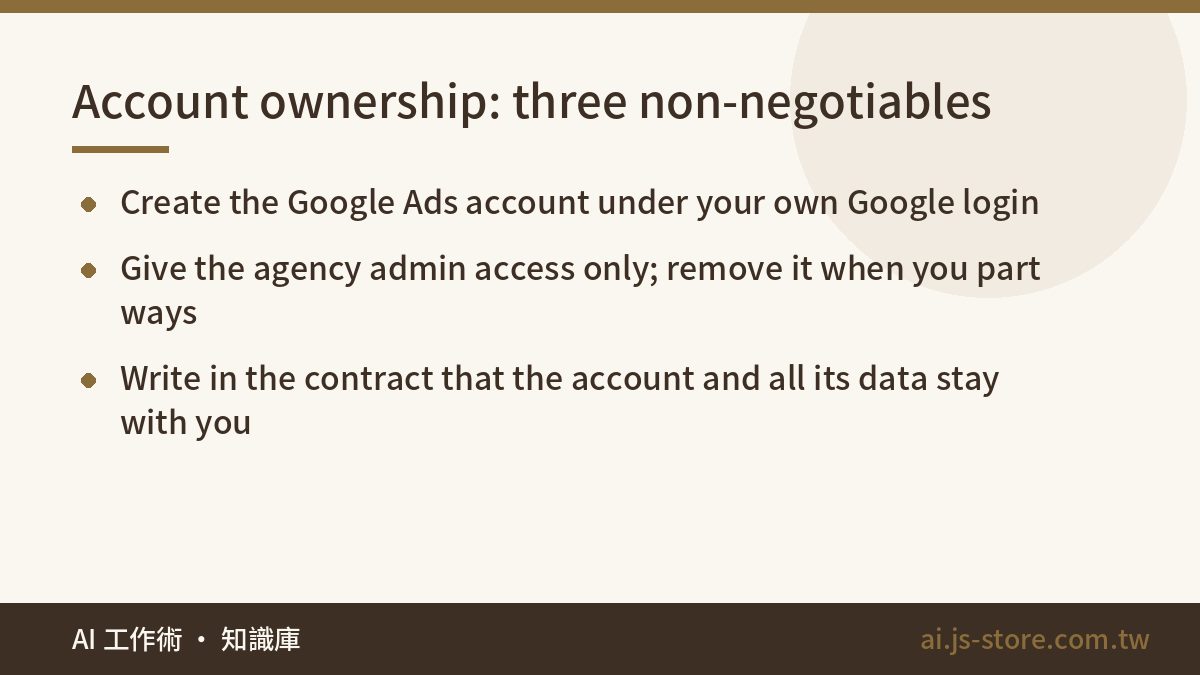
This matters more than price, so it goes first. Here's the setup you want: the Google Ads account is created under your own Google login, and the agency gets admin access to it. When the relationship ends, you remove their access. The account, its history, your conversion tracking and your remarketing audiences all stay with you.
Why does this matter so much? Because account history is the most valuable asset in any Google Ads setup. Smart bidding learns from past conversions. Performance signals build up over months. Your audience lists took time to fill. If you start over with a blank account, you pay to relearn all of it.
The answer to worry about: “Don't worry, we'll just open one under our manager account for you.” It sounds convenient. In practice, it can mean that when you switch agencies, the history stays with them. Some agencies hand it over without a fuss. Some don't, and then you're negotiating from a weak position at the worst possible moment.
Don't settle for a verbal promise. Put one sentence in the contract: the ad account and all its data, conversion tracking and audiences belong to the client and stay with the client after the agreement ends. If an agency pushes back on that sentence, you've learned something important before spending a cent.
Questions 2–3: How Do They Charge, and How Do You Leave?
There are three common fee models: a flat monthly fee, a percentage of ad spend (often somewhere around 15–25%), and a hybrid with a lower base fee plus a smaller percentage. We broke down the ranges and hidden fees in our Google Ads agency cost guide, so we won't repeat them here. For choosing an agency, what matters is how each model shapes the agency's behavior.
The answer to worry about: a percentage that's suspiciously low. Agencies that charge well below market rates make it up with volume. That means more accounts per person and fewer minutes on yours. Also be clear-eyed about percentage-of-spend pricing in general: it builds in an incentive to recommend that you spend more. Plenty of agencies resist that pull. Just remember the incentive exists when they propose a budget increase.
Then ask how you leave. A first contract of three to six months is normal, and honestly reasonable. The first month or two is testing, and you usually can't see a real trend until month three. What you need to pin down is the early-termination clause. Is there a penalty? Is the setup fee refundable? If you part ways after one month, do you keep the account structure that setup fee paid for?
The answer to worry about: a lock-in of 12 months or more on a first contract, or a fuzzy “we can discuss it” when you ask how to cancel. If they can't explain how you leave, assume leaving will be expensive.
Questions 4–5: What Will They Do Each Week, and Will the Report Show It?
“We'll continuously optimize your campaigns” is not a deliverable. Turn “optimize” into specific actions with a frequency for each, and attach that list to the contract. For example:
- How often do they review the search terms report?
- How often do they add negative keywords?
- How often do they review bidding strategy and budgets?
- How often do they rotate or test new ad copy?
- When the landing page breaks or converts badly, who tells whom, and how fast?
The answer to worry about: enthusiasm without numbers. If they can't say “weekly” or “every two weeks” for each item, it's because there's no schedule. A useful test: ask how they'd catch the most common expensive mistakes, like broad match spending money on irrelevant searches or missing negative keywords. An agency that actually works in the account answers right away, with specifics.
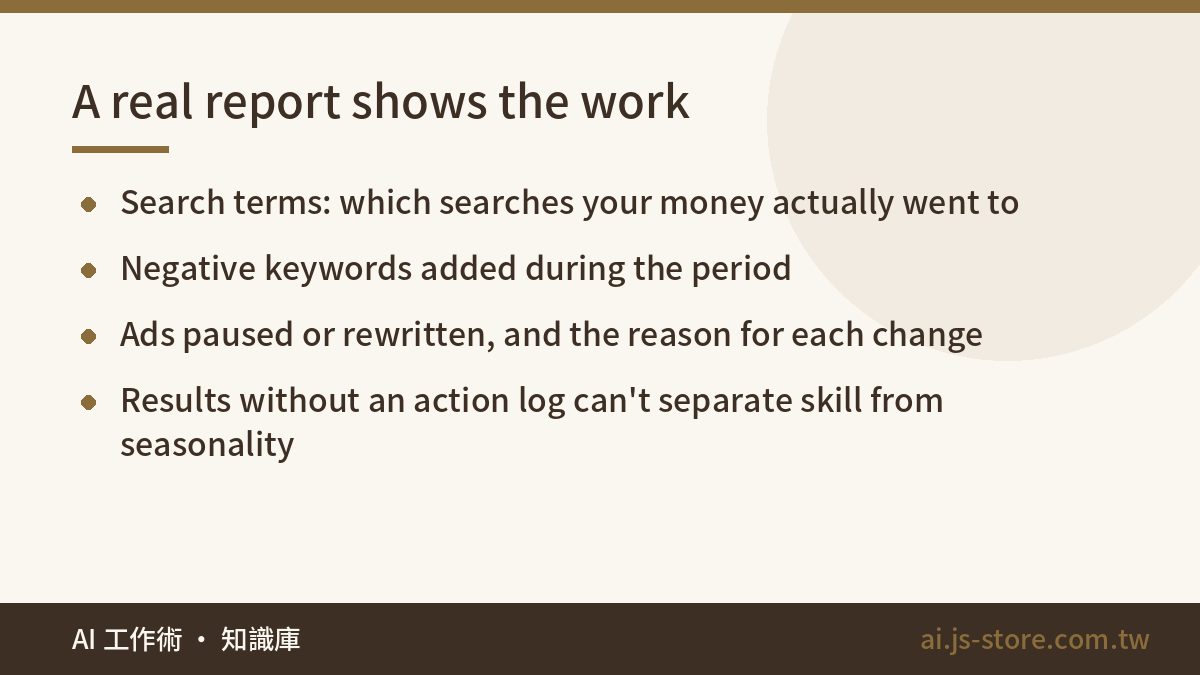
Now the report. Most agencies send one weekly or monthly. Spend, clicks, conversions and cost per conversion are the minimum, and they aren't enough. You want an action log: which negative keywords were added, which bids changed, which ads were paused or rewritten, and why.
The answer to worry about: “You'll get all the data from our reporting dashboard.” That shows results, not work. Without an action log, you can't tell whether a good month came from the agency's work or from seasonality. You also can't tell whether a bad month happened despite their effort or because nobody touched the account.
Question 6: Who Makes Sure Your Ads Still Tell the Truth?
Almost nobody asks this one, and it's the one that actually went wrong for us. We were running a promotion with a bundle price. The promotion ended and the landing page went back to full price, about 20% higher. Two ads kept running with the old promo price for a day and a half before anyone noticed. People were clicking on a price that no longer existed.
Here's the uncomfortable part: nothing in the standard setup catches this. Google Ads doesn't check whether the price in your ad text matches the page. An agency's performance report won't show it either, because it isn't a performance problem. It's a factual one. The click-through rate might even look great, because the outdated price was attractive.
So ask directly: when a promotion ends, who takes the ads down, and who checks that ad prices match the landing page? Write it into a process both sides agree on, with a name next to each step. After our incident, we built a daily automated check that compares ad copy with the live landing pages and flags any mismatch. It now ships inside ShooWork Ads. Whether a tool or a person does the checking, the point is the same: “someone will probably notice” is not a process. If you build your own checker, read our silent failure checklist first. A checker that quietly stops running is worse than having none.
Question 7: Is Your Budget Big Enough to Hire an Agency at All?
Most agencies require a minimum monthly ad spend before they'll take you on. Ask what it is, and ask what level of service you get right at that minimum. The real threshold for getting proper attention is often higher than the one they advertise.
Our rule of thumb: management fees shouldn't exceed 30% of your ad spend. If the fee is half your ad budget, most of your money pays the person spending it instead of reaching customers. At that point, don't hire an agency. We mean it. The numbers don't work at that level, and you'll end up with low-attention service to match the low fee.
Below that line, you have better options. Run the ads yourself with a tight weekly routine, hire a freelancer for a few hours a month, or use a tool to automate the daily checks: negative keywords, daily budget limits, and making sure ad prices match the landing page. Revisit agencies once your spend has grown. We compared these options over a full year in agency vs in-house vs AI.
Questions 8–9: Who Else Do They Work For, and Who Runs Your Account?
Question 8: do they manage any of your direct competitors? If the same person bids on the same keywords for you and a rival, they're effectively bidding against themselves in the same auction and pushing up both your costs. You don't necessarily need exclusivity, but you do need to know, and you should ask how they handle the conflict.
Question 9: is the person in the pitch meeting the person who'll work in your account every day? At larger agencies, it's common for a senior lead to win the deal and a junior account manager to do the work. That isn't automatically bad, but ask: who is my day-to-day contact, who makes the changes, and how many accounts are they handling right now? That last number tells you more than any case study deck.
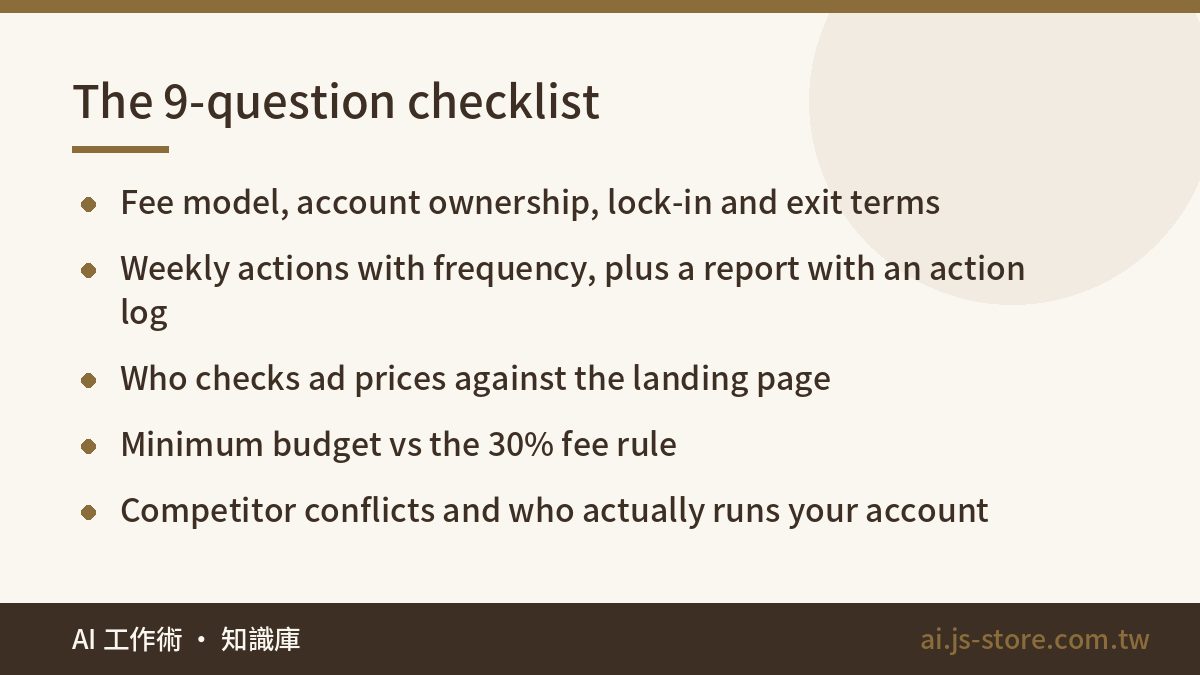
Put all nine questions on one sheet and bring it to every call: fee model, account ownership, lock-in and exit terms, weekly actions and their frequency, report contents and action log, ad-to-page accuracy, minimum budget, competitor conflicts, and who actually does the work. An agency that answers all nine with specifics is usually one you can work with. An agency that answers with adjectives is showing you how the next six months will go.
FAQ
Q: Does the Google Ads account really need to be in my name?
We strongly recommend it. If the account is under your Google login and the agency only has admin access, ending the relationship just means removing their access. Your performance history, conversion tracking and remarketing audiences stay with you. If an agency insists on using its own manager account, at least make the contract state that the account and all its data belong to you when the agreement ends.
Q: Should a Google Ads agency guarantee results?
A legitimate agency won't guarantee specific numbers, because results depend on your product, your market and your budget. Be cautious with anyone who guarantees a ROAS figure or a sales multiple. What you can ask for is a commitment to specific actions and how often they'll do them, plus transparent reporting that shows the work.
Q: What should I actually look at in a monthly agency report?
Beyond spend, clicks and conversions, check the search terms report to see which searches your money went to. Then look at which negative keywords were added during the period and which ads were paused or changed, and why. Once you can see the actions, you can judge where the results came from.
Q: No agency will take my small budget. Am I doing something wrong?
No. Agency staffing simply doesn't pay off at that budget level. Run the ads yourself, or use a tool to automate the daily checks (negative keywords, daily budget limits, matching ad prices to the landing page). Talk to agencies again once your spend grows enough that fees stay under about 30% of it. That beats signing with an agency that won't give your account real attention.