GEO Optimization Playbook: 12 Steps to Get ChatGPT to Cite You
Published 2026-10-16 · Updated 2026-10-16 · 8 min read · ShooWork (FREECO CO., LTD.)
GEO isn't a new dark art: it's solid SEO plus content AI can quote. 12 steps we ran on our own platform, and which ones actually moved the needle.
Short answer: generative engine optimization (GEO) is not a separate dark art. It's solid SEO plus content that an AI model can lift and quote without rewriting it. You don't need to rebuild your site. You do need to drop a few habits that SEO let you get away with: burying the answer in paragraph five, stacking adjectives where numbers should be, and putting key facts inside images.
If you want one sentence to act on, it's this. Rewrite every page so an AI could paste any paragraph straight into its answer. Then make sure machines can find that page, understand it, and trust it enough to cite it. Crawlability gets you found. Structured data and a clean heading hierarchy get you understood. Specific numbers, a named author and claims anyone can check get you trusted.
This is a checklist, not an introduction to GEO. At ShooWork we run our own AI tool platform, a video-editing engine and ads tooling, and we've worked through all 12 steps below on our own pages. I'll tell you which ones made a real difference and which ones are mostly insurance.
Can AI crawlers actually read your pages? (Steps 1-4)
This layer is boring, and getting it wrong sinks everything else. Fail here and the other eight steps don't matter, because the model has never seen your page.
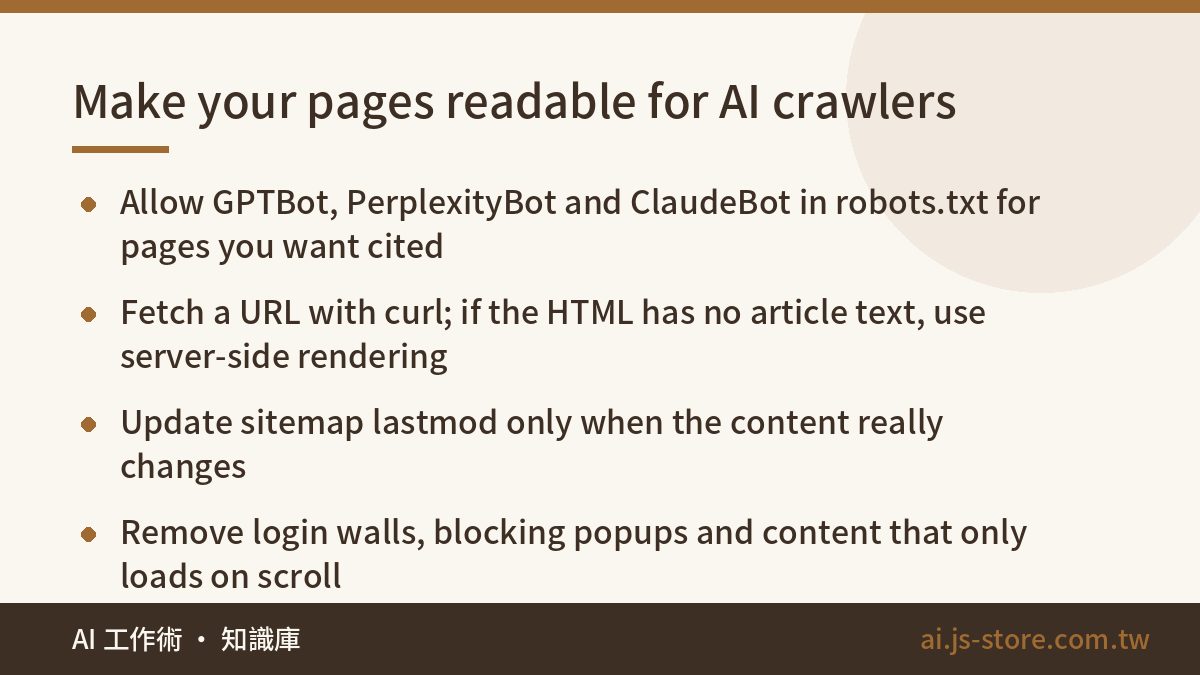
- Step 1: Check robots.txt for blocked AI crawlers. This is the most common way sites shoot themselves in the foot. Plenty of sites blocked GPTBot, CCBot, PerplexityBot, ClaudeBot and Google-Extended to “stop AI stealing content,” and now they wonder why ChatGPT never cites them. Pick a position. If you want citations, let the crawlers in, at least on the sections you're happy to have quoted, like your blog or knowledge base.
- Step 2: Make sure your text is in the HTML the server sends. If your article text only appears after JavaScript runs, most AI crawlers get an empty shell. Fetch one of your URLs with curl and read the raw HTML. No body text? You need server-side rendering or static generation. We learned this the hard way. The number of our pages being crawled only started climbing normally after we switched to server-rendered output.
- Step 3: Keep sitemap lastmod honest. Don't bump every URL's lastmod to today because you edited a footer link. Do that long enough and crawlers stop trusting the field. Update it only when the content actually changed.
- Step 4: Remove anything that hides the content. With a login wall, a full-screen popup or content that only loads as you scroll, the crawler gets part of the page or nothing at all. Every page should load fast and show its full text on the first request.
Finish these four and you're in the game. Nothing here is clever. You're just clearing the road.
Is llms.txt worth the effort? (Step 5)
llms.txt is a Markdown file at your site root (/llms.txt) that tells AI systems what your site is, which pages matter and how it's organized. It isn't an official standard, and Google has said Search doesn't use it. So set your expectations now: llms.txt is insurance, not a growth lever. It takes under an hour, some AI tools and agents do read it, and nothing bad happens if nobody does. Do it, but don't treat it as the main event.
A usable llms.txt includes:
- One line on what the site is: who you are, who you serve and what you know best
- The company that runs the site, which helps machines judge trust
- Your key pages, each with a line on what it covers, e.g.
- [GEO playbook](https://example.com/learn/geo): 12 steps to get cited by AI search - How often content is updated, and which market and language it's for
- A citation policy: quoting is welcome, please link the source URL
One practical rule: have your CMS or build step generate llms.txt automatically. Don't edit it by hand. A hand-written file goes stale within three months, and an outdated map is worse than no map. Then check that the generator actually runs. Jobs that report success while writing nothing are a classic trap. That's why we run our silent failure checklist on every auto-generated file we publish.
Which structured data should you add first? (Steps 6-7)
Structured data does far more for you than llms.txt. JSON-LD labels the author, dates, questions and answers, and ratings in a format machines can read. When an AI summarizes your page, it's less likely to credit the wrong source.
Step 6: Implement schema in this order.
| Schema type | Where it goes | Priority |
|---|---|---|
| Article / BlogPosting | Every article in your knowledge base | Must have |
| FAQPage | The FAQ block at the end of articles | Must have |
| Organization | Homepage: company, logo, social profiles | Must have |
| Person (author) | Author pages, with sameAs links to external profiles | High |
| BreadcrumbList | Category hierarchy | Medium |
| HowTo / Product | Tutorials, tool pages | Depends on content |
Step 7: Avoid the three mistakes that undo it. First, markup that doesn't match what's on the page. If your FAQPage schema lists five questions and the page shows three, search engines may treat it as spam. Second, an author called “Editorial Team.” Machines can't tell whether a team name is credible. Give every article at least one named author with a real author page. Third, fake dates. If a script rewrites dateModified every day while the content sits unchanged, the field stops meaning anything. Run every template through Google's Rich Results Test and fix every error.
How do you write content AI will quote? (Steps 8-9)
This is the step that matters most. You can get every technical detail right, and content that reads like an advertorial still earns zero citations.
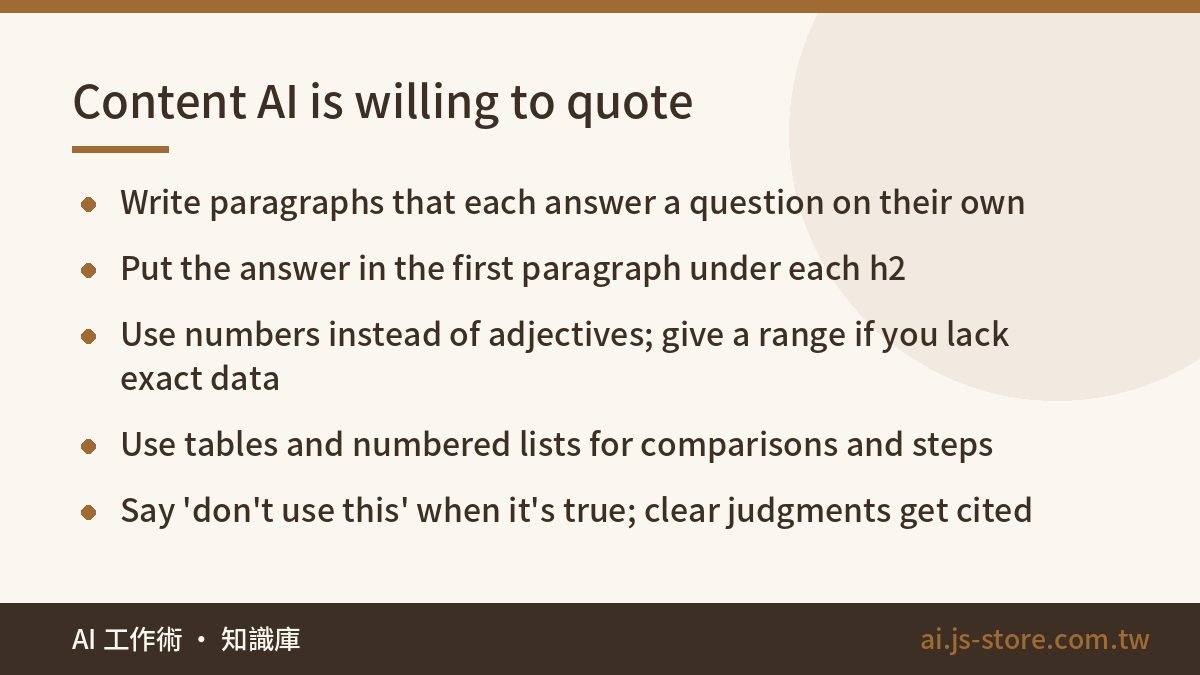
Running our own tool platform and video product, we settled on one rough but reliable test: cut out any single paragraph. Does it answer a question on its own? If it does, it's ready for GEO. If it only makes sense with the paragraphs around it, the model won't quote it.
Step 8: Put the answer first, then structure the rest.
- Open each h2 section with its conclusion, then explain. Three paragraphs of setup before the point used to be a style choice. Now it costs you citations.
- Write headings as questions or plain statements. “Pricing” tells a model nothing. “How much does this tool cost per month?” matches what people actually type into ChatGPT.
- Use tables and numbered lists for comparisons and steps. Models pull information out of lists far more accurately than out of long paragraphs.
Step 9: Replace adjectives with numbers and take a position.
- No AI will quote “great results.” It will quote “organic sessions went from 800 to 2,400 in three months.” If you don't have an exact number, give a range or the conditions. Never invent one.
- Put dates on your claims. Write “As of September 2026 the official pricing page lists X; check it for current pricing.” Admitting that information goes stale makes you more credible.
- Be willing to say “don't use this.” If an article praises every tool, a model has no judgment to pull from it. Trade-offs are what make content worth citing.
If you draft with AI, watch out for the bland, fence-sitting text it produces by default. GEO punishes exactly that kind of content. We hold ShooWork Write to the same rule: a draft without a point of view isn't finished. Our guide to fixing AI tone in writing lists the giveaways and how to remove them.
How do you get the rest of the web to mention you? (Steps 10-11)
Whether a model cites you depends heavily on whether other sites talk about you. That sounds like classic link building, but there's a difference: for GEO, a mention counts even without a link.
Step 10: Build a consistent, genuine presence.
- Make your business details match everywhere. Your company name, website, contact details and address should be identical on every profile and directory. That's the bare minimum for being recognized as a real business.
- Show up on the sites AI already cites: Reddit, Quora, Medium, GitHub and industry publications. Perplexity in particular loves forum threads. Don't post fake grassroots praise. Getting caught does more damage than staying quiet. Answer real questions under your real name.
- Give each author one consistent identity, with the same name, bio and role on LinkedIn, a personal site and guest posts. Models trust content more when they can link it to a known person.
- Publish transcripts. Audio and video are hard for AI to read, but transcripts are plain text. When we built ShooWork Clip, our video-editing engine, we found that posting full transcripts on the page gave us a whole batch of extra pages answering niche questions that AI could cite, at no extra cost.
Step 11: Create original data. Run your own tests, publish your own price comparisons, do your own annual survey. Nothing attracts citations like original data, because anyone who wants to state that fact has to cite you.
How do you know GEO is working? (Step 12)
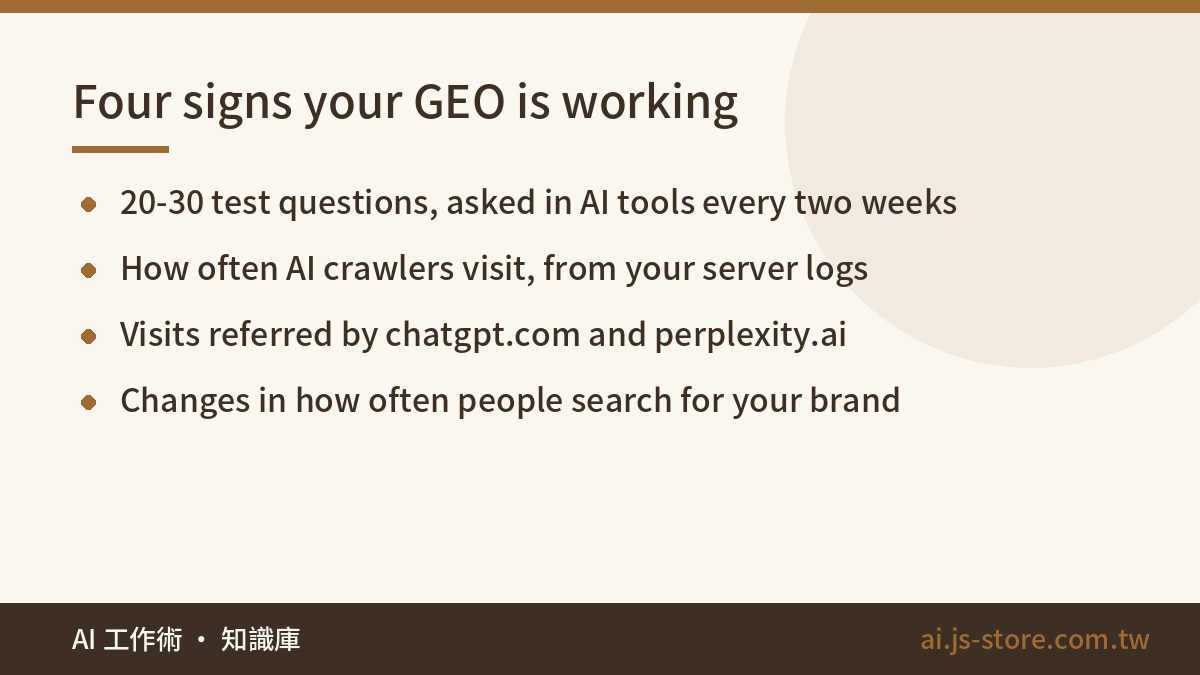
The hard part of GEO isn't doing it. It's measuring it. Your analytics can't see “ChatGPT cited you.” All you'll see is a small amount of referral traffic. Step 12 is to set up a regular measurement routine that tracks four signals:
- A list of test questions. Write down 20 to 30 questions you want to be cited for. Every two weeks, ask each one in ChatGPT, Perplexity and Google's AI Mode. Record whether your brand appears and which page gets cited. It's manual work, but nothing else is as accurate.
- AI crawler visits in your server logs. Track how often GPTBot, PerplexityBot and ClaudeBot visit and which pages they fetch. This is the first signal to move.
- Referral sessions from chatgpt.com, perplexity.ai and similar sources. The numbers are small, but the trend tells you something.
- Searches for your brand name. People who see you named in an AI answer often search for you directly.
Paid tools that track AI citations do exist, but they're immature so far. For a small or mid-sized site, your own list of test questions is enough. Don't rush into a subscription.
Here's a pre-launch checklist you can copy:
| Item | What to check | How often |
|---|---|---|
| robots.txt | AI crawlers allowed | Quarterly |
| Server rendering | curl returns the body text | After every redesign |
| llms.txt | Auto-generated, page list current | Monthly |
| JSON-LD | No errors in the test tool, matches the visible page | Before every publish |
| Self-contained paragraphs | First paragraph under each h2 answers on its own | Before every publish |
| Numbers and dates | Specific figures, with the date you checked them | Before every publish |
| Test questions | 20-30 questions asked and results recorded | Every two weeks |
| Crawler logs | Trend in AI crawler visits | Monthly |
Roughly 80% of GEO work overlaps with SEO, so don't set up a separate content process for it. If your SEO process isn't settled yet, get a working SEO AI tools workflow in place first, then add the remaining 20% of GEO on top. Doing it the other way round is painful.
FAQ
Q: How long after GEO optimization will ChatGPT start citing me?
Nobody can guarantee a timeline. Crawler visits usually pick up within weeks, and citations come later. Content sites typically need several months and a good number of strong pages before they get cited regularly. A new domain that nobody mentions will take longer. Ignore anyone who promises results in a month.
Q: Should I bother with llms.txt if Google doesn't use it?
Yes, but think of it as cheap insurance. Some AI tools and agents read it, it takes almost no time, and it can't hurt you. Just don't expect it to bring in traffic on its own. The quality of your content and how often other sites mention you matter far more.
Q: Should I block AI crawlers to protect my original content?
There's no universal answer. If your revenue comes from ad impressions and people reading on your site, blocking makes some sense. If you want AI to recommend you and send you leads, blocking shuts that door. A common compromise is to allow your free articles and guides and block member-only or paid sections. Decide first whether you want pageviews or customers.
Q: Do I need separate content for GEO and SEO?
No, and we'd advise against it. One article can serve both if you lead with the conclusion, use specific numbers, phrase headings as questions and add structured data. Keeping two versions doubles your workload and creates duplicate content problems.
Q: Can a small site with no brand recognition win at GEO?
Yes, if you publish original data. Your own test results, price comparisons and documented workflows are things big sites often don't have, so AI has to cite you to answer those questions. If you're publishing the same overview everyone else has written, being small really does hurt. Choose a topic too narrow for big sites to bother with, then make your page the most complete one anywhere.